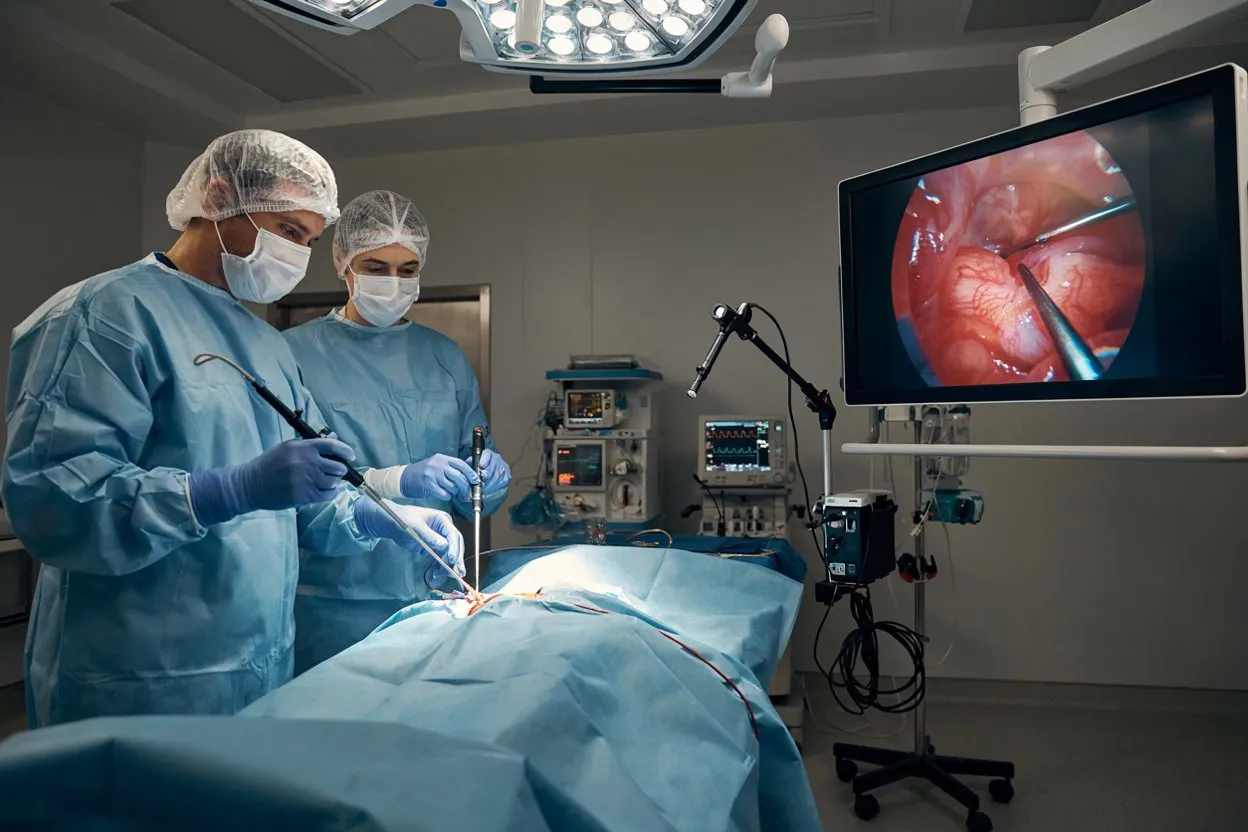

Artificial intelligence is steadily moving from research laboratories into clinical workflows, and endoscopic surgery is one area where its potential is particularly significant. As minimally invasive procedures become increasingly sophisticated, surgeons are expected to interpret complex visual information while simultaneously controlling instruments and making time-sensitive decisions.
This makes visualization more than a matter of image quality. The next generation of surgical imaging is increasingly focused on making visual information more meaningful, contextual, and actionable.
AI can contribute to this shift by analyzing endoscopic video in real time, recognizing patterns, identifying anatomical structures, enhancing images, and potentially providing decision-support information. However, its role needs to be understood realistically. AI is not intended to replace surgical expertise. Its value lies in assisting clinicians by processing visual information quickly and consistently while keeping the surgeon in control.
Why AI Matters in Endoscopic Imaging
Traditional endoscopic systems primarily capture, process, and display video. The surgeon interprets the information shown on the monitor based on training and experience.
AI introduces another layer.
Instead of simply transmitting an image, an AI-enabled platform can potentially analyze the video stream as the procedure takes place. Machine-learning algorithms can be trained to recognize specific anatomical structures, instruments, tissue characteristics, or stages of a procedure.
This creates the possibility of moving from passive visualization to intelligent visualization.
For example, rather than simply displaying a live image, an AI-assisted system could potentially highlight an area of interest, recognize a particular anatomical structure, or provide information relevant to the surgical workflow.
The technology is still developing, and its capabilities vary significantly between applications. Clinical validation is essential before any AI-based feature is relied upon for patient care.
AI-Enhanced Image Quality
One of the more immediate applications of AI is image enhancement.
An endoscopic image can be affected by motion, smoke, blood, reflections, uneven illumination, and variations in tissue appearance. These factors can make visualization more challenging during certain procedures.
AI-assisted image processing can potentially help optimize aspects such as:
- Brightness
- Contrast
- Sharpness
- Noise reduction
- Color consistency
- Image stabilization
The objective is not simply to make an image look better. The goal is to preserve and emphasize clinically relevant visual information.
This distinction is important because excessive digital enhancement could potentially create artificial visual features. Any image-processing technology used in surgery therefore needs to be carefully validated to ensure that enhancement does not introduce misleading information.
AI for Anatomical Recognition
Another important application is anatomical recognition.
Machine-learning systems can be trained using large collections of medical images and videos to identify specific structures or visual patterns. During surgery, an AI algorithm may analyze the live video feed and identify structures that match its trained patterns.
In appropriate applications, this could potentially assist surgeons by providing additional visual cues.
For example, an AI system might highlight an anatomical structure or provide an alert when a particular structure enters the field of view.
However, AI recognition should be treated as decision support rather than an autonomous clinical decision-maker. The surgeon remains responsible for interpreting the complete clinical situation.
AI models can also perform differently across patient populations, equipment configurations, surgical techniques, and imaging conditions. This makes external validation and continuous performance monitoring important considerations.
AI and Real-Time Surgical Assistance
The most exciting possibility is the development of real-time surgical assistance.
In the future, AI may be able to analyze surgical video continuously and provide contextual information while the procedure is taking place.
Potential applications include:
- Recognizing surgical phases
- Identifying instruments
- Tracking instrument movement
- Highlighting anatomical landmarks
- Providing visual alerts
- Supporting procedural navigation
- Assisting with documentation
This could reduce the cognitive burden associated with interpreting large amounts of visual information.
However, real-time assistance introduces a higher level of responsibility. Any system providing information during an active procedure must be reliable, appropriately validated, and designed to avoid unnecessary distractions.
The interface matters just as much as the algorithm.
If an AI system produces too many alerts or overlays excessive information on the surgical image, it could potentially interfere with rather than improve the workflow.
AI and Surgical Workflow
AI can also contribute beyond visualization.
Operating rooms generate significant amounts of video and procedural data. AI can potentially analyze this information to identify surgical phases and organize recorded procedures.
For example, automated recognition of procedural stages could make it easier to locate relevant sections of a recorded operation for teaching, documentation, or review.
This may also contribute to surgical education.
Trainees could potentially use annotated surgical recordings to understand anatomy, instrument movements, and procedural steps. However, patient privacy, consent, data governance, and institutional policies must be addressed when surgical video is stored or used for education.
The Importance of High-Quality Imaging Infrastructure
AI cannot compensate for every limitation in an imaging system.
A reliable AI application depends on the quality of the visual information being provided to it. Poor illumination, inadequate optics, image artifacts, motion blur, or inconsistent color reproduction can affect algorithm performance.
This means the development of AI does not make traditional imaging technologies less important. In many ways, it makes them even more important.
A modern best endoscopic imaging system in india platform may need to combine high-quality optics, capable camera sensors, effective illumination, advanced image processing, and compatible displays before AI can provide meaningful additional value.
The quality of the underlying data remains fundamental.
AI Within an Endoscopic Imaging System
An advanced best endoscopic imaging system is increasingly becoming more than a camera and monitor.
Future systems may combine:
- High-resolution cameras
- Advanced image sensors
- AI-assisted processing
- Digital recording
- Image enhancement
- Surgical data management
- OR integration
- Connected displays
This creates a broader digital ecosystem around surgical visualization.
The challenge for hospitals will be ensuring that these technologies work together reliably. Interoperability, cybersecurity, software updates, compatibility, and technical support will become increasingly important as imaging platforms become more software-driven.
What Hospitals Should Consider Before Adopting AI
AI can be promising, but hospitals should approach adoption carefully.
Before investing in AI-enabled imaging technologies, healthcare organizations should consider:
Clinical validation
Hospitals should understand what the AI system has actually been validated to do. A technology demonstrated in one procedure or clinical environment may not necessarily perform identically in another.
Regulatory status
AI-enabled medical technologies may be subject to applicable regulatory requirements depending on their intended use and jurisdiction. Hospitals should verify the regulatory status and intended clinical application of the system before deployment.
Integration
AI should fit naturally into the existing surgical workflow. Systems that require complicated additional steps may have limited practical value.
Data security
Surgical video and patient information are sensitive. Appropriate data protection, access control, storage, and cybersecurity measures are essential.
Training
Clinical teams need to understand what the AI system does, its limitations, and how its outputs should be interpreted.
Technical support
Software-driven medical equipment requires dependable technical support, updates, maintenance, and troubleshooting.
AI and Endoscopic Imaging in India
For hospitals evaluating an endoscopic imaging in india, AI introduces both opportunities and practical considerations.
Healthcare providers should evaluate not only the technology itself but also the ecosystem supporting it. Availability of trained technical personnel, service infrastructure, software support, system compatibility, and long-term maintenance can influence the success of an AI-enabled platform.
Hospitals should also consider whether AI functionality addresses a genuine clinical or workflow requirement rather than adopting it simply because it is a current technology trend.
A well-established imaging platform with reliable performance may provide greater practical value than a system with numerous advanced features that are rarely used.
Will AI Replace Surgeons?
This is one of the most common questions surrounding AI in healthcare.
The more realistic direction is AI-assisted surgery rather than AI-replaced surgery.
Surgery involves far more than recognizing images. Surgeons consider patient history, anatomy, intraoperative findings, procedural risks, clinical judgment, unexpected complications, and numerous other factors.
AI can analyze visual data rapidly, but it does not replace the broader clinical reasoning and responsibility of a trained surgical professional.
The most useful systems are therefore likely to be those designed around the surgeon rather than those attempting to operate independently.
The Future: From Visualization to Intelligent Assistance
AI has the potential to change how surgeons interact with endoscopic video.
The evolution may progress from:
Capturing images → Improving images → Understanding images → Assisting decisions
This does not mean every operating room will immediately adopt fully AI-driven systems. Clinical validation, regulation, cost, interoperability, cybersecurity, and user acceptance will all influence adoption.
But the direction is clear: surgical imaging is becoming increasingly intelligent.
The future of endoscopic visualization will likely combine high-quality imaging hardware with software capable of extracting meaningful information from live surgical video.
Conclusion
AI is opening a new chapter in endoscopic surgery. Its potential extends from image enhancement and anatomical recognition to real-time surgical assistance, workflow analysis, education, and data management.
Yet AI should not be viewed as a replacement for high-quality imaging or clinical expertise. Instead, it represents an additional layer of intelligence built on top of a reliable imaging foundation.
For hospitals, the focus should therefore be on selecting technologies that combine image quality, clinical usefulness, validated AI capabilities, usability, safety, integration, and long-term support.
The most valuable AI-enabled imaging system will not necessarily be the one with the most sophisticated algorithm. It will be the one that provides useful information at the right time, fits naturally into the surgical workflow, and ultimately helps clinicians make better-informed decisions while keeping patient safety at the center.

























Sign in to leave a comment.