
There's a moment every service brand eventually confronts. The products are good. The service teams are trained. The satisfaction scores are reasonable. And yet something is missing in the relationship between brand and customer — a quality of connection, a depth of understanding, a sense that the brand genuinely gets them.
This gap isn't a people problem. It's an environment problem. The physical and digital touchpoints where customers experience a service brand haven't kept pace with what customers now expect from every other part of their digital lives. Augmented reality for service environments closes this gap — not by adding technology for its own sake, but by redesigning how information, emotion, and interaction meet in the spaces where service actually happens.
The Problem with Traditional Service Communication
Banking halls, insurance offices, telecom stores, logistics centres — these are environments built around transactions, not experiences. Information is delivered through static displays, printed collateral, or staff-led explanations that vary in quality depending on who's working that day.
The fundamental challenge is this: service products are invisible. You can't hold a loan, see a data plan, or touch a logistics solution. Abstract products require explanation, and explanation at scale is hard to standardise without losing the human quality that makes explanation effective.
This is precisely where augmented reality development services come into their own in service environments. AR makes the invisible visible. It gives abstract service products a spatial presence — something a customer can look at, explore, and understand without needing a staff member to guide every step.
What 'Intelligent Engagement' Actually Means in Practice
An intelligent engagement system in a service environment has three characteristics. It's adaptive — it responds to the customer's actions and choices, guiding them to relevant information rather than broadcasting the same content to everyone. It's multi-layered — it communicates at different levels of depth, giving casual browsers a quick impression while offering serious prospects the ability to go deeper. And it's data-generating — every interaction creates insight about what customers explore, where they linger, and what they skip, information that feeds back into service design and marketing strategy.
None of these characteristics are achievable through static displays or printed brochures.
The IndusInd Model: AR Engagement at Scale
The InteractTech zones IIC Lab built for IndusInd Bank's Partner Meet represent a clear blueprint for what intelligent service engagement looks like at scale. IndusInd needed to communicate the full scope of their rural banking services — Gram Panchayat banking, microfinancing, small business support, digital app adoption — to an audience of partners and senior executives with limited time and varying levels of prior knowledge.
Making Rural Banking Tangible Through AR
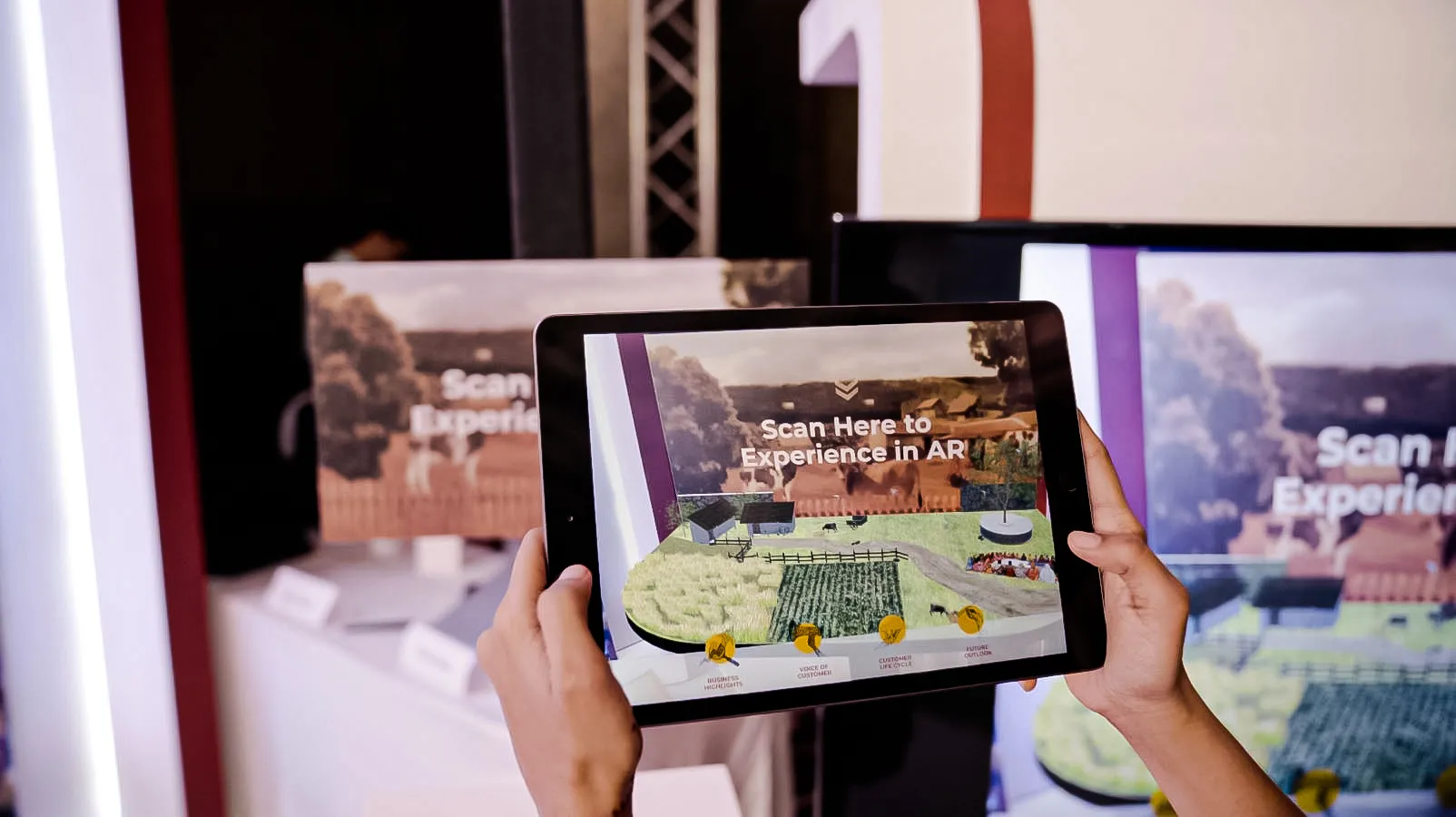
The AR environment built for IndusInd didn't just display information. It recreated the world the information was about. The team built a 3D augmented reality space that brought a rural Indian village setting to life — Gram Panchayat offices, small shop fronts, microfinancing moments — overlaid with data and storytelling that explained IndusInd's work in these communities.
The audience wasn't reading statistics about rural penetration rates. They were standing inside a visual representation of what those statistics mean. In service sectors where trust is the core product, emotional resonance directly translates into relationship capital.
The Multi-Touch Data Navigation System
For the partner data experience, IIC Lab built a multi-touch interactive panel that turned thousands of pages of confidential performance data into a navigable, visually compelling exploration. Users could select categories, drill into sub-categories, swipe between data sets — building their own understanding rather than receiving a pre-packaged presentation.
People trust information they feel they discovered themselves more than information that was presented to them. By giving partners agency over their data exploration, IndusInd created a sense of transparency and confidence that a top-down presentation could never generate.
Translating This to Customer-Facing Service Environments
The IndusInd model translates directly into consumer-facing applications for banks, insurers, telecom providers, and logistics companies. Customers could explore loan products through interactive AR visualisations that show repayment scenarios and financial planning tools in real space rather than on paper. AR overlays in insurance advisor offices could allow customers to see coverage scenarios play out visually. In telecom retail stores, AR solutions could show customers exactly what different data plans look like in their own usage patterns, reducing decision paralysis. Enterprise logistics clients could experience supply chain scenarios in AR before committing to solutions.
In every case, the outcome is the same: customers who understand what they're buying, trust the brand that helped them understand it, and make decisions with confidence rather than anxiety.
The Measurement Case for AR in Service Environments
AR experiences hold customer attention for between 68 and 127 seconds — compared to two to three seconds for static displays. Brand recall improves by around 70% when AR is integrated into the customer touchpoint architecture. In service sectors where customer lifetime value is the primary financial metric, these numbers have direct commercial consequences. A customer who understands a product thoroughly is less likely to churn, more likely to upgrade, and more likely to recommend.
If your service brand needs to communicate complex ideas with human clarity, IIC Lab (Ink In Caps) builds the experiences that close that gap.

























Sign in to leave a comment.