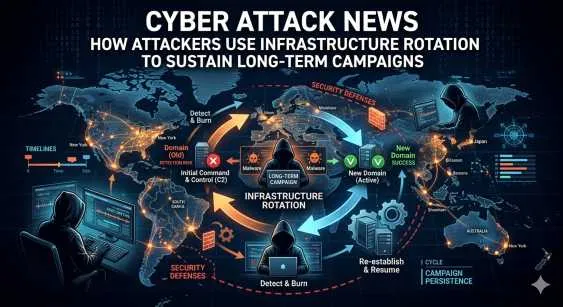

Modern cyber threats are becoming increasingly sophisticated, persistent, and difficult to contain. Security teams across industries are no longer dealing solely with isolated incidents or short-lived malware outbreaks. Instead, many organizations now face highly coordinated campaigns designed to remain active for extended periods while continuously adapting to defensive measures. One of the most effective tactics used by modern threat actors is infrastructure rotation.
Recent Cyber Attack News reports frequently highlight how attackers rotate servers, domains, IP addresses, malware delivery systems, and communication channels to evade detection and maintain operational continuity. This strategy enables cybercriminal groups to sustain attacks for weeks, months, or even years without being fully disrupted. Infrastructure rotation has become especially common in advanced ransomware operations, espionage campaigns, and large-scale credential theft activities.
At the same time, the growing number of ransomware breach incidents demonstrates how persistent threat actors exploit distributed infrastructure to maintain access to compromised environments and recover quickly after takedown attempts. Understanding how infrastructure rotation works is essential for organizations seeking to strengthen long-term cybersecurity resilience.
Understanding Infrastructure Rotation in Modern Cyber Attacks
Infrastructure rotation refers to the process of continuously changing the technical resources used during malicious operations. Attackers may rotate command-and-control servers, phishing domains, malware hosting environments, encryption keys, cloud instances, or proxy networks to reduce the effectiveness of security monitoring tools.
According to recent Cyber Attack News, this tactic has become increasingly common because static attack infrastructure is easier for defenders to identify and block. Once security teams blacklist malicious IP addresses or domains, attackers simply replace them with new infrastructure components and continue their campaigns.
For example, a cybercriminal group conducting a ransomware breach may initially deliver malware through one phishing domain. After the domain is detected and disabled, the attackers quickly transition to another domain hosted through a different provider. This rapid adaptation allows operations to continue with minimal interruption.
Infrastructure rotation also complicates attribution efforts because threat actors can distribute activities across multiple geographic regions and hosting services simultaneously.
Why Attackers Use Infrastructure Rotation?
One of the primary reasons infrastructure rotation appears so frequently in Cyber Attack News is its effectiveness in evading detection. Security systems often rely on indicators such as malicious IP addresses, domain reputations, or known malware signatures to identify threats.
By rotating infrastructure continuously, attackers reduce the lifespan of these indicators and make automated detection more difficult. A ransomware breach campaign may use hundreds of domains and servers throughout its operational lifecycle, forcing defenders to respond constantly to changing threat conditions.
Another important advantage for attackers is operational resilience. If law enforcement agencies or cybersecurity teams disrupt part of the infrastructure, backup systems are already prepared to take over immediately. This redundancy helps threat actors sustain long-term campaigns despite takedown efforts.
Infrastructure rotation also supports stealth. Attackers frequently spread malicious activity across multiple systems to avoid generating suspicious traffic concentrations that could trigger alerts.
Recent Cyber Attack News reports show that sophisticated cybercriminal groups increasingly treat infrastructure management like a professional business operation, complete with redundancy planning, cloud scalability, and automated deployment strategies.
The Role of Cloud Services in Long-Term Campaigns
Cloud infrastructure has transformed the way attackers operate. Many Cyber Attack News investigations reveal that cybercriminals increasingly abuse legitimate cloud platforms to host phishing pages, malware payloads, and command-and-control systems.
Cloud services provide scalability, rapid deployment, geographic distribution, and temporary resource provisioning. These characteristics make them attractive for sustaining a ransomware breach campaign over long periods.
For example, attackers may create short-lived cloud instances that remain active only for several hours before being replaced automatically. Security teams attempting to track malicious infrastructure often struggle because the resources disappear before full investigations can be completed.
Threat actors also take advantage of trusted cloud provider reputations. Traffic associated with well-known platforms may appear less suspicious to automated security filters, increasing the likelihood of successful malicious communications.
As highlighted repeatedly in Cyber Attack News, this growing abuse of legitimate infrastructure complicates cybersecurity defense because blocking entire cloud platforms is rarely practical for enterprises.
Infrastructure Rotation in Ransomware Operations
Modern ransomware groups rely heavily on infrastructure rotation to maximize operational success. A large-scale ransomware breach often involves multiple infrastructure layers working together simultaneously.
Attackers may use separate systems for phishing delivery, malware hosting, credential theft, data exfiltration, encryption management, and ransom negotiations. If one component is identified or disabled, alternative infrastructure takes over immediately.
This layered strategy enables ransomware operators to maintain persistence even after partial disruptions. According to ongoing Cyber Attack News coverage, some ransomware organizations rotate infrastructure daily to avoid detection by threat intelligence systems.
Another common tactic involves rotating encryption keys and malware variants regularly. By modifying technical characteristics continuously, attackers reduce the effectiveness of signature-based antivirus tools and traditional detection mechanisms.
Infrastructure rotation also helps ransomware groups target multiple organizations simultaneously. Distributed systems allow threat actors to scale campaigns globally while minimizing operational bottlenecks.
How Attackers Evade Detection Through Rotation?
A major reason infrastructure rotation appears prominently in Cyber Attack News is its ability to bypass traditional security monitoring methods. Many organizations still depend heavily on static indicators of compromise for threat detection.
Attackers exploit this weakness by continuously changing infrastructure elements faster than defenders can update detection rules. During a ransomware breach, malicious traffic may originate from dozens of rapidly changing servers and domains.
Threat actors also use techniques such as fast-flux DNS, proxy chaining, VPN routing, and decentralized hosting to conceal operational infrastructure further. These methods distribute communications dynamically across multiple systems, making tracking and blocking far more difficult.
Some advanced groups even automate infrastructure replacement processes entirely. When security researchers identify one malicious domain, automated deployment scripts immediately activate replacement infrastructure elsewhere.
As cybersecurity professionals repeatedly note in Cyber Attack News, this automation has significantly increased the speed and resilience of modern attack campaigns.
Defensive Strategies Against Infrastructure Rotation
Organizations must adopt more adaptive defense strategies to counter evolving infrastructure rotation techniques. Traditional blacklist-based security alone is often insufficient against rapidly changing threats.
Behavioral analytics has become increasingly important. Instead of focusing solely on known malicious indicators, modern security tools analyze activity patterns, traffic anomalies, and suspicious behaviors associated with a potential ransomware breach.
Zero-trust security frameworks also reduce the effectiveness of infrastructure rotation by requiring continuous authentication and limiting lateral movement opportunities inside enterprise environments.
Threat intelligence sharing is another critical defense mechanism. Security vendors and organizations increasingly collaborate to exchange indicators and campaign insights quickly in response to emerging Cyber Attack News developments.
Endpoint detection and response systems help identify malicious behaviors even when attackers rotate infrastructure components successfully. Continuous monitoring allows organizations to detect unusual encryption activity, privilege escalation attempts, or unauthorized data transfers.
Additionally, employee awareness training remains essential because phishing campaigns often serve as the initial entry point for long-term attack operations.
The Future of Infrastructure Rotation in Cybercrime
The future of cybercrime will likely involve even more sophisticated infrastructure rotation strategies. Artificial intelligence and automation technologies are expected to help attackers deploy and replace malicious infrastructure faster than ever before.
Future Cyber Attack News reports may increasingly describe self-healing attack ecosystems capable of rebuilding compromised infrastructure automatically without direct human involvement.
At the same time, decentralized technologies, anonymous hosting services, and globally distributed cloud platforms will continue complicating attribution and takedown efforts during a ransomware breach investigation.
Cybersecurity defenses must evolve accordingly. Organizations will need greater visibility, predictive analytics, AI-driven threat detection, and faster incident response capabilities to counter these adaptive attack methods effectively.
Conclusion
Modern Cyber Attack News coverage demonstrates that infrastructure rotation has become a core tactic for sustaining long-term cyber campaigns. By continuously replacing domains, servers, cloud instances, and communication systems, attackers can evade detection, maintain persistence, and recover quickly from disruptions.
The growing number of ransomware breach incidents highlights how sophisticated threat actors now operate with professional-level infrastructure management strategies designed for resilience and scalability. As cyber threats continue evolving, organizations must adopt adaptive security models focused on behavior analysis, zero-trust principles, continuous monitoring, and rapid response capabilities.
Understanding infrastructure rotation is essential for building stronger cybersecurity defenses capable of resisting the increasingly persistent and dynamic nature of modern cyberattack campaigns.



























Sign in to leave a comment.