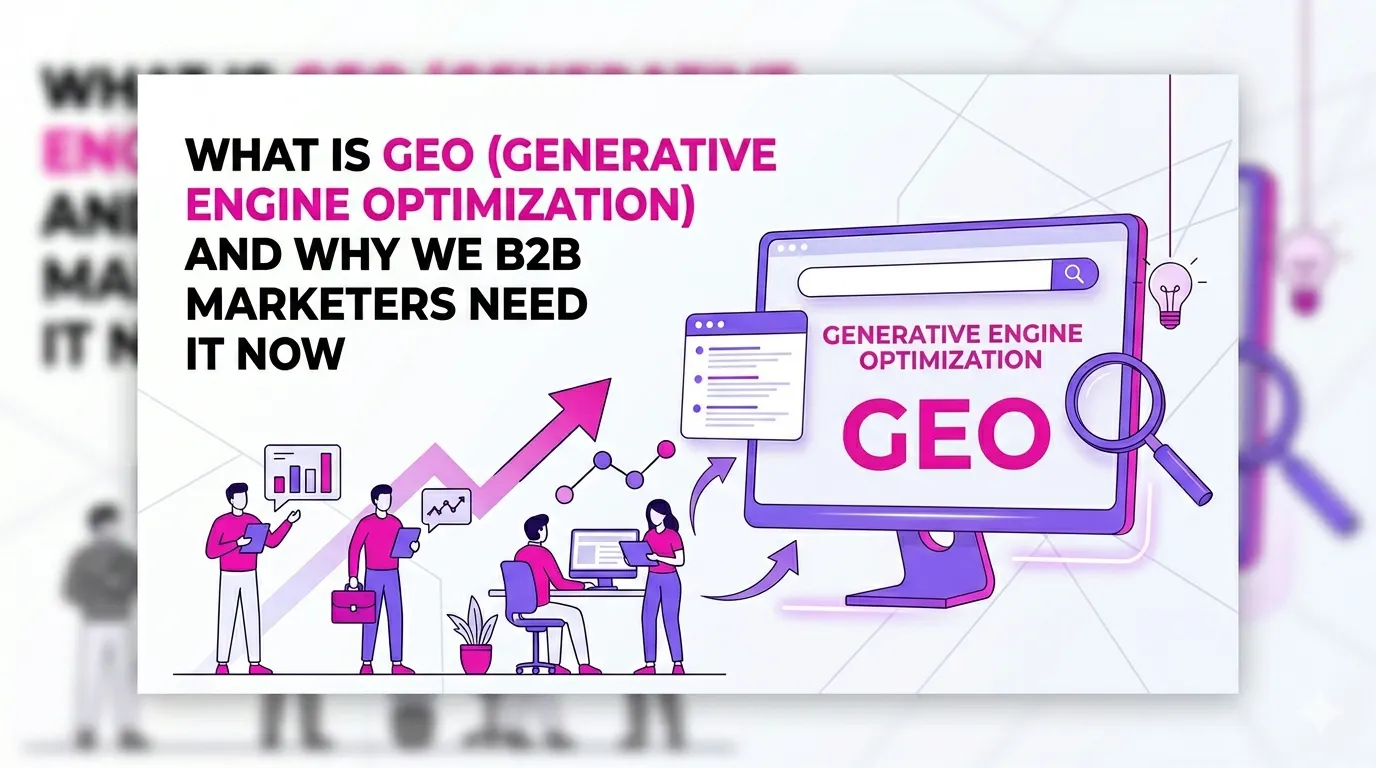

What Is GEO (Generative Engine Optimization) and Why We B2B Marketers Need It Now
The traditional search bar is rapidly changing. If you’ve tried out ChatGPT, Perplexity, and Google’s Search Generative Experience (SGE) lately, you’ve experienced the future of search. Instead of providing users with the traditional list of blue links, search engines are capturing the info user’s need and providing the answers in a conversational manner. For B2B companies, this change is enormous. This is not the “New SEO”, it is Generative Engine Optimization (GEO).
As AI Search engines become the go-to way decision makers are finding solutions, the new customer engagement, demand generation will be through AI search summaries. If your content can’t be found through AI search summaries, you are not only losing your search rank, but you are losing your audience engagement, your business presence.
The Evolution: From SEO to GEO
Normal SEO was designed to function in a world of clicks. You refined your content for Google’s crawlers, with the ultimate hope of getting a user to click to your site with your link. AI optimization has slightly shifted focus to focus on “citations” and “synthesis” instead. Large Language Models (LLMs) want to learn from you to answer user questions, not just cite you in their responses.
The term Generative Engine Optimization (GEO) relates to the practice of creating and organizing content in a so that AI actors view your organisation’s content to be the most trustworthy, authoritative, and relevant for a particular question. Traditional SEO aims to garner site visitors. GEO aims to impact the AI’s answer.
To maximize the ROI of your AI-ready assets, consider a content hybrid syndication approach. This allows you to distribute your authority-driven content across elite third-party networks while maintaining your original GEO signals, effectively amplifying your reach without diluting your brand’s search authority.
Top GEO Strategies for B2B Agencies
Top-tier agencies are already shifting their playbooks. Here are the core GEO strategies for B2B that are driving results right now:
1. Authoritative Citations and “Source” Density
LLMs are trained on credibility. To be cited by an AI engine, your content needs to include verifiable data, expert quotes, and unique statistics. AI engines favor content that looks like a primary source rather than a rehash of existing articles.
2. The “Point-of-View” (POV) Content Shift
AI is great at summarizing facts, but it struggles with original thought. By publishing strong, opinionated perspectives on industry trends, you provide the “flavor” that AI engines often pull into their summaries to provide a balanced view.
3. Technical Structuring for AI Crawlers
Beyond standard Schema markup, AI search optimization requires a clear, logical flow. Use headers that ask and answer specific questions. LLMs digest content better when it is broken down into structured “knowledge blocks.”
While GEO captures intent at the search level, integrating it with a robust ABM (Account-Based Marketing) framework ensures you are not just visible to the world, but specifically indispensable to your high-value target accounts. By aligning AI-optimized insights with personalized account data, B2B brands can bridge the gap between broad discovery and precise conversion.
Real-World Use Case: SaaS Vendor Comparison
Picture this scenario. The person asking the question on AI is the CTO of a mid-size manufacturing firm. The question being asked is “What is the best manufacturing firm CRM?” The application of traditional SEO will lead to a company landing on a page giving an explanation of “Manufacturing CRM.” On the other hand, a company using GEO will have thorough whitepapers, comparative data charts, expert evaluations that are spidered across the internet. The AI will collect and analyze these data packets. “User data and industry evaluations cite Brand X to have the best factory-grade offline capabilities.” This is what the B2B demands generation in the AI age is trying to achieve.
The Benefits of Early Adoption
• Brand Authority: Being cited by an AI engine acts as a third-party endorsement of your expertise.
• Shorter Sales Cycles: When AI provides the answers a prospect needs, they enter the funnel more educated and ready to buy.
• Reduced Dependency on Clicks: Even if a user doesn’t click a link, your brand name appears in the AI summary, building top-of-mind awareness.
How to Get Started with GEO Today
Don’t wait for your traffic to drop to zero. Start by auditing your current top-performing pages. Are they providing “direct answers” or just “fluff”?
1. Update your FAQ sections: Target long-tail, conversational queries.
2. Embed Data: Use original research and proprietary data to become an unignorable source.
3. Focus on Sentiment: AI engines consider how others talk about you. Ensure your PR and reviews are positive and consistent.
Frequently Asked Questions
Does GEO replace traditional SEO?
No, GEO complements SEO. While SEO still drives traditional web traffic, GEO ensures your brand is captured in the AI-generated responses that are increasingly appearing at the top of search results.
What are the best GEO strategies for B2B startups?
Startups should focus on “niche authority.” By providing the most detailed, data-backed content on a specific sub-topic, you can out-compete larger brands that offer more generalized information.
How does AI search optimization affect demand generation?
It shifts demand generation from “findable” to “recommendable.” In the AI era, being recommended by the engine as the best solution is the ultimate form of lead generation.



























Sign in to leave a comment.