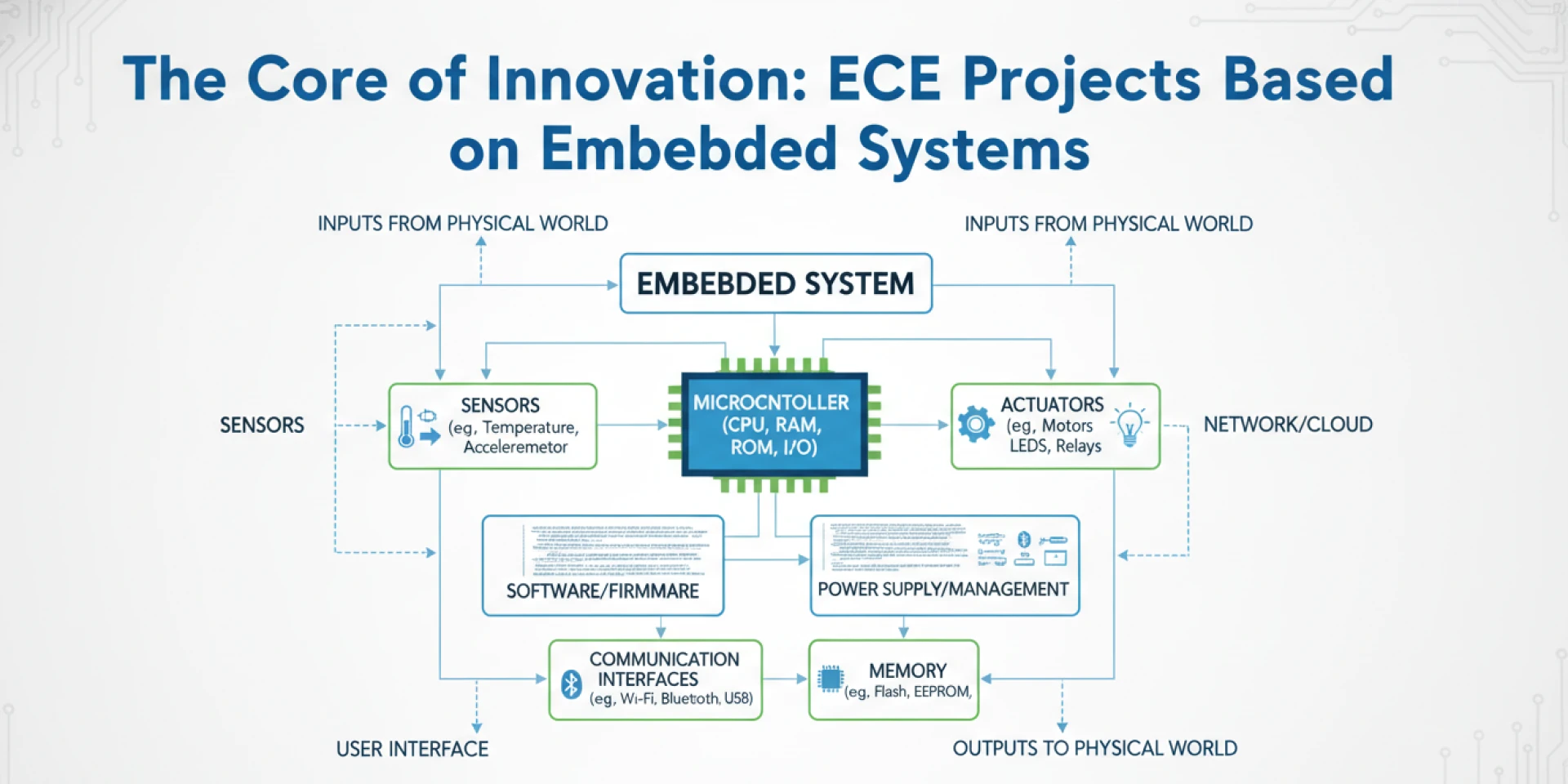

In the realm of Electronics and Communication Engineering (ECE), embedded systems represent the "brain" of modern technology. From the simple controller in a microwave to the complex navigation systems in autonomous vehicles, embedded systems integrate hardware and software to perform dedicated functions. For an ECE student, undertaking a project in this domain is the most effective way to gain industry-ready skills in circuit design, real-time programming, and system integration.
1. Why Choose Embedded Systems for ECE Projects?
Embedded systems are the backbone of the "Smart" revolution. Choosing this for a project allows students to work with:
- Microcontrollers (MCU): Learning the architecture of chips like ARM Cortex-M, AVR (Arduino), or ESP32.
- Real-Time Processing: Understanding how systems respond to external stimuli within strict time constraints.
- Low Power Consumption: Designing devices that can run for years on a single battery, a key requirement for the IoT era.
2. Key Components of an Embedded System Project
A successful ECE project Based on Embedded Systems in this field generally follows a modular structure consisting of three primary layers:
A. The Hardware Layer (Sensing and Actuation)
This involves selecting the right sensors (Ultrasonic, Gas, Temperature, Accelerometers) and actuators (Motors, Solenoids, Relays). The hardware must be interfaced correctly, often requiring voltage level shifters or signal conditioning circuits to ensure the MCU can read the data accurately.
B. The Communication Layer
Modern embedded projects rarely exist in isolation. They use communication protocols to exchange data. Students must master:
- Wired Protocols: UART, I2C, and SPI for inter-chip communication.
- Wireless Protocols: BLE (Bluetooth Low Energy), Wi-Fi, LoRa, and ZigBee for remote monitoring.
C. The Software Layer (Firmware)
This is where the logic resides. Writing firmware involves managing interrupts, timers, and memory. For complex major projects, students often transition from simple "Bare Metal" programming (coding directly on the hardware) to using an RTOS (Real-Time Operating System) like FreeRTOS, which allows for efficient multitasking.
3. Trending Project Ideas in Embedded Systems
If you are looking for high-impact project ideas for your final year, consider these specialized applications:
I. IoT-Based Smart Health Monitoring System
Using an ESP32 or STM32, you can develop a wearable device that monitors heart rate (using a PPG sensor) and blood oxygen levels. The data is processed locally and then transmitted to a cloud platform via Wi-Fi, where a mobile app can alert doctors if vitals cross a certain threshold.
II. Autonomous Obstacle Avoidance Robot with SLAM
This project moves beyond simple robotics. By using an embedded processor interfaced with a LiDAR sensor, the robot can map its surroundings in real-time. This involves implementing complex algorithms like Simultaneous Localization and Mapping (SLAM) within the constraints of an embedded environment.
III. Edge-AI Powered Gesture Recognition
With the rise of "TinyML," you can now run machine learning models directly on microcontrollers. A project could involve using a 3-axis accelerometer to recognize specific hand gestures (like a "wave" or "circle") to control home appliances, entirely offline.
4. The Development Workflow
To ensure your project is professional and functional, follow these industry-standard steps:
- Simulation: Use Proteus or Tinkercad to verify your circuit logic. This prevents the "magic smoke" (burning components) when you move to physical hardware.
- PCB Design: Instead of messy jumper wires, design a custom PCB using KiCad or EasyEDA. A custom board significantly reduces electromagnetic interference (EMI).
- Debugging: Use tools like Logic Analyzers and Oscilloscopes to debug communication signals. If your I2C sensor isn't responding, these tools help you see if the data packets are actually being sent.
5. Challenges and Troubleshooting
The most common hurdle in embedded projects is the "Hardware-Software Gap." Often, the code is perfect, but the hardware fails due to:
- Power Dips: High-current devices like motors can cause voltage drops that reset the MCU. Adding decoupling capacitors (100nF) near the power pins is a standard fix.
- Floating Pins: Unconnected input pins can pick up noise. Always use pull-up or pull-down resistors to ensure a stable logic state.
Conclusion
ECE projects based on embedded systems offer a unique blend of creativity and technical rigor. They force you to think about efficiency, timing, and physical constraints—skills that are highly sought after by companies like Qualcomm, Intel, and Tesla. By moving from a simple breadboard prototype to a custom-designed, optimized system, you demonstrate that you are not just a student of theory, but a practical engineer ready for the industry.




















Sign in to leave a comment.