Energy consumption is a major concern in industrial vacuum operations. Many facilities operate liquid ring systems continuously, making efficiency critical for controlling power and water use. When properly optimized, liquid ring technology delivers a stable vacuum with a lower lifecycle cost. This guide explains how to improve the performance of Nash liquid ring vacuum pumps through proper operation, maintenance, and system design, enabling plants to reduce waste while maintaining reliable production.
Why Energy Efficiency Matters in Liquid Ring Vacuum Systems
Vacuum pumps often run 24 hours a day. Even small inefficiencies can lead to significant cost increases over time.
According to the U.S. Department of Energy, Motor-driven systems account for nearly 70 percent of industrial electricity use. Improving system efficiency is one of the fastest ways to reduce operating expense and emissions.
Liquid ring vacuum pumps are known for their durability, but they must be optimized to achieve maximum efficiency.
How Liquid Ring Pumps Use Energy
Unlike dry pumps, liquid ring systems rely on a rotating impeller and sealing liquid. Energy is used to:
- Rotate the impeller
- Compress gases
- Circulate sealing water
- Remove heat from the process
If any of these elements are not controlled, energy losses increase quickly.
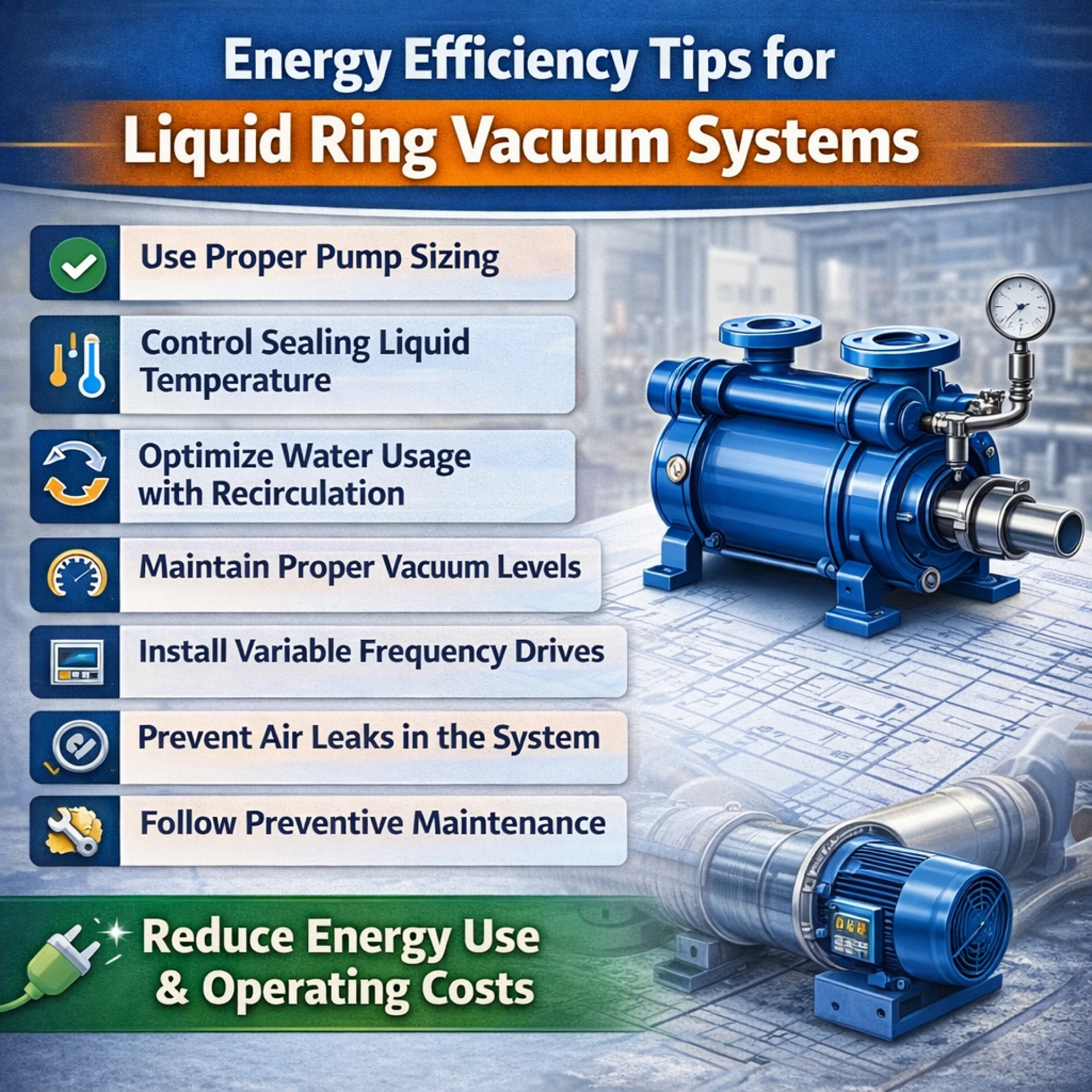
Top Energy Efficiency Tips for Liquid Ring Vacuum Systems
1. Use Proper Pump Sizing
Oversized pumps waste power and water. Undersized pumps run at maximum load and wear faster.
Correct sizing ensures the pump operates near its best efficiency point.
Key benefits of proper sizing:
- Lower motor load
- Stable vacuum pressure
- Reduced heat generation
- Longer equipment life
Refer to your vacuum pump sizing calculations to match flow and pressure to actual process demand.
2. Control Sealing Liquid Temperature
Sealing water temperature directly affects vacuum performance. Warmer water increases vapor pressure, which reduces efficiency.
Research shows that reducing the temperature of sealing liquid can improve vacuum capacity by up to 10 percent in many applications.
Best practices include:
- Install heat exchangers
- Use closed-loop recirculation systems
- Monitor inlet water temperature
- Prevent seasonal temperature spikes
3. Optimize Water Usage with Recirculation Systems
Once through water systems wastes both energy and resources. A recirculated sealing liquid system lowers utility demand while maintaining performance.
According to the U.S. Environmental Protection Agency, industrial water reuse programs significantly reduce operational costs and environmental impact.
Advantages of recirculation:
- Lower water consumption
- Reduced discharge treatment
- Stable operating temperature
- Improved system control
4. Maintain Proper Vacuum Levels
Operating at a deeper vacuum than required increases power consumption without improving results.
Always match the vacuum level to the process needs.
Example:
| Required Vacuum | Energy Impact |
|---|---|
| Too deep | High energy waste |
| Optimized level | Efficient operation |
| Fluctuating pressure | Increased wear |
Install control valves or variable speed drives to maintain the correct setpoint.
5. Install Variable Frequency Drives
Variable Frequency Drives adjust motor speed to match real-time demand. Instead of running at full speed continuously, the pump slows down during lower-load conditions.
Benefits include:
- Energy savings of 15 percent to 30 percent in variable load systems
- Reduced mechanical stress
- Quieter operation
- Improved process control
6. Prevent Air Leaks in the Vacuum System
Air leaks are one of the most common causes of energy loss. Every leak increases the volume of gas the pump must handle.
Routine inspections should include:
- Flange connections
- Valve packing
- Mechanical seals
- Instrument ports
Even small leaks can increase energy consumption significantly over time.
7. Follow a Preventive Maintenance Schedule
Poor maintenance forces pumps to work harder. Fouling, scaling, and worn components reduce efficiency.
Maintenance tasks that improve performance:
- Clean internal passages
- Replace worn seals
- Check impeller clearances
- Monitor vibration and load
- Maintain proper lubrication of bearings
Facilities that implement preventive maintenance often see measurable energy reduction.
Efficiency Comparison Example
| Factor | Poorly Maintained System | Optimized System |
|---|---|---|
| Power Use | High | Reduced |
| Water Consumption | Excessive | Controlled |
| Operating Temperature | Unstable | Managed |
| Vacuum Stability | Inconsistent | Reliable |
| Lifecycle Cost | Increased | Lower |
Monitoring Tools That Improve Efficiency
Modern monitoring technology helps operators maintain peak performance.
Recommended instruments:
- Temperature sensors for sealing liquid
- Flow meters for water control
- Vacuum transmitters for pressure stability
- Power meters for motor efficiency
Data-driven adjustments allow facilities to identify inefficiencies early.
System Design Considerations for Long-Term Savings
Efficiency begins during system design, not after installation.
Important Design Elements
- Short and direct piping layouts
- Proper separator sizing
- Adequate cooling capacity
- Correct material selection to prevent fouling
- Balanced integration with process equipment
Well-designed systems reduce resistance losses and improve overall performance.
Frequently Asked Questions
Are liquid ring vacuum pumps energy efficient?
Yes. They can be very efficient when properly sized, cooled, and maintained. Most energy losses occur due to incorrect operation rather than pump design.
How can I reduce water consumption in a liquid ring system?
Install a closed-loop recirculation system with a heat exchanger. This reduces both water and energy usage.
Do variable-frequency drives work with liquid-ring pumps?
Yes. Variable-speed control allows the pump to match demand, reducing unnecessary energy consumption.
What is the biggest cause of inefficiency in vacuum systems?
Air leaks and incorrect vacuum levels are the most common causes of wasted energy.
How often should efficiency be evaluated?
System performance should be reviewed at least once per year or whenever process conditions change.
Final Thoughts
Improving energy efficiency in vacuum systems does not require major equipment changes. Most savings come from correct sizing, temperature control, leak prevention, and smart monitoring. When operators focus on these practical improvements, they reduce operating cost while maintaining reliable vacuum performance.
Facilities that invest in optimization learn that even small adjustments deliver long-term savings. With proper engineering support and maintenance planning, Nash liquid ring vacuum pumps can operate efficiently for decades. For expert guidance, performance upgrades, and system evaluations, Airvac Technical Services provides trusted solutions tailored to demanding industrial environments.
























Sign in to leave a comment.