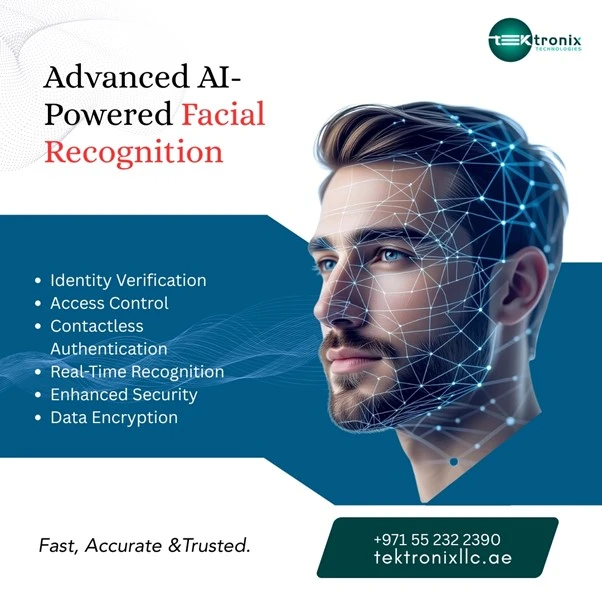

The UAE consistently positions it as an international leading innovator in smart governance as well as sophisticated security infrastructure. The government structures and towers across the nation manage sensitive processes sensitive data, private information and large numbers of visitors daily. To safeguard the critical areas the latest facial recognition techniques are being used as the foundation of contemporary security strategies. Combining AI and biometrics the facial recognition system provides increased security, while preserving the efficiency of operations and a general sense of convenience.
With the increasing density of cities and security requirements increase, the traditional methods for accessing buildings do not suffice anymore. AI facial technology now allows authorities to pinpoint individuals with precision track movement in real-time as well as prevent unauthorised access to facilities of the government as well as towers that are iconic.
The Evolution of Facial Recognition Systems in the UAE
A contemporary facial Recognition system goes beyond basic image match. The system employs sophisticated algorithms to study distinctive facial characteristics and generate an identity digitally unique to each person. Within UAE government facilities the systems are integrated with security platforms for access control including surveillance cameras, access control platforms and central command centers to make sure that security operations are seamless.
By using precisely face identification authorized individuals as well as visitors with a valid ID are easily identified by facial recognition, which reduces manual checking as well as increasing efficiency in entry. In addition, unauthorised visitors will be identified immediately which allows security staff to initiate proactive actions.
Face Detection and Real-Time Monitoring
In the heart of all facial-based technology is the accuracy of face detection. This method identifies human faces in live video feeds and photographs, even in noisy or chaotic surroundings. UAE government towers typically have high traffic, which makes live detection vital for maintaining the awareness of the situation.
If a person's face is recognized, facial tracking allows continuous tracking of individuals' movements through multiple cameras and different zones. This is especially beneficial in complex government facilities that tracker's activity helps improve security, control crowd movement and aid in investigation of incidents without disrupting everyday routines.
Advanced Facial Analysis and Verification
Beyond the detection limit, facial analysis analyses facial characteristics such as geometry, shape and facial expressions in order to increase recognition accuracy. The analysis enables reliable decision-making even in situations where the light circumstances, angles of the camera or obstructions that are partial may differ.
Face Verification provides a further security layer by verifying that a person's face is in fact an identity stored. It is typically used in security entrances, restricted floors as well as sensitive areas within UAE government facilities. The verification process ensures that access is only granted to those who are authorized in the appropriate time.
Facial Authentication and AI-Driven Intelligence
Facial authentication allows contactless and extremely secure access control. This reduces dependence on PINs, cards or physical keys. This method improves security, hygiene and efficiency, especially when it comes to high-security areas and those with a high volume of traffic.
Utilizing Face AI These machines continuously improve and learn with the course of. AI algorithms are able to adapt to the changes in appearance for example, aging or accessory and maintain high precision. The AI algorithms ensure long-term reliability and decreases false positives making facial recognition more suitable for government agencies with mission-critical requirements.
3D Facial Recognition and Liveness Detection
In order to stop spoofing to improve accuracy, modern technologies that are used in the UAE use 3D facial recognition. Unlike the traditional 2D systems, the 3D system records both the depth and contour information and hence can be recognized based on a number of angles accurately.
Also, Liveness Detection can be used to ensure that the system interacts with a live and real person, not an image or video. This is crucial in protecting buildings of government as well as towers against identity theft as well as sophisticated attempts to hack.
Strengthening Security Across Government Towers
Face recognition systems are extensively employed in UAE government towers to provide surveillance, access control as well as incident response. Integration of building management systems as well as security command centers enables central control as well as real-time alerts. This comprehensive approach helps speedy and effective decision making, increases emergency response and increases public security.
Through reducing the need for manual intervention as well as improving accuracy, facial technology can also improve operational efficiency and optimizing resources. This is in line with the vision of the UAE of digital and smart cities as well as governance.
Conclusion
The use of facial recognition has grown into an essential element in the security of UAE government towers and buildings. Modern facial recognition system capabilities, together with face detection, facial analysis as well as facial verification ensure precise and effective security of identity. AI powered by facial AI enhanced with 3d facial recognition as well as liveness detection ensures security against new security threat. through features such as facial authentication as well as face tracking government facilities can have real-time monitoring as well as easy access control. In combination, these tools ensure a secure, efficient and a future-proof environment, which supports the UAE's dedication to safety and advancement.
FAQs
1. What is the reason Facial Recognition preferred in UAE public structures?
It is a reliable, touchless as well as real-time authentication, increasing security and efficiency.
2. What are the differences between Face Detection differ from Face Identification?
Face Identification detects faces within images or video. Face Recognition denotes what kind of individual is.
3. What is the point of Liveness Detection in facial features security?
Liveness detection assists to avoid spoofing by ensuring that it is a human being who is alive.
4. What can 3D Facial Recognition do to enhance the accuracy?
3D facial recognition can capture depth and facial contours. It allows accurate recognition of faces from a variety of angles.
5. Does Facial Recognition integrate with existing security measures?
Yes Facial recognition systems effortlessly connect to surveillance, access control, and security systems for government agencies.
For more information contact us on:
Tektronix Technology Systems Dubai-Head Office
+971 50 814 4086
facial recognition software



























Sign in to leave a comment.