

Facial Recognition System technology is fundamentally changing how educational institutions across the UAE manage security, attendance, and access control. As schools, universities, and training academies accommodate thousands of students, staff, and visitors every day, the need for a fast, accurate, and non-intrusive identity management solution has never been more urgent. Tektronix LLC delivers AI-Powered Facial Recognition platforms purpose-built for the unique demands of educational environments — combining cutting-edge biometric intelligence with the regulatory sensitivities and cultural expectations of the UAE market.
Why Educational Institutions in the UAE Need Advanced Biometric Security
UAE campuses are dynamic, high-footfall environments that present a layered set of security challenges. A large university in Dubai or Abu Dhabi may process upwards of 20,000 individuals through its gates daily. Manual ID checks are slow, inconsistent, and scalable only at significant staffing cost. Tailgating at turnstiles, unauthorised visitor access, and the inability to verify identities in real time at multiple simultaneous entry points are persistent vulnerabilities that traditional access control systems cannot adequately address.
Beyond perimeter security, educational institutions carry a duty of care that extends to knowing — at any given moment — who is on campus and where. In the event of a lockdown, evacuation, or emergency, instant Face Detection and population-mapping capabilities can mean the difference between a managed response and a catastrophic outcome. The UAE Ministry of Education's ongoing focus on smart campus initiatives and its alignment with the UAE's National Agenda for innovation further reinforce why institutions are actively exploring biometric-grade security infrastructure.
Core Technology: How AI-Powered Facial Recognition Works on Campus
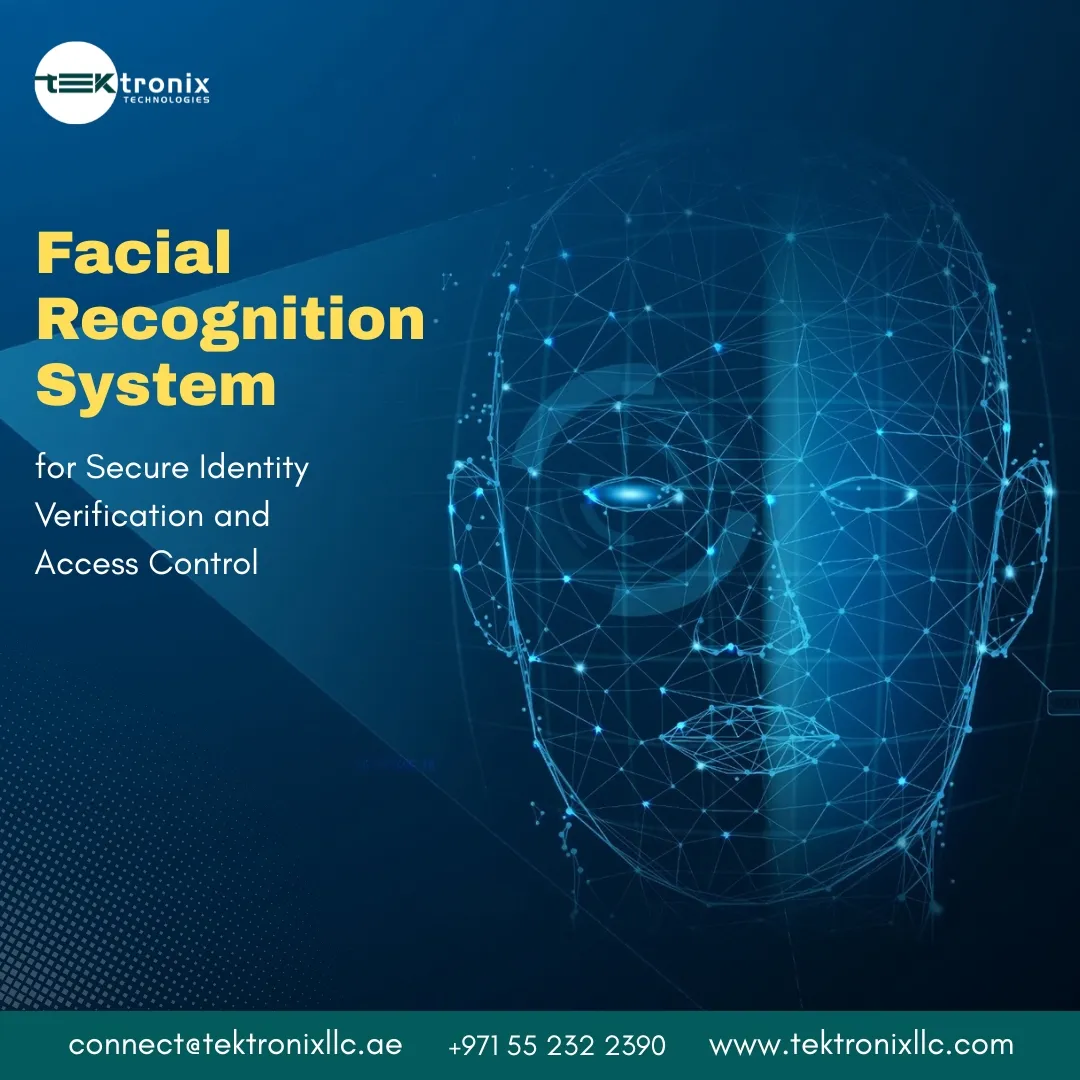
Modern AI-Powered Facial Recognition systems operate through a pipeline of interconnected machine learning processes. A high-resolution camera — typically an infrared-equipped Facial Recognition Device — captures a live image or video frame at the entry point. The system's neural network then extracts a unique faceprint: a mathematical representation of the individual's facial geometry derived from over 100 nodal points including the distance between the eyes, the contour of the jawline, and the depth of the eye sockets.
This faceprint is compared in milliseconds against an enrolled database of authorised individuals — students, faculty, administrative staff, and pre-registered visitors. The matching process, known as
Facial Identification, determines one-to-many identity — matching an unknown face against all records simultaneously. The system then either grants access, triggers an alert for an unrecognised individual, or flags a watchlisted subject for immediate security intervention. This entire process, from camera capture to access decision, is completed in under half a second — transparent and frictionless for the user.
Facial Authentication: Securing Restricted Zones Within the Campus
While perimeter access is the most visible use case, Facial Authentication within a campus unlocks a second layer of granular access management. Server rooms, examination halls, administrative offices, laboratories, and staff-only zones can each be governed by authentication rules that are enforced automatically — without keys, cards, or PIN codes. Because the individual's face is the credential, there is no risk of lost access cards, shared PINs, or credential theft.
For examination integrity in particular, Facial Authentication presents a compelling solution to the persistent problem of impersonation. By verifying the enrolled student's identity at the exam room entrance and cross-referencing against the student information system, institutions can eliminate proxy examination fraud entirely — a regulatory priority for UAE academic accreditation bodies such as the Commission for Academic Accreditation (CAA).
Choosing the Right Facial Recognition Device for School and University Environments
Hardware selection is as critical as software intelligence in any biometric deployment. The ideal Facial Recognition Device for an educational institution must balance performance with durability, ease of use, and aesthetic suitability for a campus environment. Key hardware considerations include:
- Infrared and Dual-Camera Sensors: Essential for outdoor UAE deployments where intense sunlight can overwhelm standard optical cameras, and for indoor low-light environments such as corridors and parking structures.
- Liveness Detection: Anti-spoofing algorithms embedded at the hardware level prevent unauthorised access via photographs, printed images, or video replays — protecting the integrity of the biometric process.
- Processing Architecture: Edge-computing devices that process biometric data locally — without transmitting raw facial images to a central cloud — satisfy data minimisation principles under UAE personal data protection law.
- IP-Rated Enclosures: Outdoor-mounted devices at main gates and sports facilities require IP65 or higher ratings to withstand dust, heat, and occasional water exposure across the UAE's varied climate conditions.
- Integration Interfaces: Wiegand, RS-485, and TCP/IP outputs ensure compatibility with existing turnstile gates, barrier arms, and access control panels already installed across the campus.
Facial Recognition Software: The Intelligence Layer Behind Seamless Campus Security
Facial Recognition Software is the management and analytics backbone that transforms individual biometric events into institution-wide security intelligence. A robust software platform provides administrators with a single-pane-of-glass view of campus access activity — surfacing real-time dashboards, automated attendance logs, exception reports, and audit trails that are invaluable for both day-to-day operations and post-incident investigation.
Core software capabilities that Tektronix LLC delivers for educational clients include:
- Automated Attendance Management: Student and staff presence is recorded automatically at entry points and classroom doors, eliminating manual registers and enabling instant reporting to academic departments and HR systems.
- Visitor Pre-Registration and Watchlist Management: Parents, contractors, and external guests can be pre-enrolled via a self-service portal, with time-limited access permissions that expire automatically.
- Multi-Site Synchronisation: For university groups operating multiple campuses across Dubai, Abu Dhabi, or Sharjah, the software synchronises enrolment databases and access logs across all locations in real time.
- Integration with Student Information Systems (SIS): Direct API connectors to platforms such as Banner, PeopleSoft, and Oracle HCM automate enrolment updates, ensuring the biometric database stays current as students matriculate, graduate, or are suspended.
- Compliance Reporting: Structured audit logs and exportable reports support compliance with UAE Federal Law No. 45 of 2021 on Personal Data Protection and institutional audit requirements.
Facial Recognition System UAE: Deployment Across the Education Sector
Facial Recognition System Dubai: International Schools and Higher Education
Dubai's education landscape is one of the most diverse in the world, with over 200 international schools operating across Knowledge Village, Academic City, and community school zones. The Facial Recognition System Dubai deployments that Tektronix LLC has engineered for this market address a specific challenge: managing security for multi-nationality student populations while respecting the varied cultural expectations of parents and students regarding biometric data use. Our solutions are configured with transparency-first enrolment workflows — explicit consent, data purpose limitation, and parent-accessible opt-out processes — meeting both KHDA (Knowledge and Human Development Authority) expectations and international best practice standards such as the UK GDPR and US FERPA frameworks adopted by British and American curriculum schools.
Facial Recognition System Abu Dhabi: Government Schools and University Campuses
Facial Recognition System Abu Dhabi projects handled by Tektronix LLC span ADEK-regulated government schools, Zayed University, NYU Abu Dhabi, and private sector training academies. Abu Dhabi's regulatory environment — overseen by the Abu Dhabi Digital Authority (ADDA) and ADEK — places strong emphasis on data localisation and cybersecurity architecture. Our platform architecture for Abu Dhabi deployments routes all biometric processing through on-premise edge infrastructure, ensuring that no facial data traverses public networks and that the institution retains full data sovereignty.
Nationwide Educational Security: From Sharjah to Ras Al Khaimah
Tektronix LLC's Facial Recognition System UAE capability is not confined to the two primary emirates. GEMS Education, Taaleem, Aldar Education, and a growing number of independent operators across Sharjah, Fujairah, Ajman, and Ras Al Khaimah have engaged our team to design and commission biometric access systems tailored to their campus architectures and student populations.
Why Tektronix LLC: Expertise, Authority, and Trust in UAE Educational Security
Deploying biometric technology in an educational setting requires more than technical competence — it demands an understanding of child data protection obligations, parental consent frameworks, and the reputational sensitivities that schools and universities carry as public-facing institutions. Tektronix LLC brings a multi-disciplinary capability: security engineers certified by ASIS International, data privacy consultants familiar with UAE Federal Law No. 45 of 2021, and project managers with direct experience navigating KHDA and ADEK regulatory processes.
Our procurement and deployment methodology follows a phased approach: stakeholder engagement and consent framework design, site survey and camera positioning, hardware installation and network integration, software configuration and SIS connectivity, operator training, and a structured go-live with ongoing SLA-backed support. Every project is delivered with full documentation, enabling institutions to demonstrate due diligence to regulators, accreditation bodies, and parent communities.
Conclusion
The adoption of a Facial Recognition System in UAE educational institutions represents a convergence of three powerful trends: the UAE's national commitment to smart technology adoption, the education sector's escalating duty of care obligations, and the maturation of biometric AI to the point where accuracy, speed, and privacy compliance can coexist in a single, deployable platform.
From automated attendance and exam integrity to perimeter security and emergency roll-call, the use cases for Facial Recognition Software on campus are broad, measurable, and directly linked to outcomes that institution leaders, regulators, and parents all care about. Tektronix LLC's proven track record across Facial Recognition System UAE deployments — spanning international schools, government universities, and private training academies — positions us as the partner of choice for institutions ready to move beyond card-based access and manual attendance into the intelligent security era.
FAQs
1. Is a Facial Recognition System legally permitted in UAE schools and universities?
Yes, provided institutions comply with UAE Federal Law No. 45 of 2021 on Personal Data Protection. A Facial Recognition System deployed in an educational setting must be based on explicit informed consent, serve a clearly defined and proportionate security purpose, and implement appropriate data security safeguards. Tektronix LLC includes a compliance framework as a standard component of every educational deployment, ensuring institutions satisfy both UAE law and relevant international standards adopted by curriculum-specific regulators such as KHDA.
2. How does Face Detection handle students who wear niqab or other face coverings?
This is a material consideration in UAE educational deployments. Face Detection algorithms in our platform are configured to support partial-face recognition, using periocular features (the eye region and surrounding geometry) when full facial geometry is unavailable. Additionally, multi-modal fallback options — such as iris recognition or card-plus-face verification at staffed reception points — are incorporated into the system design for environments where face covering is common.
3. What happens to biometric data if a student leaves the institution?
Under our standard deployment architecture, biometric faceprints are stored as encrypted mathematical templates — not as photographs. Upon a student's departure, their enrolment record and associated biometric template are purged from the Facial Recognition Software database within the institution's defined data retention period (typically 30 to 90 days post-departure). Institutions can configure automated deletion workflows to ensure compliance without manual intervention.
4. Can the Facial Recognition Device work outdoors in UAE summer temperatures?
Yes. The Facial Recognition Device models Tektronix LLC specifies for outdoor UAE installations are rated for operating temperatures up to 60°C and are housed in IP65-certified enclosures. Infrared illuminators ensure accurate Facial Identification performance in direct sunlight conditions, and anti-reflective coatings on camera lenses mitigate the glare typical of UAE summer daylight. All hardware is sourced from manufacturers with proven Middle East field deployment histories.
5. How long does it take to enrol an entire student population into the system?
Bulk enrolment is one of the most common concerns for institutions considering a Facial Recognition System Dubai or Facial Recognition System Abu Dhabi deployment. For institutions with existing student photo databases — common in any institution using a student ID card system — our software can perform automated bulk enrolment by extracting faceprints from existing identity photographs, eliminating the need for individual in-person enrolment sessions. A student population of 5,000 can typically be onboarded into the biometric database within 24 to 48 hours, with live campus deployment achievable within the same week.






























Sign in to leave a comment.