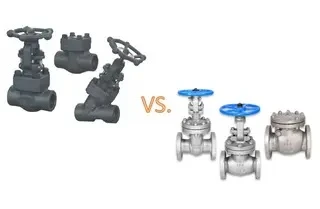
Forged Steel Valves vs. Cast Steel Valves: Key Differences and Selection Guide
China Industrial Valve Seal Kits Manufacturer Delivering Low-Emission Valves, Advanced Valve Packing, and High-Performance Sealing Materials for Demanding Applications.
In industrial piping systems, valves are essential for ensuring safety, reliability, and efficiency. Among the most common options are forged steel valves and cast steel valves, which differ in material properties, manufacturing processes, performance, and applications. Understanding these differences is crucial for selecting the right valve for specific operating conditions.
Basic Concepts
Cast Steel Valves
Cast steel valves are produced by pouring molten metal into molds, where it solidifies into shape. The main advantage of casting is the ability to create complex geometries, especially for valve components with intricate internal cavities. Typical materials include cast carbon steel, low-alloy steels, and special steels, enabling a balance of strength and ductility.
Forged Steel Valves
Forged steel valves are made by applying pressure to solid metal billets, causing plastic deformation and refining the grain structure. This process improves density, toughness, and mechanical strength, making forged steel valves highly resistant to impact and pressure. As a result, they are preferred for critical applications requiring durability under extreme conditions.
Key Differences Between Forged and Cast Steel Valves
1. Material Density and Process
- Forged Steel: Higher density, refined grain structure, stronger and tougher. Shapes are simpler due to forging limitations.
- Cast Steel: More prone to segregation, porosity, or shrinkage, which can reduce strength. However, casting excels in producing complex shapes at lower cost.
2. Performance
- Strength & Toughness: Forged steel valves withstand higher impact and pressure, ideal for heavy-duty, high-pressure systems.
- Cast Steel Valves: Lower toughness but sufficient for moderate pressure applications where shape complexity is important.
- Pressure Ratings:
- Forged steel: PN100–PN320, 1500LB–3500LB (petroleum, natural gas, chemical processing).
- Cast steel: PN16–PN40, 150LB–900LB (municipal water, general chemical systems).
3. Economic Considerations
- Forging: Requires high-tonnage equipment and expensive dies; economical only in large-scale production.
- Casting: Lower equipment costs and cheaper molds, making it more suitable for small batches or complex shapes.
Valve Selection Guidelines
1. Based on Working Conditions
- High strength/pressure: Choose forged steel valves (e.g., petroleum and gas pipelines).
- Complex shapes/lower loads: Choose cast steel valves (e.g., chemical equipment with intricate flow paths).
- Temperature:
- High temperature: alloys like A182 F91 for ultra-supercritical steam systems.
- Low temperature: steels like A350 LF2 for cryogenic applications.
2. Based on Medium Characteristics
- Corrosive media: Austenitic stainless steels such as A182 F316 or cast grades like CF3M/CF8M for chloride resistance.
- Conventional fluids: Cost-effective carbon steels (e.g., WCB) for water, oil, or non-aggressive media.
3. Based on Economic Costs
- Mass production: Forging is justified despite high tooling costs.
- Small batches: Casting is more economical, especially for complex geometries.
Common Materials
Forged Steel
- Carbon Steel: ASTM A105 (general), A350 LF2 (low-temperature).
- Stainless Steel: ASTM A182 F304/F316/F316L.
- Alloy Steel: ASTM A182 F11, F22, F91 for high-temperature service.
- Duplex Stainless Steel: ASTM A182 F51 for strength + corrosion resistance.
Cast Steel
- Carbon Steel: ASTM A216 WCB (general), A352 LCB (low-temperature).
- Alloy Steel: ASTM A217 WC6, WC9, C12A for high-temperature/pressure.
- Stainless Steel: ASTM A351 CF3, CF8, CF3M, CF8M for corrosion resistance.
Conclusion
Forged steel valves deliver superior strength, toughness, and pressure resistance, making them the right choice for demanding high-pressure and high-temperature conditions. Cast steel valves, on the other hand, are more cost-effective for complex designs and moderate operating requirements.
Ultimately, valve selection should be guided by working conditions, medium characteristics, and economic factors. Careful matching of valve type and material ensures long-term safety, efficiency, and reliability of industrial systems.It's important to know about Google SEO to help your website rank higher in search results.
























Sign in to leave a comment.