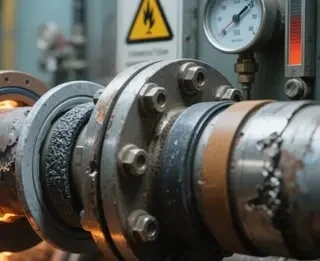
Gasket Performance and Reliability in High-Temperature Applications
In industries such as chemical processing, power generation, papermaking, and oil refining, the sealing performance of pipelines and equipment is critical to production safety and efficiency. As the core of sealing systems, gaskets play an especially important role in high-temperature environments. This article explores gasket failure modes, influencing factors, and practical strategies for improving sealing reliability under high heat.
Sealing Principle of Gaskets
The basic sealing principle of gaskets is simple yet vital. A bolt’s pre-tightening load compresses the gasket against the flange surface, forcing it to elastically or plastically deform. This deformation fills micro-gaps between flange surfaces, preventing fluid leakage. For reliable sealing, gaskets must maintain compressibility and resilience. However, at high temperatures, material properties degrade, often leading to reduced sealing capability and even leakage.
Failure Modes of Gaskets
1. Creep Relaxation
When exposed to constant stress, gaskets deform over time—a process called creep. Simultaneously, the clamping stress decreases, known as stress relaxation. In high-temperature service, both phenomena accelerate: materials age, thermal loss increases, and internal manufacturing stresses dissipate. This reduces residual stress at the sealing interface. If residual stress drops below the required sealing pressure, leakage occurs. Temperature has a far stronger influence on creep relaxation than stress alone.
2. Loss of Resilience
During operation, rising temperatures cause gasket creep and bolt elongation, reducing flange contact pressure. Gaskets must possess resilience to compensate. Yet at high temperature and pressure, the material’s elastic modulus and yield strength decline, while plastic deformation grows. Resilience diminishes, and if medium pressure is high, the gasket may even be blown out, causing leakage.
3. Strength Failure
Extended exposure to high heat alters gasket material properties. Stress fluctuations and medium corrosion further accelerate failure. For example, graphite wound gaskets reinforced with stainless steel are vulnerable to stress corrosion cracking in sulfide or chloride environments. If sulfur or chloride impurities exceed standards, the gasket’s metal skeleton can fracture suddenly, leading to catastrophic failure.
Strategies for Gasket Selection and Maintenance
1. Choosing the Right Material
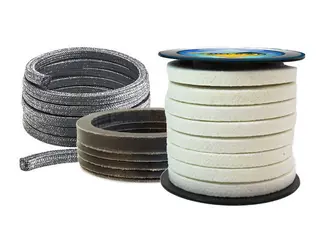
Selecting suitable gasket materials is the first step to reliable sealing in high-temperature service. Corrosion-resistant PTFE gaskets, with proper processing, offer creep resistance, cold-flow resistance, and broad chemical compatibility. They perform reliably across a wide temperature range, adapting well to uneven or damaged flange surfaces, making them suitable for demanding industries such as petrochemicals, power, and refining.
2. Hot-Tightening Practices
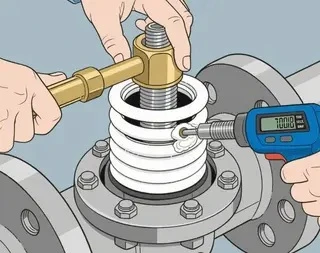
High temperatures reduce a gasket’s yield limit and elastic modulus, loosening the flange-gasket interface. Hot-tightening bolts can restore sealing force, but material changes such as brittleness or hardening may cause sudden rupture if handled incorrectly. Operators must be skilled and cautious to avoid inducing gasket strength failure.
3. Managing Thermal Stress
Flanges typically heat faster than bolts, creating axial expansion differences that induce thermal stress. Combined with fluid pressure, this can cause bolt yielding or creep. Cylinder wall expansion and flange deflection further increase bolt load, reducing gasket clamping force and promoting leakage. Proper design must account for these stresses to preserve sealing performance.
4. Self-Tightening Seal Challenges
Lens-type metal gaskets and similar designs can still leak at high temperature. Their faster thermal expansion compared to flanges induces significant thermal stress. Once this exceeds the material’s yield limit, stress relaxation and permanent deformation occur. Cooling cycles worsen clamping force loss, and repeated cycles accumulate damage, leading to leakage. Effective design must consider these thermal mismatch effects.
5. Gasket Load Variations
Temperature differences between cylinder, flange, and bolts cause fluctuating gasket loads. Rising internal pressure typically decreases gasket load. If flange temperature exceeds bolt temperature, load rises; if cylinder temperature exceeds flange temperature, load falls. Inadequate load results in leakage. To counter this, operators may need to increase pre-tightening load or re-tighten bolts during service.
6. Asymmetric Thermal Deformation
Non-uniform flange heating creates circumferential deformation and uneven gasket loading. Localized underloading may trigger leaks. Designers should minimize circumferential temperature gradients to maintain uniform load distribution and sealing reliability.
Conclusion
Gaskets are critical to maintaining sealing integrity in high-temperature industrial operations. Understanding creep relaxation, resilience loss, and strength failure allows engineers to anticipate problems and implement solutions. With proper material selection, maintenance practices, and thermal stress management, gasket reliability can be significantly improved. Ultimately, careful consideration of temperature, pressure, and corrosive environments ensures safe, efficient, and stable production.It's important to know about Google SEO to help your website rank higher in search results.



























Sign in to leave a comment.