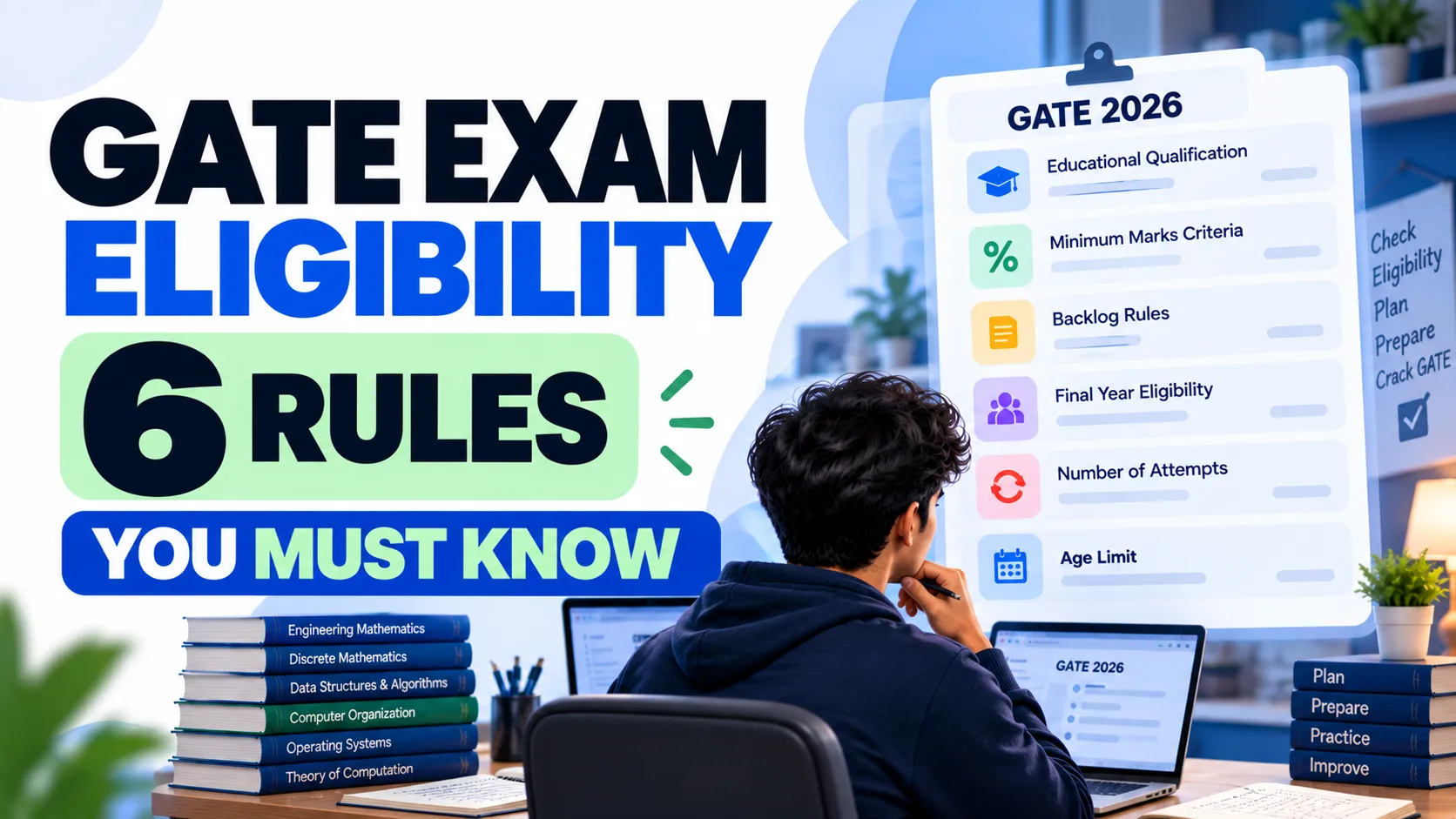

Few moments during college bring as much nervous energy as deciding to take a national-level competitive exam. You map out standard textbooks, count the remaining months, and start looking at test series. But before you bury yourself in engineering mathematics or circuit theory, there is a fundamental question you must answer: Are you officially qualified to sit for the paper?
Every registration cycle, hundreds of students either panic unnecessarily over semester backlogs or get their application forms rejected due to simple administrative misunderstandings. Navigating the official brochures can feel dense and confusing.
Whether you are aiming for immediate M.Tech admissions or planning ahead for the upcoming cycle, understanding the official gate exam eligibility standards is the first concrete step in your preparation. Here are the 6 foundational rules you need to know to confirm your status and avoid registration mistakes.

Rule 1: The Minimum Academic Year Requirement
The most significant change in recent editions of GATE is how early you can appear for the test. You do not need to wait until your graduation cap is in hand.
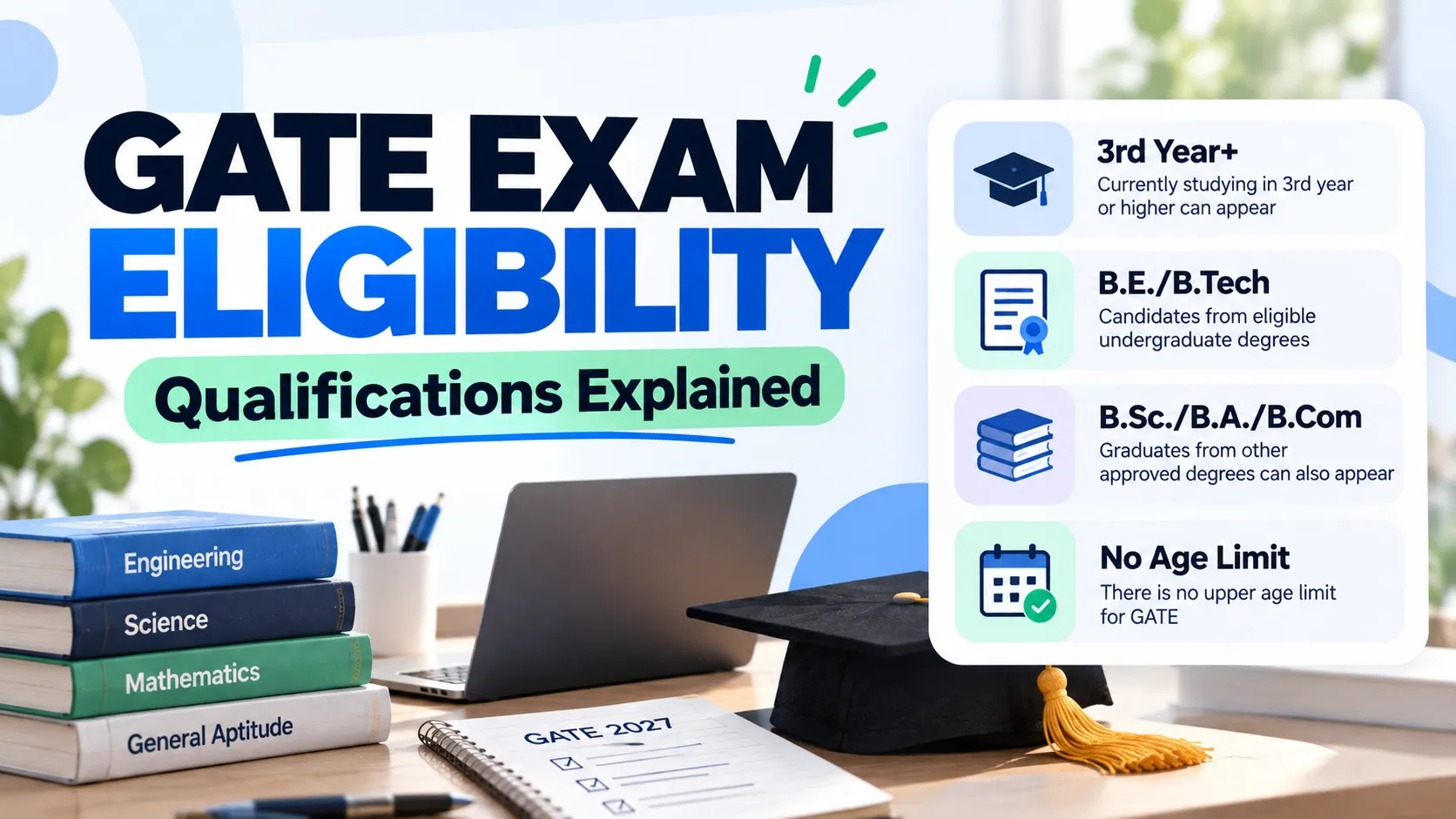
Under the current gate eligibility criteria, you can register if you satisfy either of these two scenarios:
You are currently enrolled in the 3rd year or higher of an approved undergraduate degree program.
You have already completed a government-approved qualifying degree.
For standard four-year bachelor’s programs (such as B.Tech, B.E., or B.S.), this means you can sit for GATE during your pre-final year (5th/6th semester). This offers a major strategic advantage: taking the exam in your pre-final year gives you direct exposure to real test pressure, and your score remains valid for three years. If your score is high, you can use it right after graduation; if not, you can re-attempt in your final year without losing a placement cycle.
Rule 2: Qualified Degrees Beyond Traditional B.Tech
A persistent misconception is that GATE is reserved strictly for engineering graduates. That is no longer the case. The expanded gate 2027 eligibility criteria cover a wide range of academic paths:
Engineering & Technology: B.E., B.Tech, B.Arch, and Naval Architecture (3rd year onwards or graduated).
Science & Computer Applications: B.Sc. (Research/4-year), MCA, M.Sc., and BCA/3-year B.Sc. candidates (final year or completed).
Commerce, Arts & Humanities: Candidates pursuing or holding degrees like B.Com, B.A., or M.A. in relevant analytical subjects.
Integrated & Dual Degrees: 5-year integrated M.Tech/M.Sc. or B.Tech + MBA students (eligible from their 3rd year onwards).
Professional Certifications: Candidates who have completed Section A or equivalent examinations from recognized professional societies (e.g., AMIE by IEI) recognized by AICTE or the Ministry of Education.
If your degree comes from a recognized university or institute approved by UGC/AICTE, you likely qualify to pick a test paper aligned with your academic background.
Rule 3: Zero Age Caps and Unlimited Attempts
Competitive exams like UPSC, state services, or banking tests come with strict age barriers and attempt limits. GATE is distinctly different.
Upper Age Limit: None.
Lower Age Limit: None (provided you meet the academic enrollment threshold).
Number of Attempts: Unlimited.
Whether you are 20 years old and attempting your very first paper, a 28-year-old software engineer planning a transition into research, or a 40-year-old professional returning to academia, the gate eligibility criteria 2027 treat all candidates equally on the application portal. You can attempt the exam as many times as necessary to secure the score you need for PSU interviews or IIT admissions.
Rule 4: The Distinction Between Exam Eligibility and Admission Cut-offs
This is where the majority of confusion takes place. You must distinguish between eligibility to appear for GATE and eligibility for admission or hiring.
| Parameter | Eligibility to Sit for GATE | Eligibility for IIT/NIT Admissions | Eligibility for PSUs |
|---|---|---|---|
| Minimum Percentage | No minimum marks required (0% to 100%) | Typically 60% or 6.5 CGPA in Bachelor's degree | Typically 60%–65% aggregate in qualifying degree |
| Academic Standing | 3rd-year enrolled or completed | Must complete degree before joining session | Must complete degree before document verification |
| Backlog Restrictions | Permitted to sit for exam | Must clear all backlogs by admission date | Must have no active backlogs at time of joining |
To register and sit for the exam, the organising committee imposes no minimum percentage requirement. You could have a 5.8 CGPA and still download your admit card. However, qualifying GATE does not waive the independent minimum criteria set by individual IITs during COAP counseling or public sector units (PSUs) during their recruitment rounds. Always check the specific requirements of your target institutions alongside your test preparation.
Rule 5: Active Backlogs Do Not Disqualify Your Exam Entry
One of the most frequent panic-inducing questions from students is: "I have an uncleared backlog from my 4th semester. Can I still register?"
The short answer is yes.
Having an active backlog or an uncleared paper in your university curriculum does not block you from writing GATE. The exam authority requires proof that you are actively pursuing your degree in the requisite year (such as a Certificate from the Head of Department or Principal, or your latest grade sheet).
The caveat: While you can take the exam and receive a valid scorecard, you must clear those arrears before actual admission into an M.Tech program or final onboarding at a public sector enterprise. The score itself remains valid for three years, giving you time to clear backlogs in subsequent semesters.
Rule 6: Two-Paper Combinations and Discipline Freedom
Candidates are not locked strictly into their undergraduate major. The organizing committee allows candidates to appear for either one paper or a designated combination of two papers from the official list.
For instance, an undergraduate in Mechanical Engineering can choose to appear for the Data Science and Artificial Intelligence (DA) paper, or an Electrical Engineering student might combine Electrical (EE) with Instrumentation (IN).
When selecting paper combinations:
- Both papers must be chosen from the approved pre-set combination list published by the organising institute.
You will pay separate fees for each paper.
Exam schedules are coordinated to avoid timing clashes between eligible two-paper sets.
Things You Should Know: Critical Application Pitfalls
Even candidates who satisfy all academic rules occasionally run into administrative rejections. Keep these practical considerations in mind during the application window:
- Certificate Upload Formatting: If you are currently in your 3rd or final year, do not upload unofficial web screenshots of your university portal. Use a properly signed Bonafide/Study Certificate or your official consolidated grade card as specified in the brochure.
Category Certificate Validity: If you are applying under OBC-NCL, EWS, SC, ST, or PwD categories, ensure your certificates match central government formats and dates. State-level certificates that deviate from central guidelines often lead to candidates being moved to the General category during counseling.
- Name Matching: Ensure the name you enter on the application matches your government photo identity proof (Aadhaar, Passport, Voter ID) letter for letter. Even slight spelling mismatches cause unnecessary hurdles at the exam center.
Real Candidate Experiences
Arjun S. (B.Tech Mechanical, appeared in 3rd year):
"I was unsure if giving GATE in my 6th semester was worth the fee. I registered anyway, thinking of it as a low-stakes mock test. That 3rd-year attempt showed me exactly where my weak spots were under exam pressure. When I sat for my final year attempt, the familiarity with the interface and question temperament made all the difference."
Pooja M. (B.Sc. Mathematics graduate):
"Coming from a pure sciences background, many of my batchmates assumed GATE was strictly an engineering thing. Finding out I was eligible for the DA and MA papers opened up direct avenues to applied data research programs at IISc that I had previously thought were out of reach."
Frequently Asked Questions
1. What are the core criteria to meet gate exam eligibility?
To meet the basic gate exam eligibility, you must either be currently studying in the 3rd year or higher of an approved undergraduate degree program or have already completed a recognized bachelor's degree in engineering, technology, architecture, science, commerce, or arts.
2. Does the gate eligibility criteria require a minimum 60% in college?
No. The official gate eligibility criteria set by the organizing committee does not require any minimum percentage or CGPA to sit for the examination. However, individual institutes (like IITs and NITs) and PSUs typically require 60% or 6.5 CGPA in your graduation degree for admission and recruitment.
3. How many times can I attempt the test under gate 2027 eligibility criteria?
Under the gate 2027 eligibility criteria, there is no limit on the number of attempts. You can take the exam as many times as you choose, regardless of age, provided you satisfy the educational qualification requirements.
4. Can lateral entry diploma students sit for GATE?
Yes. Candidates who entered an engineering degree via lateral entry after completing a 3-year polytechnic diploma are fully eligible once they reach the 3rd year (5th semester) of their B.E./B.Tech program.
5. How long does my GATE scorecard remain valid?
A GATE scorecard is valid for three years from the date of result announcement. For example, if you qualify the 2027 session, your scorecard can be used for admissions through the 2027, 2028, and 2029 academic cycles.
Reviewing official exam guidelines is rarely the most exciting part of your preparation, but doing it early removes guesswork and protects your investment of time. Once you know where you stand regarding degree requirements, documentation, and academic standing, you can put the administrative details aside and focus entirely on mastering your syllabus.























Sign in to leave a comment.