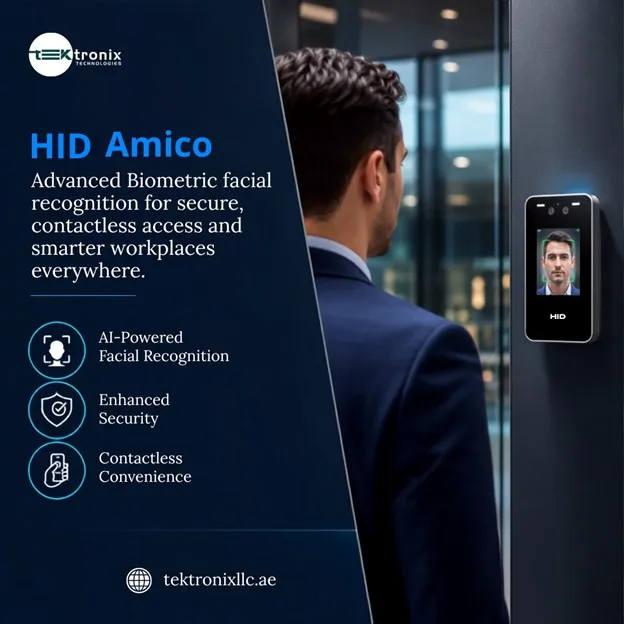

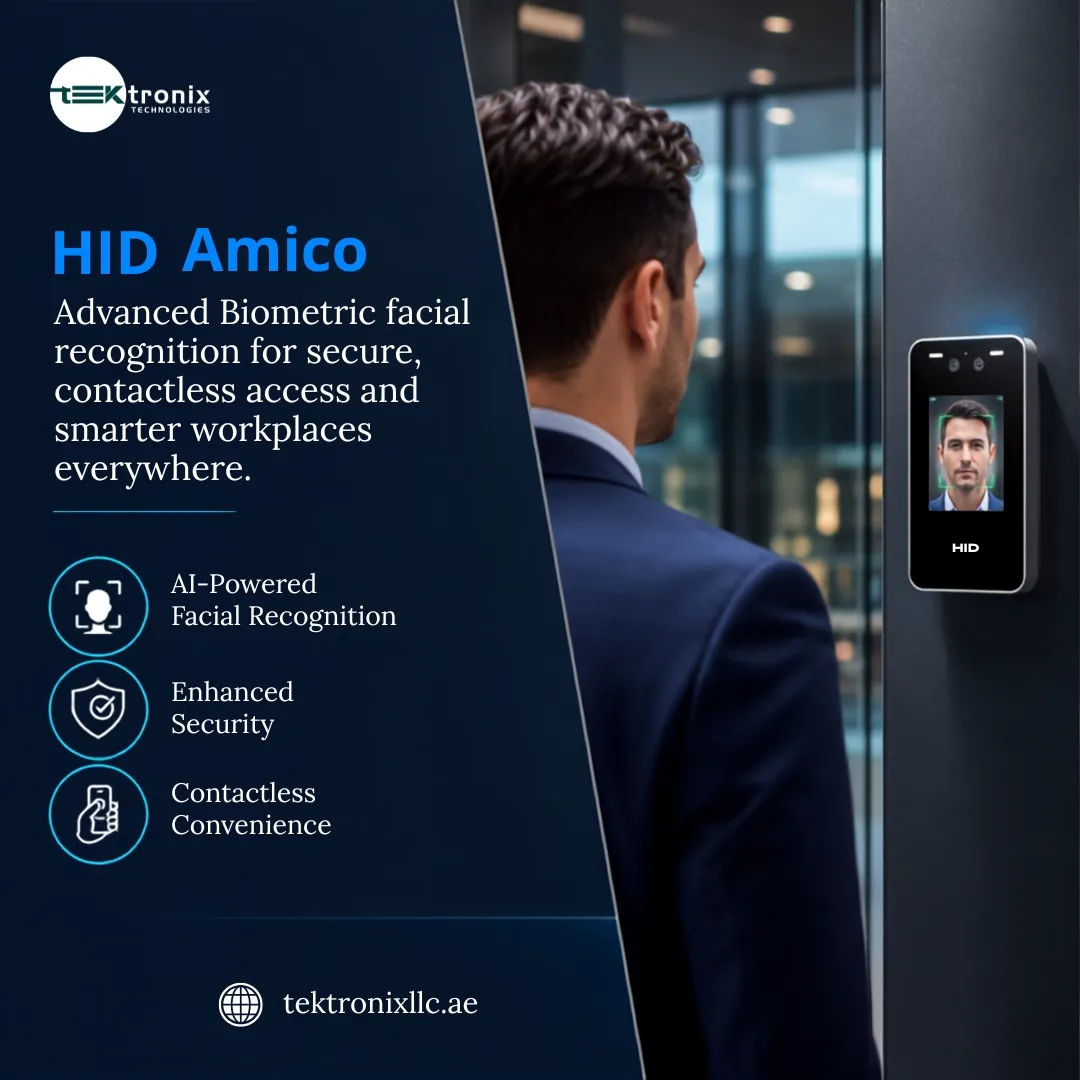
HID Amico is changing how UAE enterprises verify staff identity at entry points, turning slow badge checks and shared PIN codes into a single glance at the door. As banks, free zone tenants, and government offices across Dubai and Abu Dhabi scale up headcount, security teams need authentication that moves large numbers of people through checkpoints daily without sacrificing accuracy or auditability. This guide walks through the hardware, software, and anti-fraud safeguards that make this platform a genuine gateway to smarter enterprise security in the UAE.
Why UAE Enterprises Are Modernizing Staff Authentication
The UAE's banking sector, free zone companies, and government ministries all share a common challenge: verifying large numbers of staff quickly at shift changes and daily arrivals without creating bottlenecks or security gaps. As organizations grow alongside the country's continued smart-city expansion, the gap between how fast people need to move and how carefully their identity needs to be checked keeps widening, pushing facilities toward automated, camera-based verification instead of manual guard checks.
Dubai and Abu Dhabi's Growing Enterprise Security Needs
Large employers across DIFC, Dubai Internet City, and Abu Dhabi Global Market all manage high daily staff turnover across multiple shifts and a constant flow of visiting clients and partners. Each of these environments needs an entry system that can confirm identity in seconds without creating queues at peak hours, while still producing a reliable, timestamped record for compliance and investigations.
The Limits of Badges and PINs at Scale
Badge-and-PIN systems break down at scale because both credentials can be lent out, lost, or stolen without the system ever knowing. A shared PIN or a borrowed badge means the audit trail technically shows someone entered, but not who was actually behind that entry — a gap that becomes far more consequential as facility size and staff count increase.
HID Amico Facial Recognition: How It Works
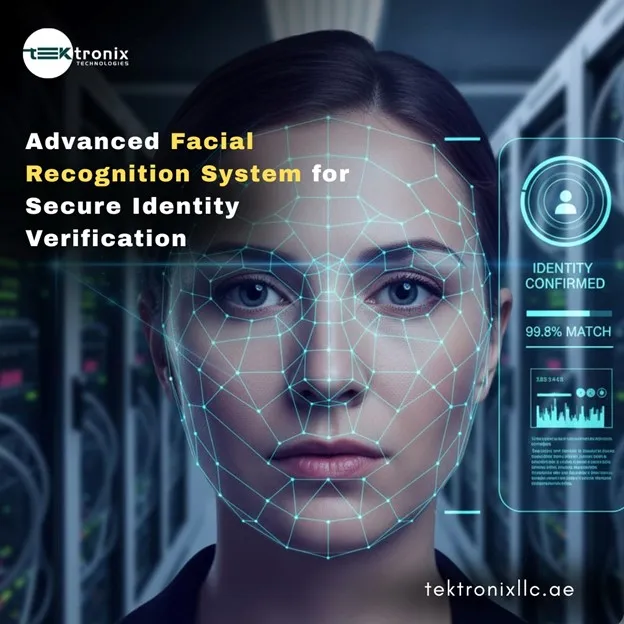
Camera-based staff verification captures a live face at the point of entry and matches it against an enrolled staff database within a fraction of a second, allowing authorized personnel to pass through without touching a reader or presenting a card. Unlike a badge swipe, this match is tied directly to the individual rather than to an object that can change hands, closing one of the most common gaps in traditional access systems.
HID Amico Facial Recognition Reader: Hardware Built for High-Traffic Entry
The reader hardware itself is engineered for continuous use at busy entrances, combining a high-resolution camera, on-device processing, and a compact form factor suited to turnstiles, mantraps, and standard door frames. Facilities evaluating a facial reader for UAE enterprise entrances should pay close attention to how the hardware performs under real shift-change conditions — bright lobby lighting, queues of people moving quickly, and varied head angles — rather than relying on specs alone.
HID Aero Controller: The Backbone of the Access Network
Behind every reader sits a networked controller that manages credential validation, door hardware, and system-wide rules across every entry point in a facility. This controller layer is what allows a single access policy — say, restricting a server room entrance after hours — to apply consistently across dozens of doors without manually reconfiguring each reader individually.
HID Access Control: Unifying Credentials Across the Enterprise
A unified credentialing platform brings together facial verification, mobile credentials, and traditional cards under one policy engine, so security teams manage a single set of access rules rather than juggling separate systems for each entry method. For multi-tenant towers or facilities with several access types in use simultaneously, this consolidation significantly reduces administrative overhead and closes gaps between disconnected systems.
HID Mobile Access: Badge-Free Entry from a Smartphone
Smartphone-based credentials let employees carry their access rights on a device they already have with them at all times, reducing the operational cost and loss risk associated with issuing and reissuing physical badges. Combined with facial verification at higher-security checkpoints, mobile credentials give organizations a flexible, layered approach to authentication depending on the sensitivity of each entry point.
AI-Powered Anti-Spoofing: Stopping Fraudulent Attempts
Machine learning models trained to detect fraudulent attempts can identify when someone tries to bypass facial verification using a printed photo, a screen replay, or a mask, rejecting the attempt before it ever reaches the matching stage. This layer of protection is what separates a genuinely secure deployment from one that merely looks secure on paper.
Liveness Detection: Confirming a Real, Present Person
Depth analysis, texture evaluation, and micro-movement tracking work together to confirm that a live, physically present person — not an image or recording — is standing in front of the camera. This check happens in the background within milliseconds, adding no noticeable delay for legitimate staff while closing off one of the most common attack vectors against camera-based verification.
Visitor and Contractor Access: Extending Verification Beyond Employees
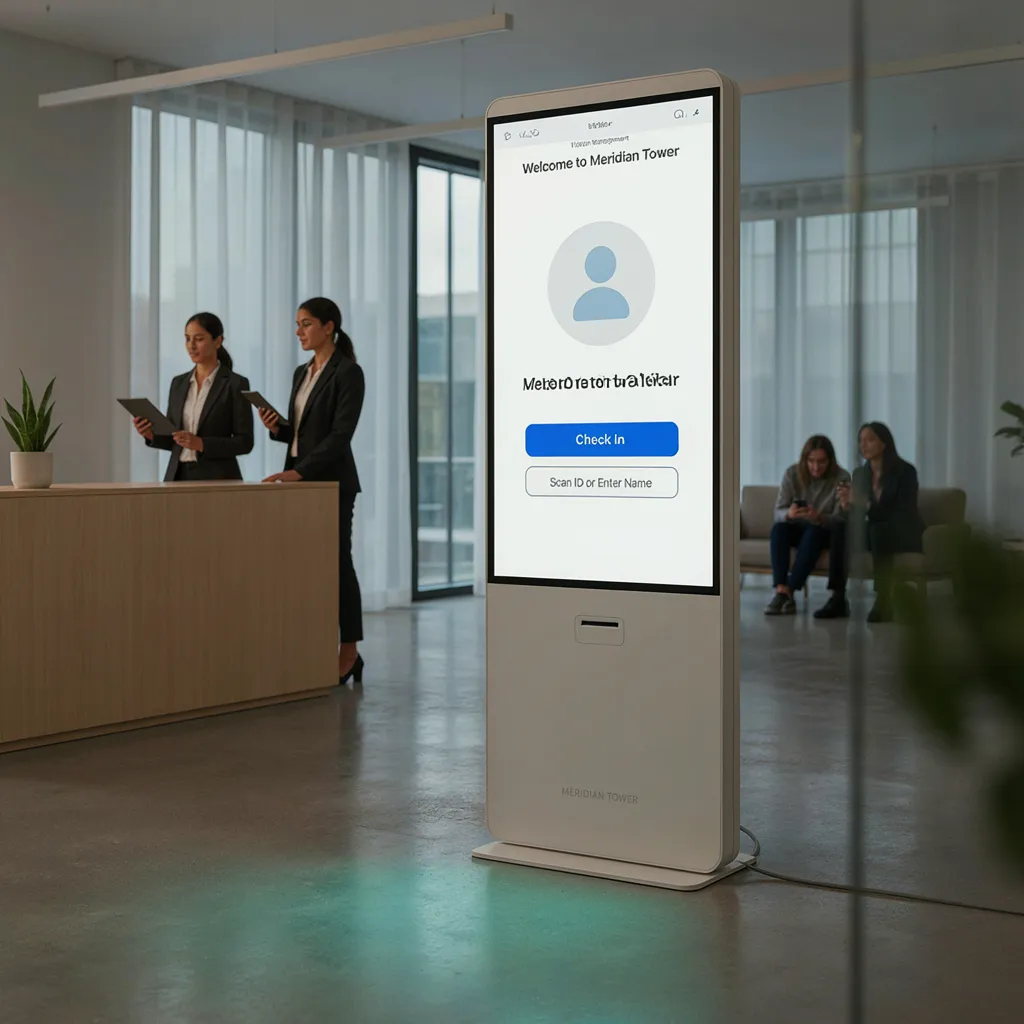
Enterprise authentication needs to account for far more than full-time staff — contractors, delivery personnel, and client visitors all require some form of temporary, time-limited access that does not carry the same privileges as a permanent employee credential. Integrating a visitor registration workflow with the broader authentication platform allows a guest to receive a temporary credential automatically restricted to specific floors, zones, or time windows, rather than requiring a staff member to manually escort every visitor throughout their entire stay.
Aligning Security Investment with UAE Smart-City Priorities
The UAE's continued push toward smart-city and smart-building standards across Dubai and Abu Dhabi means new commercial developments increasingly specify connected, biometric-ready entry infrastructure from the earliest design stages rather than retrofitting it after construction. Organizations building new facilities have an opportunity to specify modern staff authentication as a foundational requirement from day one, rather than adding it onto a building designed around older badge-and-key assumptions.
Scaling Authentication as Your Organization Grows
A system that works well for a single-entrance headquarters with a few hundred staff may behave very differently once an organization expands to several branches or adds a large contractor workforce during a project. Organizations should evaluate how easily a platform can add new sites, new reader hardware, and temporary bulk enrollments without requiring a complete system redesign each time headcount or footprint changes. Vendors with genuine multi-site experience in the region typically have established processes for this kind of scaling.
Common Deployment Scenarios: Banks, Free Zones, and Government Offices
Bank branches and headquarters typically prioritize a fast, discreet entry experience for staff, often layering facial verification at staff-only doors while maintaining a separate flow for visiting clients. Free zone companies in JAFZA and DMCC frequently benefit from a shared building deployment where each tenant manages its own enrolled staff list without needing a fully separate security team. Government offices tend to apply the strictest combination of both, using facial verification alongside dedicated security personnel for the most sensitive buildings and floors.
Integration with Existing Building and Security Systems
A staff authentication upgrade rarely stands alone — most deployments need to integrate with existing turnstiles, elevator access systems, visitor management kiosks, and building-wide video surveillance already in place. Organizations should confirm that a prospective platform can work alongside legacy card readers during a phased rollout, rather than requiring an all-at-once replacement of every door in the building on a single go-live date.
Data Privacy and Governance for Biometric Credentials in the UAE
Because facial verification systems store biometric templates alongside staff identity information, organizations need clear policies on how this data is encrypted, retained, and who within the company can access it. UAE organizations should confirm that enrollment data is stored securely, that departing employees have their biometric records properly removed from the system, and that the platform's data handling aligns with the company's own internal privacy commitments to its workforce.
Measuring Return on Investment for Staff Authentication Upgrades
The cost case for modern staff authentication usually rests on three measurable savings: reduced time lost to manual badge checks at shift changes, fewer security incidents tied to lost or shared credentials, and a stronger audit trail that simplifies compliance reviews and incident investigations. Organizations that previously staffed a manual checkpoint at every entrance often find that automated verification absorbs much of that workload, freeing security personnel for patrols and exception handling rather than routine credential checks.
Staff Training and Change Management for Biometric Rollouts
Even the most reliable authentication hardware depends on staff actually using it correctly and reporting issues promptly. A short enrollment and orientation session — explaining how the camera capture works, what to do if verification fails, and how to report a lost mobile credential — significantly reduces help-desk friction in the weeks following a rollout. Organizations that skip this step often see a spike in support requests during the first month, not because the technology is unreliable, but because staff were never given a clear, simple explanation of how the new process differs from the badge system they are used to.
Multi-Site Deployment: Managing Authentication Across Several UAE Offices
Organizations operating more than one office or facility across the UAE benefit significantly from a centralized management platform that oversees enrollment, credentials, and access logs across every site from a single dashboard. This is particularly valuable for banks with multiple branches or companies with offices in both Dubai and Abu Dhabi, since security teams can apply consistent policies everywhere rather than managing each location as an isolated system with its own separate database.
Choosing the Right Vendor: Questions to Ask Before You Commit
Organizations evaluating a provider should ask for specific examples of comparable regional deployments at similar staff scale, not just international case studies from markets with different infrastructure and climate conditions. Useful questions include how quickly the vendor can issue and revoke credentials following the company's own onboarding and offboarding process, what happens to entry security during a network outage, and how the system's accuracy has been validated under Gulf-region lighting conditions specifically.
Physical Design Considerations for High-Traffic Corporate Entrances
Where a reader is physically mounted, how it is angled relative to typical staff height, and how much ambient light falls on the capture zone all affect real-world accuracy just as much as the underlying software. Entrances facing direct sun exposure often need shade structures or adjusted camera positioning to avoid glare washing out the capture, while entrances used by a diverse workforce need cameras positioned to capture a clear facial view across a range of heights and angles.
Business Continuity: What Happens When the Network Goes Down
A staff authentication system that depends entirely on a live network connection to a central server introduces a single point of failure that a determined facility manager needs to plan around. Well-designed controller architectures cache recent credential and policy data locally, allowing doors to continue operating on cached rules for a defined period even if connectivity to the central system is temporarily lost. Organizations should ask vendors directly how their system behaves during an outage — whether doors fail open, fail locked, or continue operating on cached data.
Comparing Facial Verification to Other Biometric Modalities
Fingerprint and iris scanning remain viable alternatives in certain high-security contexts, but each carries its own operational trade-offs worth weighing against a camera-based approach. Fingerprint readers require physical contact, which can slow throughput at a busy entrance, while facial verification's combination of contactless operation, natural walking-speed capture, and mature anti-spoofing safeguards is why it has become the default choice for high-volume corporate entrances specifically, while other modalities still play a role at the most sensitive individual doors within a facility.
Total Cost of Ownership Beyond the Initial Hardware Purchase
Organizations comparing providers often focus heavily on the upfront cost of readers and controllers, but the total cost of ownership over a multi-year deployment includes software licensing, firmware updates, ongoing technical support, and the labour required for enrolment and credential management as staff join and leave the organization. A cheaper initial hardware quote can end up costing more over several years if the vendor's support response times are slow or if firmware updates require a costly on-site visit rather than a remote push.
Incident Response: What to Do When Verification Fails or Is Bypassed
Even a well-tuned system will occasionally reject a legitimate staff member due to lighting changes, a new haircut, or a minor camera obstruction, and facilities need a clear fallback procedure for these moments that does not simply default to propping the door open. A documented exception process — typically involving a manual verification step by security personnel and a logged override — keeps the audit trail intact even when the automated system cannot make a confident match. Equally important is a clear escalation path for suspected spoofing attempts flagged by the anti-spoofing layer.
HID Amico UAE: Local Deployment Considerations
Deployments across the Emirates need to account for the UAE's concentration of financial-sector facilities, free zones, and rapidly growing corporate towers, each with distinct shift patterns and security clearance requirements. Facilities operating under UAE data-handling expectations should confirm that enrollment data and match logs are stored and processed in line with local regulatory expectations before committing to a rollout.
HID Amico Dubai: Business Hub Deployments
Projects in the emirate are concentrated among DIFC banking headquarters, free zone companies, and premium corporate towers, where high staff volume and elevated security expectations make automated verification especially valuable at busy entrances.
Why Organizations Choose Tektronix LLC
Tektronix LLC has delivered staff-authentication and access-control projects for banking, government, and corporate clients across the UAE and wider GCC, with engineering teams experienced in configuring controller networks, tuning recognition accuracy for regional lighting conditions, and integrating mobile credentials alongside facial verification. Its regional deployment portfolio spans single-entrance corporate lobbies to multi-building free zone campuses requiring centralized policy management. Organizations evaluating a rollout can review the full Tektronix LLC HID Amico reader and controller deployment to see how these capabilities are applied on real projects in the region.
Implementation Checklist for Staff Authentication Deployment
Before rolling out a facility-wide authentication upgrade, security teams should confirm the following:
- Reader hardware has been tested under actual shift-change traffic and lighting conditions
- Anti-spoofing and liveness checks are enabled and verified before go-live
- Controller policies are consistent across every door and entry point
- Mobile credentials and facial verification are configured to complement each other, not conflict
- Enrollment and match data are stored in compliance with local data-handling requirements
- Staff have completed a short orientation session before go-live
- Vendor references include comparable regional deployments at similar staff scale
Conclusion
HID Amico and HID Amico Facial Recognition are helping UAE enterprises replace slow, shareable credentials with fast, auditable entry, using the HID Amico Facial Recognition Reader alongside the HID Aero Controller and unified HID Access Control policies to keep every door consistent. HID Mobile Access adds a badge-free option for staff, while AI-Powered Anti-Spoofing and Liveness Detection close the door on photo and video fraud before it reaches the system. As HID Amico UAE and HID Amico Dubai deployments expand across the country's banking, free zone, and government sectors, organizations that modernize now will move people faster while keeping a far stronger audit trail than badges ever could.
FAQs
1. How fast is facial verification at high-traffic entrances?
Modern camera-based verification typically completes a match within a fraction of a second, allowing staff to pass through checkpoints without stopping or presenting a card.
2. Can this system be spoofed with a photo or video?
Deployments with proper anti-spoofing and liveness detection are built specifically to reject printed photos, screen replays, and masks before they reach the matching stage.
3. Do employees need to carry a badge if facial verification is enabled?
Not necessarily. Many organizations combine facial verification with smartphone-based credentials, allowing staff to move badge-free while still supporting cards as a backup option where needed.
4. Can one controller network manage access across multiple UAE offices?
Yes, a networked controller layer is designed to apply consistent access policies across every door and entry point in a facility, including multi-site organizations managed from a single system.
5. Is staff enrollment data handled in compliance with UAE regulations?
Compliance depends on the specific deployment configuration; organizations should confirm data storage, retention, and processing practices align with UAE's local regulatory expectations before rollout.
For more information contact us on:
Tektronix Technology Systems Dubai-Head Office
+971 50 814 4086
+971 55 232 2390
Office No.1E1 | Hamarain Center 132 Abu Baker Al Siddique Rd – Deira – Dubai P.O. Box 85955






























Sign in to leave a comment.