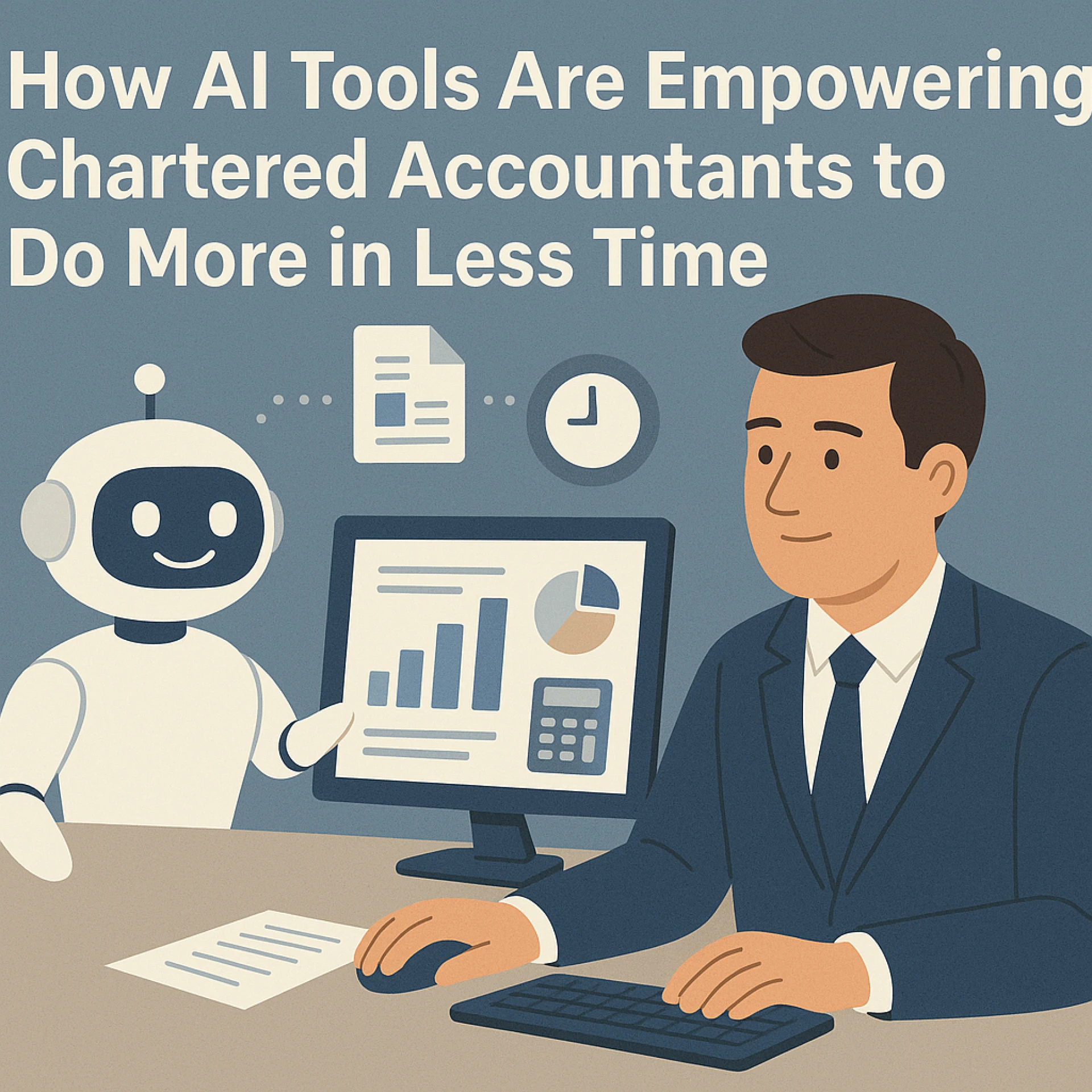

The role of a chartered accountant has evolved far beyond number crunching and ledger maintenance. In today’s dynamic business world, accountants are expected to analyze data, offer financial insights, ensure compliance, and guide strategic decision-making—all at once. But with mounting workloads, complex regulations, and client demands for faster results, even the most skilled professionals can feel stretched thin.
That’s why the rise of AI tools for chartered accountants is so transformative. By automating repetitive tasks and enhancing data analysis, artificial intelligence allows accountants to focus on what truly matters, insight, strategy, and value creation. The result? Greater productivity, higher accuracy, and a smarter, more efficient way of working.
1. The Changing Expectations in the Accounting Profession
Modern clients expect real-time updates, instant reports, and data-backed recommendations. Traditional methods, however, often involve tedious manual entry, time-consuming reconciliations, and delayed insights.
AI is changing that. It brings automation, speed, and precision into everyday accounting processes, enabling professionals to deliver outcomes faster and with greater confidence. Whether you’re managing audit reports, tax filings, or advisory services, AI technology ensures no time is wasted on tasks that machines can handle better.
2. Automating the Mundane to Focus on the Meaningful
Every accountant knows the time drain caused by repetitive, low-value tasks, data entry, transaction categorization, and invoice matching. AI automation streamlines these processes by learning from past actions and performing them automatically with minimal oversight.
Imagine a system that categorizes thousands of transactions accurately in seconds or flags mismatched entries before they become problems. That’s the power of AI at work. By automating such routine duties, chartered accountants can redirect their time to strategic activities like client consultations, financial analysis, and business forecasting.
3. Real-Time Data, Real-Time Insights
Speed is a major advantage in finance. Waiting for end-of-month closings or quarterly reconciliations is no longer feasible in today’s fast-paced environment. AI-powered platforms provide real-time financial visibility, updating reports and dashboards as transactions occur.
This continuous flow of data means chartered accountants can spot irregularities early, identify opportunities promptly, and advise clients immediately. Whether it’s detecting unusual spending patterns or predicting potential cash flow gaps, AI enables accountants to act instead of react.
4. Enhancing Accuracy and Reducing Human Error
Even experienced professionals can make mistakes when handling vast amounts of data manually. Typos, missed entries, or duplication can cause discrepancies that ripple across financial statements. AI drastically reduces these errors by following strict logic and identifying anomalies instantly.
When every transaction is verified and validated in real time, accountants can trust that their reports are accurate and audit-ready. This reliability builds stronger relationships with clients and enhances the overall credibility of accounting firms.
5. Smarter Decision-Making Through Predictive Insights
AI isn’t limited to automation, it’s also an analytical powerhouse. Using machine learning, it can analyze historical financial data, detect trends, and even forecast future outcomes.
For example, by studying past revenue patterns, AI can predict seasonal fluctuations or anticipate potential financial risks. Chartered accountants can use this information to advise clients proactively, helping them make informed business decisions before challenges arise. This predictive approach elevates accountants from financial reporters to strategic advisors.
6. Improved Compliance and Audit Readiness
Regulatory compliance is a constant concern for accountants. Tracking every document, tax rule, and submission deadline can feel like an endless race. AI simplifies this process by automating recordkeeping, tagging transactions, and maintaining digital audit trails.
When audit season arrives, accountants no longer have to sift through piles of spreadsheets and paper receipts. Instead, they can generate comprehensive, error-free reports instantly. This not only saves time but also ensures full transparency during audits and regulatory reviews.
7. Collaboration and Workflow Efficiency
Modern AI accounting platforms often include built-in collaboration features that make teamwork smoother. Multiple accountants can access the same real-time data, comment on reports, and share updates instantly.
This eliminates communication gaps that often arise when teams rely on static spreadsheets or email exchanges. The result is a more synchronized workflow where everyone, from junior associates to partners, works with up-to-date, reliable information.
8. Cost Efficiency Through Intelligent Resource Management
Efficiency isn’t just about saving time; it’s also about reducing operational costs. By automating routine work, accounting firms can manage larger client portfolios without increasing their team size.
This scalability translates directly into cost savings and higher profitability. Additionally, fewer manual errors mean fewer hours spent on corrections, freeing up resources for business development and client engagement.
9. Enhancing Client Relationships
Clients today expect more than accurate books, they want insights and solutions. When AI tools handle the operational workload, accountants have more bandwidth to focus on strategic discussions and personalized advice.
With real-time data and predictive analytics at their fingertips, accountants can offer clients detailed insights into performance, cash flow, and risk management. This level of service builds stronger, long-term relationships based on trust and value.
10. Upskilling for the Future
AI is not here to replace chartered accountants, it’s here to empower them. However, the profession is evolving, and accountants who embrace technology early will have a distinct competitive edge.
Learning to leverage AI effectively can transform an accountant’s career. It opens doors to data analysis, digital advisory services, and strategic consulting, fields that are rapidly becoming the future of accounting. Upskilling in AI literacy, automation tools, and analytics will soon be as essential as mastering tax laws or auditing standards.
11. Overcoming the Resistance to Change
Despite its benefits, some firms hesitate to adopt AI, fearing complexity or high costs. But modern AI solutions are increasingly user-friendly and affordable, even for small practices.
The key is to start small. Automate one process, say expense management or bank reconciliation, and assess the results. Once your team experiences the time savings and accuracy improvements firsthand, expanding AI adoption becomes a natural next step.
12. Case in Point: The Power of AI Efficiency
Consider a small accounting firm handling 30 clients. Before adopting AI, preparing monthly reports took two days of manual work. After integrating AI automation, the same task now takes only a few hours, with greater accuracy.
The saved time allows the firm to onboard more clients without increasing workload or hiring extra staff. It’s a clear example of how AI drives tangible results in both productivity and profitability.
13. The Balance Between Technology and Human Expertise
No matter how advanced AI becomes, it can’t replicate human judgment or ethical reasoning. The greatest value emerges when technology and human expertise work hand in hand.
AI can crunch data and generate insights, but it’s the accountant who interprets those insights, contextualizes them, and translates them into strategic decisions. This partnership creates a new kind of professional, one who’s both tech-savvy and deeply analytical.
14. Preparing for an AI-Driven Future
The integration of artificial intelligence into accounting is not a passing trend, it’s a fundamental shift. As AI becomes more accessible and affordable, firms that embrace it early will lead the industry. Those that resist may struggle to compete with faster, more efficient peers.
For chartered accountants, adopting AI isn’t just about staying relevant, it’s about unlocking their full potential. The future belongs to professionals who can combine human expertise with machine intelligence to deliver deeper insights and faster results.
Conclusion
In a world where speed, precision, and strategy define success, AI tools for chartered accountants are transforming how professionals work. From automating everyday tasks to delivering predictive insights, these tools free up valuable time and allow accountants to focus on higher-impact work that drives growth.
Platforms like AI Accountant make this transformation simple and accessible. With intelligent automation, real-time reporting, and robust analytics, they empower chartered accountants to do more in less time, without compromising accuracy or compliance. As accounting continues to evolve, those who harness AI today will define the standards of excellence tomorrow.





























Sign in to leave a comment.