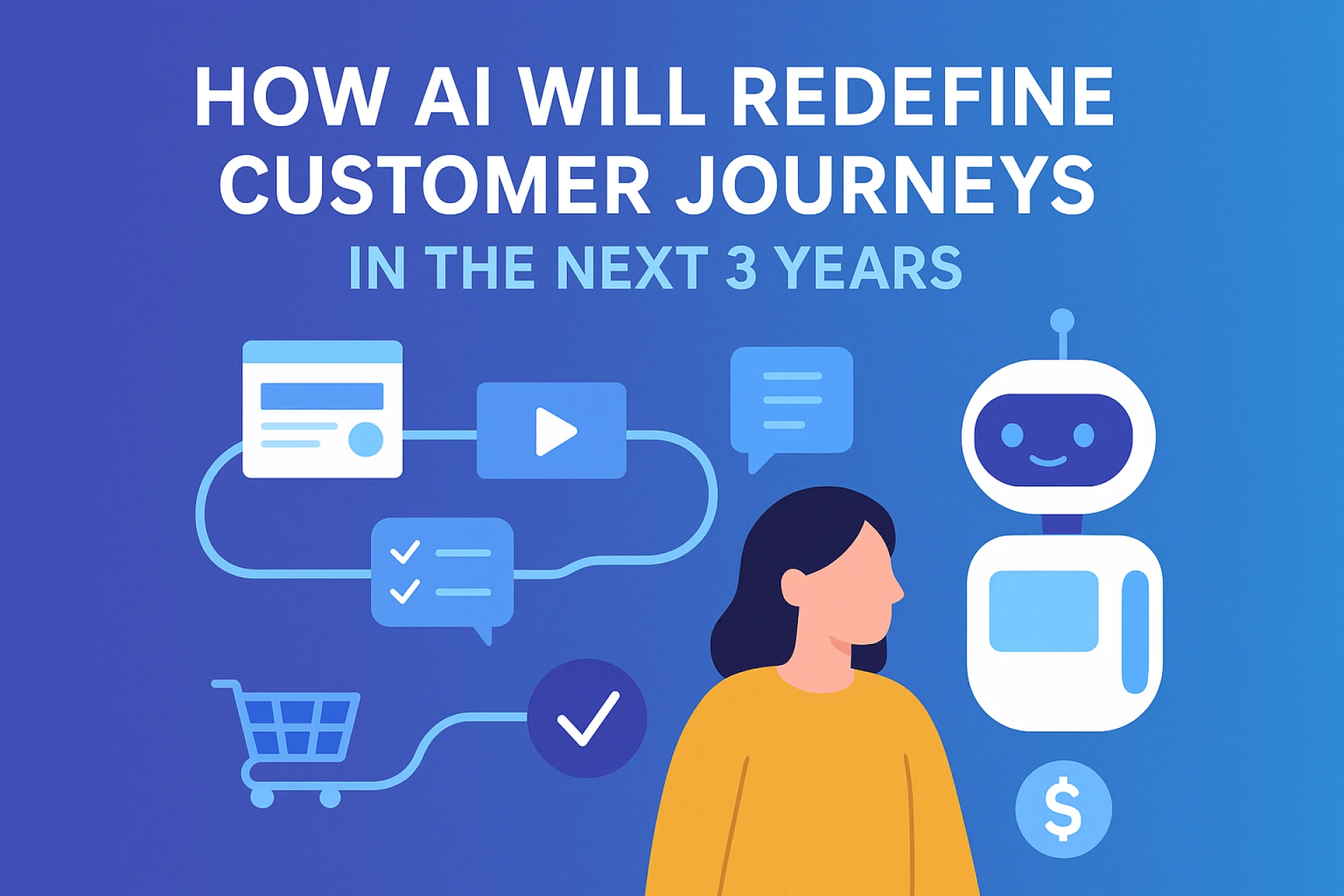

Artificial intelligence is becoming the invisible force shaping every touchpoint. The next three years will redefine how people discover, evaluate, and interact with brands. What used to be linear funnels will evolve into intelligent, adaptive, and deeply personalized experiences.
AI isn’t just improving customer journeys; it’s rewriting them.
1. From Generic Funnels to Hyper-Personalized Journeys
Traditional customer funnels treat every user the same.
AI flips this completely.
In the next 3 years, journeys will become:
- Dynamic
- Personalized
- Real-time
- Behavior-driven
AI will analyze browsing patterns, purchase history, interests, and micro-signals to craft unique paths for each user.
Example:
Two people visiting the same website will see different content, different CTAs, and even different product recommendations, all generated on the fly.
2. Predictive Experiences Will Outperform Reactive Marketing
Today, brands react to customers.
Tomorrow, they will predict them.
AI-powered systems will forecast:
- What a customer will need next
- When they’re likely to buy
- What might cause them to churn
- When they need support
- What content will convert them
This transforms marketing from “responding to behavior” to “shaping behavior.”
It’s like having a marketing engine that knows the customer's next move, before the customer does.
3. AI Assistants Will Become the New Storefront
AI chatbots will evolve from simple Q&A to full-fledged shopping assistants.
In the next 3 years, assistants will:
- Suggest products
- Compare features
- Provide personalized offers
- Handle returns and service
- Create custom bundles
- Act as 24/7 brand representatives
They won’t just answer questions, they’ll guide customers through the entire journey.
Every brand will have its own AI concierge.
4. Emotional Intelligence Will Be Built Into AI
The next evolution of customer experience is emotional understanding.
AI will soon detect:
- Sentiment
- Frustration
- Confusion
- Excitement
- Intent
Based on tone, interaction patterns, and contextual clues.
This means:
- Angry customer? AI routes them to priority support.
- Confused shopper? AI simplifies the options.
- Research-mode visitor? AI offers educational content.
Brands will create experiences that feel more human than ever.
5. Content Will Adapt Automatically to Each User
Static content is dying.
AI will generate:
- Personalized landing pages
- Adaptive product descriptions
- On-the-fly emails
- Customized offers
- Dynamic website layouts
Imagine a customer journey where the experience rebuilds itself in real time based on who’s visiting.
That’s where we’re headed.
6. AI Will Make Post-Purchase Moments More Important Than Ever
The journey doesn’t end at checkout, it evolves.
AI will help brands:
- Predict reorder timings
- Personalize loyalty rewards
- Suggest complementary products
- Proactively solve issues
- Strengthen retention
Loyalty will be driven by smart, timely, predictive experiences rather than generic loyalty programs.
7. Voice & Visual Search Will Reshape Discovery
Soon, customers won’t type.
They’ll ask and show.
AI will make discovery more intuitive:
- “Show me shoes that match this outfit.”
- “Find a phone under ₹30,000 with a great camera.”
- “Find travel packages for a weekend trip.”
Brands must optimize for visual and voice-first journeys or risk becoming invisible.
8. Privacy-First AI Will Build Trust
With new regulations rising worldwide, AI will shift toward:
- Zero-party data
- Consent-driven personalization
- On-device processing
- Transparent data practices
The brands that embrace privacy-first AI will gain customer trust and an unfair advantage.
The Next 3 Years Will Redefine Everything
The AI-enabled customer journey will be:
- More intuitive
- More predictive
- More personal
- More connected
- More efficient
Brands that adopt AI early will create frictionless experiences customers can’t resist. Brands that wait will struggle to catch up.
In the future, customer journeys won’t be designed, they’ll be intelligently generated in real time.
























Sign in to leave a comment.