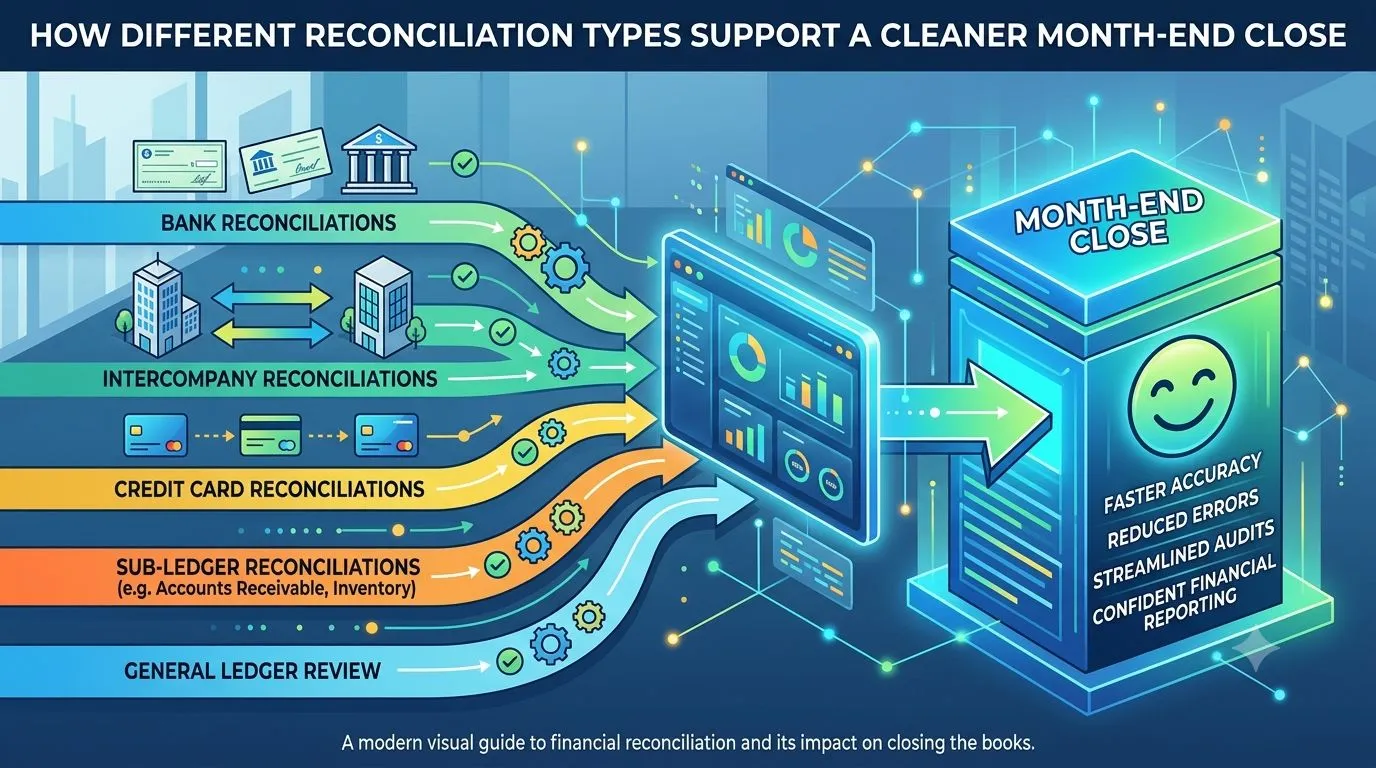

Month-end close becomes difficult when finance teams are still searching for missing transactions, resolving balance differences, and validating account activity at the last minute. As transaction volumes grow across payables, receivables, payroll, expenses, and cash management, even small discrepancies can delay reporting and create uncertainty around financial results.
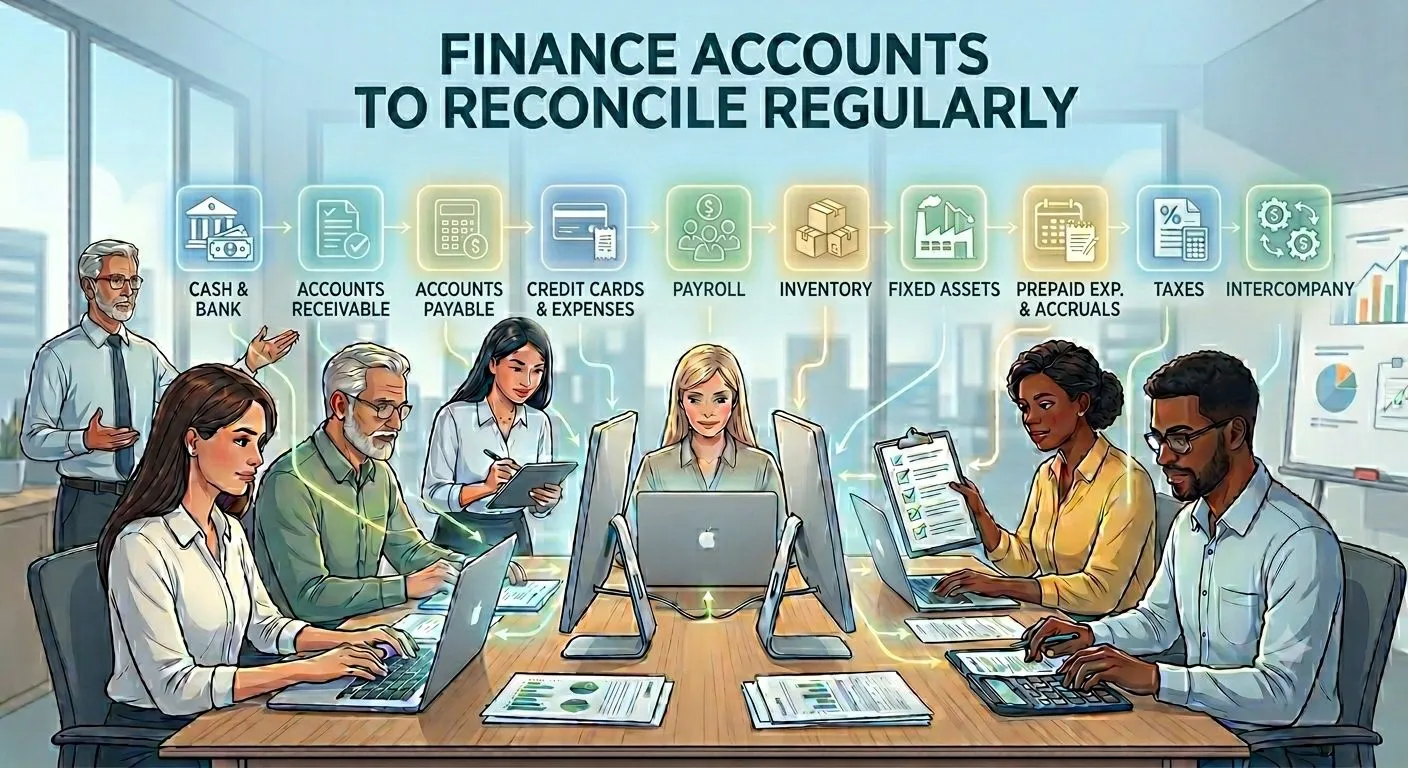
The challenge is that no single reconciliation process can validate every financial account. Different transaction types require different reconciliation approaches. A cleaner month-end close depends on how effectively finance teams reconcile cash, payables, payroll, expenses, inventory, and intercompany activity throughout the reporting period. In this guide, we will examine how different reconciliation types support close accuracy, reduce reporting delays, and improve confidence in financial statements.
Why Month-End Close Depends on Reconciliation Accuracy
A successful close process starts with accurate account balances.
Growth in financial transactions across finance systems before close
Organizations process thousands of transactions across ERP systems, payroll platforms, banking portals, expense systems, and procurement applications every month.
Why unresolved discrepancies create reporting delays
When discrepancies remain unresolved, finance teams spend additional time investigating balances before financial statements can be finalized.
Impact of reconciliation quality on close accuracy and confidence
Well-reconciled accounts reduce uncertainty and help management rely on reported numbers.
What Reconciliation Means in the Month-End Close Process
Reconciliation validates whether financial records accurately reflect business activity.
Definition of reconciliation in finance operations
Reconciliation compares accounting records against supporting documents, transaction sources, and external records.
Relationship between transaction validation and financial reporting
Financial reports are only as reliable as the transactions supporting them.
Why reconciliation helps confirm account accuracy before close
It identifies errors, omissions, duplicates, and timing differences before reporting deadlines arrive.
Why Different Reconciliation Types Exist Across Finance Functions
Different accounts require different validation methods.
Different transaction sources require different validation methods
Bank transactions, supplier invoices, payroll records, and expense claims each have unique supporting records.
Relationship between operational records and accounting balances
Accounting balances must match the operational activity that generated them.
Why no single reconciliation process covers every account
Each account category presents different risks, transaction volumes, and reporting requirements.
How Reconciliation Supports a Cleaner Month-End Close
Reconciliation acts as a quality check before reporting begins.
Identification of discrepancies before reporting deadlines
Issues are detected earlier when reconciliations occur continuously throughout the month.
Validation of balances before financial statements are prepared
Validated balances reduce the need for late-stage corrections.
Reduction of manual corrections during close
Fewer unresolved issues mean less rework during reporting.
Better visibility into unresolved accounting issues
Teams can focus on exceptions instead of reviewing every transaction manually.
Bank Reconciliation and Its Role in Month-End Close
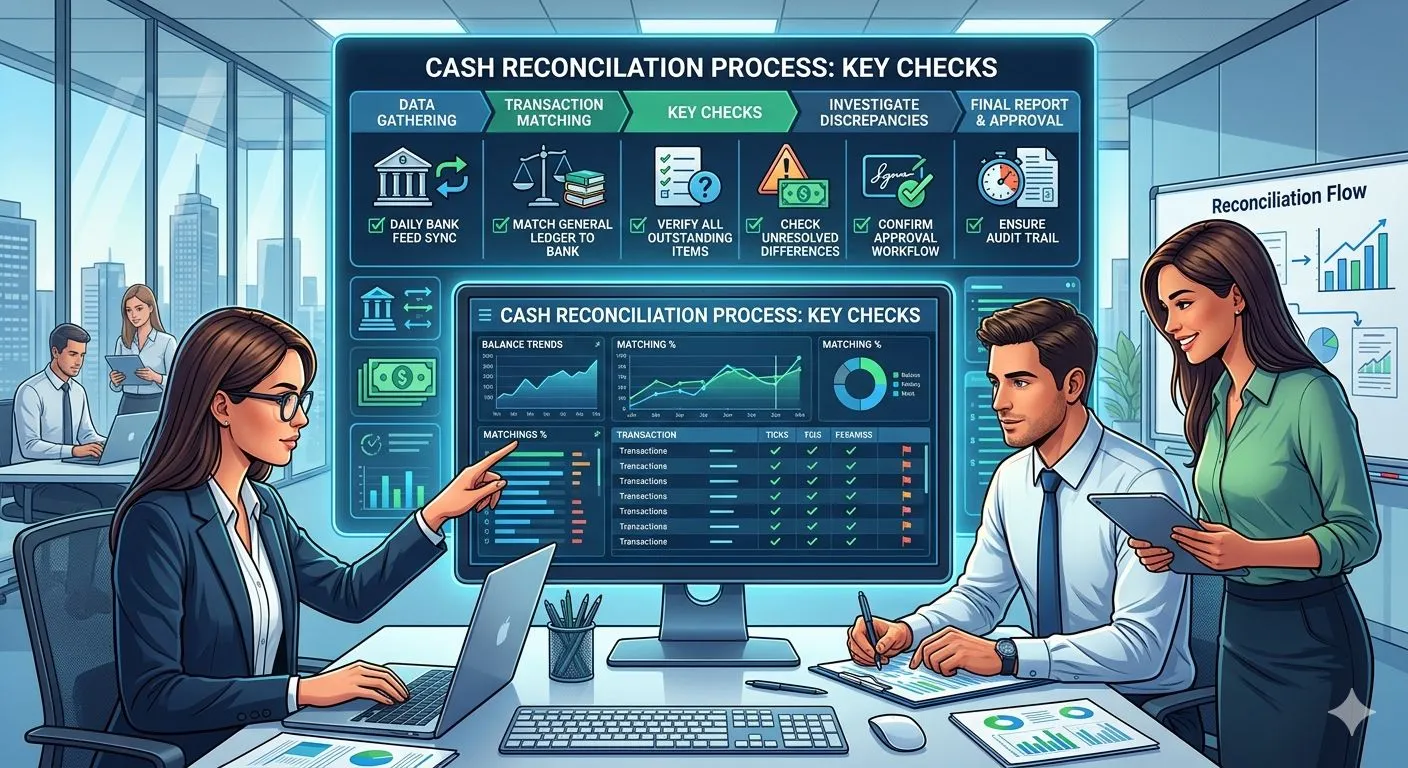
Bank reconciliation validates whether recorded cash activity matches bank records.
Validation of bank balances against general ledger records
Bank balances should align with ledger balances after timing differences are accounted for.
Review of deposits in transit and outstanding payments
Deposits and payments that have not yet settled explain temporary differences.
Common bank-reconciliation issues affecting close timelines
Missing transactions, delayed settlements, and duplicate entries often require investigation.
Why cash accuracy starts with bank reconciliation
Cash reporting depends on understanding actual bank activity.
Cash Reconciliation and Liquidity Validation
Strong liquidity reporting depends on accurate cash records.
Validation of cash balances across finance and treasury records
Cash Reconciliation compares cash balances across banking, treasury, and accounting systems.
Treatment of settlement timing differences
Finance teams must identify transactions recorded in one system but not yet reflected in another.
Common cash discrepancies identified before close
Common issues include bank fees, settlement delays, duplicate payments, and missing deposits.
Impact on liquidity and working-capital reporting
Accurate cash balances improve visibility into available funds and working capital.
Accounts Receivable Reconciliation and Revenue Accuracy
Receivable reconciliation validates customer balances and collection activity.
Validation of customer invoices and collections
Finance teams compare invoices, payments, credits, and outstanding balances.
Review of unapplied cash and disputed balances
Unresolved items can distort receivable reporting.
Common receivable discrepancies affecting reporting
Incorrect allocations, missing payments, and duplicate postings frequently occur.
Relationship between AR reconciliation and revenue accuracy
Accurate receivable balances support reliable revenue reporting.
Accounts Payable Reconciliation and Liability Accuracy
Payable reconciliation validates obligations owed to suppliers.
Validation of supplier invoices and payment activity
Vendor Reconciliation helps finance teams compare supplier statements, invoices, credits, and payment records.
Review of outstanding obligations and vendor balances
Open liabilities should match supplier records and accounting balances.
Common payable discrepancies affecting close
Duplicate invoices, missing credits, and payment mismatches can affect liability reporting.
Relationship between AP reconciliation and liability reporting
Validated supplier balances support accurate liability recognition.
Payroll Reconciliation and Expense Validation
Payroll accounts represent significant financial commitments.
Validation of payroll records against accounting balances
Payroll Reconciliation compares payroll registers, tax records, deductions, and accounting entries.
Review of deductions, taxes, and employee payments
Every payroll component should reconcile with supporting records.
Common payroll discrepancies affecting period-end reporting
Incorrect deductions, duplicate payments, and timing differences are common issues.
Why payroll reconciliation supports expense accuracy
Accurate payroll balances contribute to reliable expense reporting.
Inventory Reconciliation and Asset Accuracy
Inventory often represents one of the largest balance sheet assets.
Validation of inventory balances against operational records
Inventory records should align with warehouse activity and physical counts.
Review of write-offs, transfers, and valuation adjustments
These activities directly affect reported inventory value.
Common inventory discrepancies affecting profitability reporting
Missing stock movements and valuation differences can distort results.
Relationship between inventory reconciliation and balance-sheet accuracy
Reliable inventory balances improve asset reporting quality.
Credit Card and Expense Reconciliation Before Close
Expense activity affects profitability and budget reporting.
Validation of card transactions against expense records
Finance teams compare card activity with receipts, expense reports, and accounting entries.
Review of receipts, approvals, and reimbursements
Missing documentation creates reporting risk.
Common spend-related discrepancies affecting reporting
Duplicate claims, missing receipts, and coding errors frequently occur.
Why expense reconciliation improves spend visibility
Expense Reconciliation helps finance teams understand actual spending activity before close.
Intercompany Reconciliation Across Multi-Entity Organizations
Intercompany balances require additional attention.
Validation of intercompany balances between entities
Balances recorded by one entity should match balances recorded by the other.
Settlement tracking and elimination requirements
Settlement activity must be tracked before consolidation.
Common intercompany mismatches affecting consolidated reporting
Timing differences and inconsistent accounting treatment often create issues.
Why intercompany reconciliation often delays close
Unresolved intercompany balances can hold up consolidated reporting.
Why Timing Differences Create Month-End Reconciliation Pressure
Timing differences are one of the most common reconciliation challenges.
Delayed settlements and transaction feeds
External systems may update after accounting records.
Cross-period posting inconsistencies
Transactions may be recorded in different reporting periods.
Outstanding transactions remaining unresolved before close
Open items require investigation before financial statements are finalized.
Impact of aging reconciliation items on reporting readiness
Older exceptions become more difficult to resolve.
Common Reconciliation Issues That Delay Month-End Close
Several recurring issues create close delays.
Duplicate transactions and duplicate postings
Duplicates can overstate balances.
Missing transactions and incomplete records
Missing activity creates unsupported balances.
Incorrect account mappings and coding errors
Coding issues affect classification and reporting.
Unsupported adjustments and write-offs
Manual corrections require validation.
Unresolved exceptions carried into future periods
Open issues increase reporting risk.
Reconciliation Controls That Improve Close Accuracy
Controls help finance teams maintain consistency.
Segregation of duties across finance workflows
Separate responsibilities reduce error risk.
Validation checkpoints before ledger posting
Checks help identify issues before balances are finalized.
Approval governance for adjustments and write-offs
Approvals support accountability.
Documentation standards supporting audit readiness
Strong documentation supports reporting confidence.
How Automation Supports Multiple Reconciliation Types
Automation helps finance teams manage larger transaction volumes.
Automated matching across finance systems
Matching engines compare transactions from multiple sources automatically.
Real-time visibility into unresolved balances
Teams can review issues as they occur.
Continuous validation before close deadlines
Problems are identified earlier in the reporting cycle.
Reduced repetitive manual review effort
Finance professionals can focus on exception analysis instead of repetitive transaction matching.
Future Direction of Reconciliation and Month-End Close
Month-end close processes are becoming more proactive and data-driven.
AI-assisted identification of unusual transaction activity
AI can highlight exceptions requiring attention.
Predictive detection of close-related risks
Potential reporting issues can be identified earlier.
Continuous reconciliation across enterprise finance systems
Organizations are moving away from period-end dependency.
Real-time close readiness supported by intelligent matching logic
Continuous validation creates cleaner closes, stronger reporting confidence, and more reliable financial statements.



























Sign in to leave a comment.