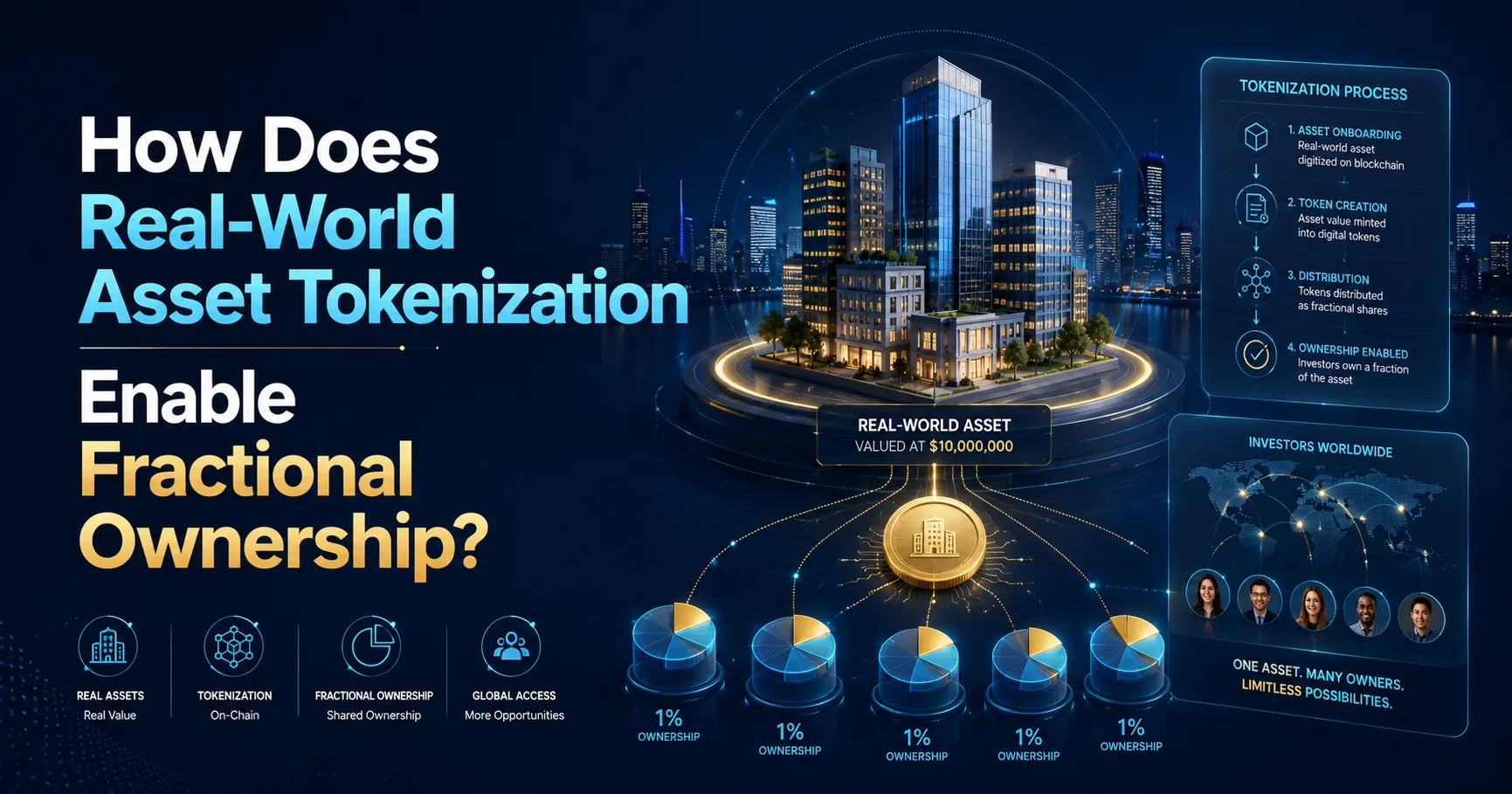

Real-world asset tokenization is changing the way investors think about ownership, access, and liquidity. Traditionally, investing in high-value assets such as commercial buildings, luxury properties, private credit, infrastructure, artwork, or commodities often required substantial capital and involved multiple intermediaries. Fractional ownership existed before blockchain, but it could be difficult to structure, administer, transfer, and scale efficiently.
Tokenization introduces a digital layer to this model by representing ownership interests or economic rights in an asset through blockchain-based tokens. Instead of requiring one investor to purchase an entire property or asset, an issuer can structure an asset into smaller units that can potentially be distributed among many eligible investors. Deloitte describes tokenized real estate as converting physical or financial assets into smaller digital representations that can be owned or traded fractionally through digital platforms.
The important point is that tokenization does not magically divide a physical building into pieces. Rather, the legal and economic ownership structure is designed first, often through an entity such as a special-purpose vehicle or fund, and blockchain tokens are then used to represent defined interests in that structure. Understanding this distinction is essential to understanding how fractional ownership actually works.
What Is Fractional Ownership in Real-World Assets?
Fractional ownership means that an asset or investment vehicle is divided among multiple owners or investors. Each participant owns a proportionate interest rather than purchasing the entire asset.
Consider a commercial property valued at $10 million. Under a traditional ownership model, an investor seeking direct ownership might need to contribute a significant amount of capital. Under a fractional structure, the property could instead be held by a legal entity that issues interests representing portions of the underlying investment. If 1 million tokens represented the economic interests in the structure, an investor purchasing 10,000 tokens could potentially represent a 1% interest, depending on the legal structure and token terms.
This can make high-value assets accessible to a broader range of investors. More importantly, blockchain can provide infrastructure for recording ownership, automating transfers, managing distributions, and maintaining an auditable transaction history.
However, the token itself does not automatically establish legal ownership of the underlying property. The rights attached to a token depend on the legal structure, jurisdiction, offering documents, custody arrangements, and applicable securities and property laws. The U.S. Securities and Exchange Commission has emphasized that tokenized securities remain securities when they meet the relevant legal definition, regardless of whether their ownership records are maintained on blockchain infrastructure.
How RWA Tokenization Creates Fractional Ownership
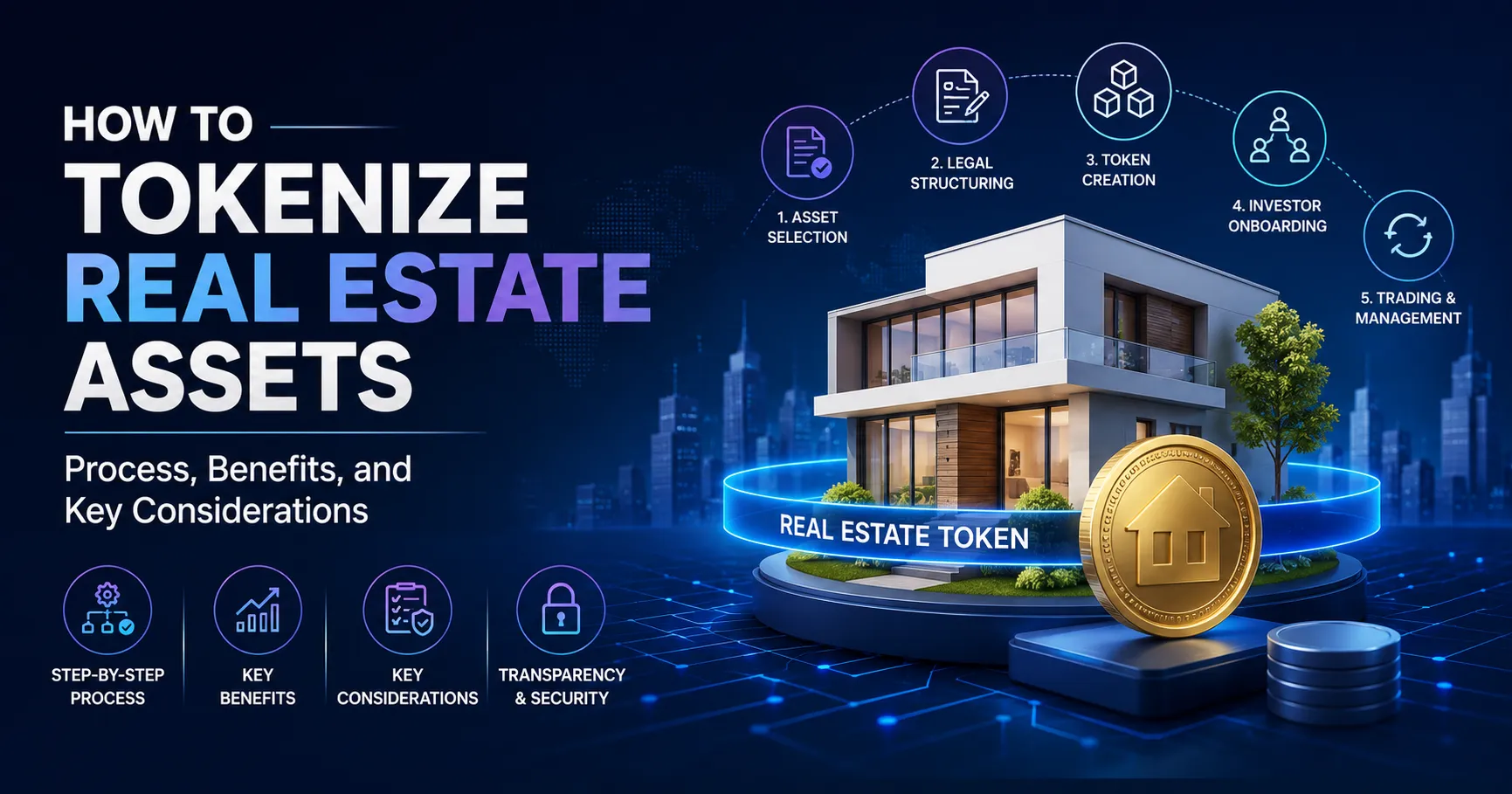
The process generally begins by identifying the real-world asset and determining what type of ownership or economic interest will be tokenized. For real estate, this could involve an income-producing property, a development project, a real estate fund, a mortgage-related asset, or another property-linked investment.
The asset is then placed within an appropriate legal structure. For example, an SPV may acquire or hold the property, while investors receive interests in the SPV. Tokens can subsequently represent those interests or specified rights associated with them.
Smart contracts can manage important aspects of the token lifecycle. They can define the number of tokens issued, enforce transfer restrictions, record transactions, and automate certain distributions when the underlying legal and operational systems support such automation.
This creates a connection between the traditional asset and blockchain infrastructure:
Real-world asset - Legal structure - Token issuance - Investor ownership - Digital transfer and management
The blockchain becomes the technological infrastructure for recording and administering the digital representation, while the legal framework establishes what investors actually own and what rights they possess.
Lowering the Capital Barrier to Asset Ownership
One of the strongest arguments for fractional tokenization is the possibility of lowering the minimum investment required to gain exposure to expensive assets.
Real estate provides a clear example. A $5 million office building may be financially inaccessible to many individual investors when purchased directly. If the investment is legally structured into smaller interests, investors may be able to participate with significantly less capital.
This does not necessarily mean that every tokenized asset will have a low minimum investment. Issuers can establish different minimums depending on regulatory requirements, investor eligibility, platform policies, and the economics of the offering. Nevertheless, tokenization creates infrastructure that can support much finer ownership divisions than traditional direct ownership models.
Deloitte expects tokenized real estate to expand significantly over the coming decade. Its 2025 analysis estimates that the value of tokenized real estate could reach approximately $4 trillion by 2035, compared with less than $0.3 trillion in 2024. The forecast includes tokenized private real estate funds, loans and securitizations, and undeveloped or under-construction property.
These figures are projections rather than guaranteed outcomes, but they demonstrate the scale of institutional interest in using tokenization to restructure access to real estate and other assets.
Blockchain Makes Fractional Ownership Easier to Manage
Fractional ownership is not new. Real estate investment trusts, partnerships, private funds, syndications, and other structures have allowed investors to participate in assets without owning them individually for decades.
The difference is the infrastructure used to manage ownership.
Traditional fractional structures can involve registrars, brokers, administrators, custodians, lawyers, banks, and other intermediaries. Changes in ownership may require multiple records to be updated across different systems. Distributions may also involve manual reconciliation and administrative processing.
Blockchain can provide a shared digital record of token ownership. Depending on the implementation, transactions can be recorded transparently and processed through smart contracts. This may reduce reconciliation requirements and improve operational efficiency.
The SEC's January 2026 statement on tokenized securities explains that an issuer-sponsored tokenization model can integrate distributed ledger technology into ownership records so that transferring the token corresponds with transferring the relevant security record.
This distinction is important: blockchain is not valuable simply because it is blockchain. Its value comes from using distributed infrastructure to improve specific processes such as ownership records, settlement, compliance controls, and asset servicing.
Enabling More Flexible Investor Participation
Fractionalization can also change how investors construct portfolios.
Instead of allocating a large percentage of capital to one property, an investor could potentially spread capital across several tokenized opportunities. For example, an investor with $50,000 might divide capital among interests in a residential development, commercial property, logistics facility, and real estate debt opportunity rather than concentrating the entire amount in one asset.
This can potentially improve diversification, although tokenization does not eliminate investment risk.
The same concept applies beyond real estate. Tokenization can be used for private credit, bonds, funds, commodities, infrastructure projects, and other assets. McKinsey has estimated that the overall tokenized asset market could approach $2 trillion by 2030 in its base-case scenario, demonstrating why financial institutions increasingly view tokenization as more than a niche blockchain application.
Fractional Ownership Can Support Secondary Liquidity
Another potential advantage is improved transferability.
Traditional private investments can be difficult to sell before maturity. Finding another buyer, completing due diligence, updating legal documents, and settling the transaction can take significant time.
Tokenization can create digital representations that are technically easier to transfer. In a compliant marketplace, eligible investors could potentially buy and sell tokens representing fractional interests without repeating the entire process used in traditional private transactions.
However, tokenization should not be confused with guaranteed liquidity. A token can be technically transferable while having few actual buyers. Regulatory restrictions, investor eligibility requirements, lock-up periods, market depth, asset quality, and platform participation can all affect liquidity.
Therefore, the real benefit comes from combining tokenization with appropriate secondary-market infrastructure, compliance systems, investor networks, and reliable information about the underlying asset.
Real-World Example: Tokenized Real Estate Development
A useful example is the tokenization of large development projects. Deloitte notes that T-RIZE Group signed a $300 million deal in 2024 to tokenize Project Champfleury, a 960-unit residential development in Canada.
The example illustrates an important evolution in tokenization. The technology is not limited to existing rental properties that already generate income. Tokenization can potentially be applied to development projects, allowing investors to participate in capital-intensive projects through structured digital interests.
For a development project, tokens could potentially represent equity or debt interests, depending on the legal arrangement. Investors may then receive economic benefits according to the terms of the investment, such as distributions, interest, or participation in project returns.
The structure remains critical. Investors need to understand whether they own property directly, own shares in an SPV, hold debt, or possess another form of financial interest. The token's label alone does not determine these rights.
Smart Contracts and Automated Ownership Management
Smart contracts are another major component of fractional RWA tokenization.
A smart contract can establish rules for token issuance and transfer. For example, a tokenized real estate platform could configure its contracts so that tokens can only move between verified wallets. It could also integrate compliance mechanisms that restrict transfers according to investor eligibility or jurisdictional requirements.
Smart contracts can potentially automate other processes, including distribution calculations, voting mechanisms, transfer records, and certain corporate actions.
This creates a programmable ownership environment. Instead of relying entirely on manual administrative processes, certain rules can be embedded directly into the digital infrastructure.
Nevertheless, automation should be implemented carefully. A smart contract cannot determine whether a property title is legally valid or whether an underlying asset actually exists unless trustworthy external systems provide that information. Tokenization therefore requires both blockchain infrastructure and reliable off-chain verification.
Compliance Remains Central to Fractional Tokenization
The biggest misconception surrounding RWA tokenization is that putting an asset on blockchain removes traditional regulatory requirements.
It does not.
If a token represents a security, securities regulations may apply. The SEC states that tokenized securities can have different structures and that the rights associated with a token may differ from those associated with the underlying security.
A compliant tokenization project therefore needs to consider investor eligibility, KYC and AML procedures, disclosures, custody, transfer restrictions, taxation, securities regulations, property law, and jurisdiction-specific requirements.
For real estate specifically, the legal relationship between the token holder, the property-owning entity, and the underlying property must be clearly defined. Investors should know precisely what they are purchasing and what rights accompany the token.
This is why successful fractional tokenization is fundamentally a combination of legal structuring, financial engineering, blockchain technology, compliance, and investor management rather than simply creating a digital token.
Benefits for Asset Owners and Businesses
Fractional tokenization can benefit asset owners as well as investors.
Property owners may gain access to a broader pool of potential capital. Developers could potentially use tokenized structures to finance projects. Asset managers can create digitally managed investment products, while financial institutions can explore new ways to distribute traditionally illiquid assets.
Tokenization may also improve operational efficiency by creating a common digital infrastructure for ownership records and asset servicing. Deloitte highlights the potential for tokenized real estate to address inefficiencies, administrative costs, and limited retail participation.
For businesses, the opportunity is therefore not simply to sell smaller portions of an asset. It is to redesign how assets are issued, distributed, administered, transferred, and potentially integrated with digital financial infrastructure.
Challenges That Should Not Be Ignored
Despite its potential, fractional RWA tokenization has significant challenges.
The first is legal enforceability. The token must correspond to clearly defined rights under applicable law. The second is asset verification. Investors need confidence that the underlying property or asset exists, is properly valued, and is controlled by the entity represented in the offering.
The third challenge is liquidity. A tokenized asset does not automatically create an active market. Fourth is technology risk, including smart contract vulnerabilities, wallet security, oracle failures, and platform infrastructure problems.
There is also a regulatory challenge. Different countries treat tokenized assets differently, and requirements can change as regulators develop new frameworks.
Consequently, tokenization should be approached as an integrated financial infrastructure project rather than a simple cryptocurrency initiative.
The Future of Fractional RWA Ownership
The long-term potential of tokenization lies in connecting traditionally illiquid assets with digital financial infrastructure.
As blockchain networks, compliance systems, custody solutions, identity technologies, and secondary marketplaces mature, fractional ownership could become increasingly practical for a wider range of assets.
Real estate is particularly well suited to this model because property values are high, ownership structures can be complex, and many assets generate predictable economic activity such as rental income or development proceeds.
Yet the most successful platforms will likely be those that treat blockchain as one component of a broader ecosystem. Legal ownership, investor protection, asset servicing, compliance, valuation, custody, and liquidity must work together.
The future of fractional ownership is therefore not simply about dividing a property into thousands of digital tokens. It is about creating trustworthy infrastructure through which those digital interests have clear legal meaning, reliable economic value, and practical mechanisms for ownership and transfer.
Conclusion
Real-world asset tokenization enables fractional ownership by combining legally structured asset interests with blockchain-based digital tokens, allowing expensive assets to be divided into smaller investment units and potentially managed more efficiently. It can lower investment barriers, broaden access to traditionally illiquid markets, streamline ownership administration, and create new possibilities for digital transfers and secondary-market participation. However, tokenization does not remove the need for legal compliance, asset verification, investor protection, or liquidity management. As the market develops, businesses need secure technology and carefully structured solutions to turn fractional ownership concepts into practical products. For organizations exploring this opportunity, Blockchain App Factory provides best service for building scalable blockchain and tokenization solutions tailored to real-world asset use cases.





























Sign in to leave a comment.