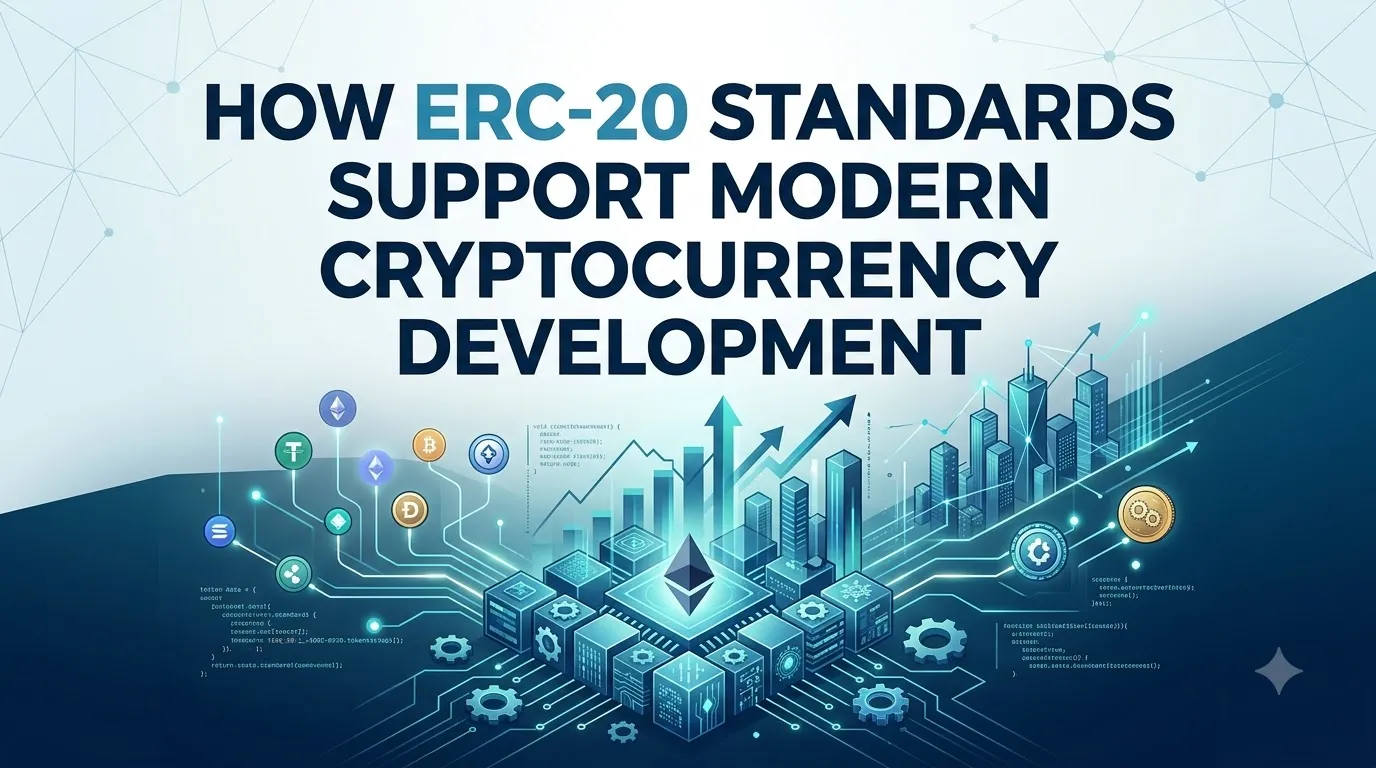

ERC-20 remains one of the most important standards in cryptocurrency development. Introduced through Ethereum Improvement Proposal 20 in 2015, the standard established a common interface for fungible tokens on Ethereum. Its significance comes less from the complexity of its code and more from the compatibility it creates between token contracts, wallets, exchanges, decentralized applications, and other smart contracts.
Modern cryptocurrency projects often require more than simply creating a digital asset. A token may need to interact with decentralized exchanges, lending protocols, staking systems, governance applications, payment platforms, wallets, and portfolio trackers. ERC-20 provides a predictable foundation for these interactions. This article examines how the standard supports cryptocurrency development, why its interface remains relevant, and where developers need additional functionality beyond the basic specification.
What Is the ERC-20 Standard?
ERC-20 is a technical standard that defines how fungible tokens should behave through a smart-contract interface. Fungible means that each unit of a particular token is interchangeable with another unit of the same token. One unit of an ERC-20 token does not have a unique identity in the way an NFT does. This makes the standard suitable for currencies, governance tokens, utility tokens, staking assets, and other divisible digital assets.
The original EIP-20 specification defines functions including totalSupply, balanceOf, transfer, approve, allowance, and transferFrom. It also defines the Transfer and Approval events that applications can monitor. The specification additionally identifies name, symbol, and decimals as optional metadata functions.
This standardized interface is important because applications do not need a completely different integration model for every token. A wallet can use the standard balance and transfer functions, while a decentralized exchange can interact with approved token allowances and transfer funds through the same general interface.
Interoperability Is ERC-20's Biggest Contribution
The strongest contribution of ERC-20 to cryptocurrency development is interoperability. Ethereum smart contracts can interact with other contracts, but without agreed interfaces, every token could require separate integration logic. ERC-20 reduces this problem by establishing common expectations.
Consider a decentralized exchange. The exchange contract needs to receive one token from a user and provide another token in return. With ERC-20 assets, the exchange can work with standard functions such as approve() and transferFrom() rather than requiring a unique transaction method for every token.
The same principle applies to wallets. A wallet does not need to understand the internal business logic of every token to display balances and support basic transfers. It can query the token contract using the expected interface.
This network effect has helped ERC-20 become deeply embedded in Ethereum's application ecosystem. The standard effectively separates token-specific economics from common technical behavior. For projects looking to Build Your Own Cryptocurrency, this provides a reliable foundation for defining supply models, distribution strategies, utility, and governance while maintaining compatibility with a widely recognized token interface.
Core Functions That Make ERC-20 Useful
ERC-20's functions provide the basic infrastructure needed for token ownership and movement.
totalSupply() reports the token supply, while balanceOf() allows applications to query the balance associated with an address. transfer() moves tokens from the caller's balance to another address. These functions support the most basic requirements of a digital asset system.
The allowance model is particularly important for DeFi. A token holder can use approve() to authorize another address or contract to spend a specified amount. The authorized contract can then use transferFrom() within the permitted allowance. allowance() allows applications to check the remaining authorization.
This model is fundamental to many token-based applications. For example, when a user interacts with a decentralized exchange, the exchange contract may need permission to move the tokens being swapped. Similarly, lending applications can use allowances when users deposit ERC-20 assets into lending pools.
However, allowance management also requires careful implementation and user-interface design. Developers should not treat approval as an insignificant transaction because excessive or poorly managed allowances can increase user exposure if an authorized contract is compromised.
ERC-20 and Token Economics
The ERC-20 specification defines how tokens can be represented and transferred, but it does not dictate a project's economic model. This distinction is important in cryptocurrency development.
A developer still needs to determine whether tokens are minted at deployment, created according to a controlled schedule, capped at a maximum supply, burned under specific conditions, or managed through governance. The standard itself does not prescribe these choices.
For example, a project could create a fixed supply and distribute it through predefined allocations. Another project could implement controlled minting for rewards or staking. A third could introduce burning mechanisms that permanently remove tokens from circulation.
Modern development frameworks provide extensions that help developers implement these different requirements. OpenZeppelin's ERC-20 implementations include extensions for features such as capped supply, burning, pausing, snapshots, and permit-based approvals.
This separation between interface and economics gives developers considerable flexibility. The ERC-20 standard defines the expected external behavior, while additional contract logic determines what the token actually does within its ecosystem.
ERC-20 in DeFi Applications
Decentralized finance is one of the clearest examples of why standardized tokens matter. DeFi applications frequently need to accept, transfer, lock, exchange, lend, borrow, or otherwise account for digital assets.
A lending protocol, for example, may accept an ERC-20 token as collateral. A decentralized exchange can use ERC-20 assets in liquidity pools. A staking contract can receive tokens and later return rewards. A governance application can use token balances to determine voting power.
Because these applications can rely on standardized interfaces, developers can build composable systems where one smart contract interacts with another. OpenZeppelin describes ERC-20 as the widespread standard for fungible assets, while noting that its simplicity also creates limitations for more specialized requirements.
This composability is a major reason ERC-20 remains relevant. Cryptocurrency development increasingly involves interconnected protocols rather than isolated token contracts.
Extensions Expand ERC-20's Capabilities
The basic ERC-20 interface is intentionally limited. Modern projects frequently require additional functionality that goes beyond simple transfers and approvals.
One significant development is ERC-20 Permit, associated with EIP-2612. It enables approval through signed messages rather than requiring a separate on-chain approval transaction in supported implementations. OpenZeppelin provides ERC-20 Permit functionality as one of its token extensions.
Other extensions address different requirements:
- Burnable: Allows tokens to be permanently destroyed under defined rules.
- Capped: Establishes a maximum supply for minting.
- Pausable: Allows authorized mechanisms to temporarily stop transfers.
- Snapshot: Records historical balances for applications such as governance or distribution.
- Permit: Supports signature-based approvals and can improve transaction flows.
These extensions demonstrate an important characteristic of modern cryptocurrency development: ERC-20 is often the foundation rather than the complete product.
Developers must select extensions according to the project's actual requirements instead of adding features simply because they are available.
Security Matters More Than Standard Compliance
Following ERC-20 does not automatically make a token secure. A contract can expose the expected functions while still containing serious vulnerabilities in its custom logic.
Security risks can arise from incorrect access control, flawed minting mechanisms, unsafe upgrade patterns, arithmetic mistakes, poorly designed approval systems, or interactions with external contracts. Supply controls are particularly important because unauthorized minting can undermine the token's economic model.
Established libraries can reduce implementation risks by providing reviewed contract components. OpenZeppelin, for example, provides reusable Solidity contracts covering ERC-20 tokens, access control, governance, and other common blockchain functions.
Nevertheless, reusable code is not a substitute for project-specific testing. A production token should undergo unit testing, integration testing, static analysis, security review, and appropriate smart-contract auditing. Developers should also test unusual conditions such as zero-value transfers, maximum supply boundaries, failed transfers, allowance changes, and unauthorized administrative actions.
ERC-20's Role in Modern Cryptocurrency Development
The continued importance of ERC-20 comes from its ability to provide a common technical language for fungible assets. Developers can create specialized token economies without abandoning compatibility with established blockchain infrastructure.
Its influence also extends beyond basic token transfers. ERC-20-based assets can become components of larger systems involving decentralized finance, governance, staking, payments, gaming, tokenized assets, and other applications. The development of related standards also shows how the ecosystem has evolved. For specialized use cases, developers can consider alternatives such as ERC-721, ERC-1155, or ERC-4626 rather than forcing every asset into an ERC-20 design.
The key lesson is that a token standard should be selected according to the asset's function. ERC-20 works particularly well when every unit of an asset is interchangeable and the application benefits from standardized balances, transfers, and allowances.
Conclusion
ERC-20 has remained a foundation of cryptocurrency development because it solved a practical problem: different applications needed a consistent way to understand and interact with fungible tokens. Its standardized functions and events allow wallets, exchanges, DeFi protocols, and smart contracts to work with tokens through common interfaces.
At the same time, ERC-20 should not be viewed as a complete token-development strategy. Supply design, access control, security architecture, governance, compliance requirements, and application-specific functionality still require careful planning. Extensions such as Permit, Burnable, Capped, and Pausable can provide additional capabilities when they match the project's needs.
For modern cryptocurrency development, the lasting value of ERC-20 is therefore not simply that it defines a token format. Its greater contribution is standardized interoperability, which allows individual tokens to participate in a much broader blockchain ecosystem.






















Sign in to leave a comment.