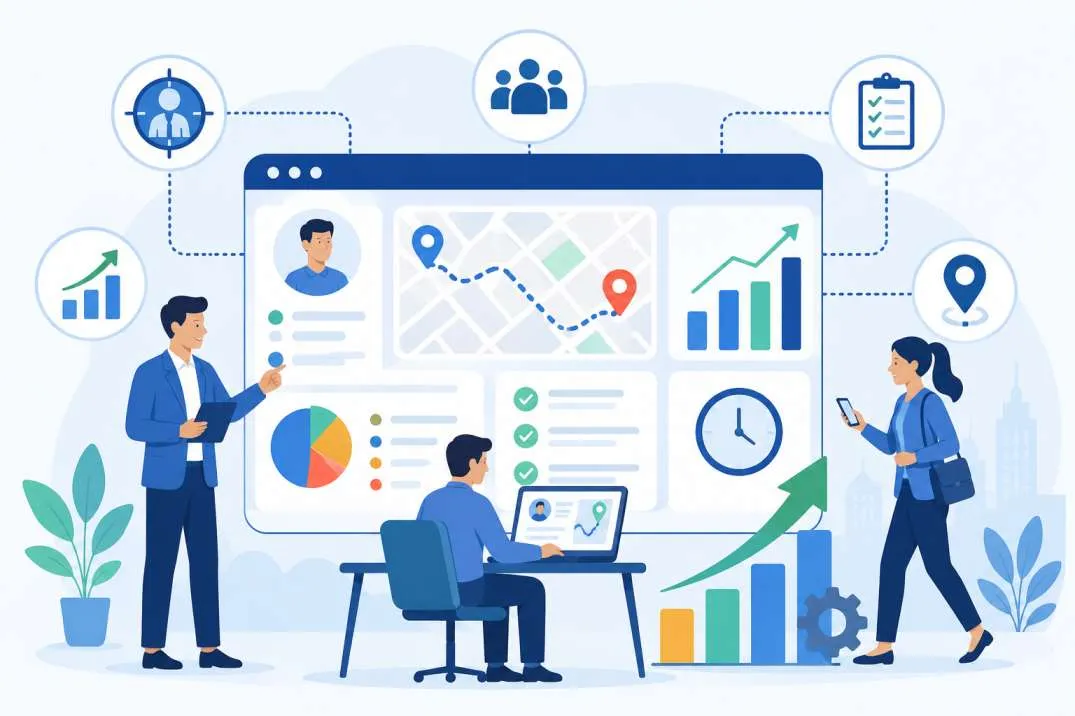

I’ve sat through enough sales review meetings to notice a pattern.
Everything looks fine on the surface. Calls are being made, CRM is updated, follow-ups are logged, and the team is “active” all day. But when the numbers come in, there’s always that uncomfortable question:
“If everyone is working, why isn’t performance improving?”
Sales numbers don't fail in obvious ways. It leaks in small gaps like delayed follow-ups, uneven calling hours, lost context between shifts, and leads that quietly slip through unnoticed.
Nothing dramatic. Just enough inefficiency to hold growth back.
And this is exactly where sales employee tracking software starts to matter.
Not as a control system, but as a clarity layer.
Because once you’ve managed enough teams, one thing becomes clear: It’s rarely about how much people work. It’s about how consistently that work actually translates into action.
And without visibility into that consistency, productivity always stays a guessing game.
Sales Employee Tracking Software: what it actually solves in real operations
Before we talk about improvement, it’s important to understand what this system is not.
It is not designed to watch employees. That’s an outdated interpretation.
In real sales operations, sales employee tracking software is not just about tracking daily activity. It reveals how work is actually being executed. How leads are handled, how follow-ups are managed, and how consistent the overall sales rhythm really is.
In most teams I’ve worked with, it typically reveals:
- Uneven calling patterns across agents
- Delays between lead assignment and first call
- Gaps between follow-ups that were never intentional
- Differences between “active time” and “productive time”
When teams use a proper employee tracking app, the shift is subtle at first. But over time, it changes how decisions are made.
You stop judging performance based on effort or intent, and start noticing real operational patterns. For example, some lead segments consistently respond better at 11AM to 1:00PM, while others lose momentum if follow-ups are delayed even slightly.
That shift is where operational improvement begins.
The Real Productivity Problem: It’s Rarely About Effort
One thing I’ve learned after working closely with sales teams is this. Effort is rarely the issue.
Most teams are working. Calls are happening. Leads are being followed up. Activity is visible.
But still, performance feels inconsistent.
Let me describe a situation that is very common in real sales floors.
A sales rep starts the day with good momentum. The first couple of hours are usually strong. Calls go out, conversations happen, and things feel productive.
Then the rhythm breaks a bit. The rep shifts to updating CRM, checking messages, waiting for fresh leads, or handling internal coordination. Calling slows down during this phase.
Later, they come back to calls again. Follow-ups get picked up. The day continues like this in cycles.
If you only look at end-of-day numbers, everything looks normal.
- Call volume is fine
- CRM is updated
- Leads are contacted
Nothing looks alarming.
But when you look at the flow more closely, the gaps start to show.
Some follow-ups happen later than they should.
Some leads are contacted, but not at the right time.
Some high intent prospects lose momentum simply because the next action took too long.
This is not a problem of effort. It is a problem of consistency in execution.
This is where sales employee tracking software becomes important in a practical sense.
It helps you see how work is actually happening during the day, not just what gets reported at the end. You can clearly understand calling patterns, follow-up delays, idle gaps, and how the work is distributed across hours.
Once that visibility is available, sales performance tracking becomes more meaningful. You are no longer just looking at outcomes. You are able to connect outcomes with actual working behavior.
And that changes how improvement happens. Instead of reacting after results are already affected, you start identifying and fixing issues while the work is still in progress.
Why Visibility Changes Behavior More Than Instructions Ever Will
In my experience, productivity doesn’t improve when you tell teams to “work better.”
It improves when they can actually see their own work patterns.
When sales employee tracking software is implemented properly, it creates these shifts:
- It changes how reps plan their own work instead of reacting throughout the day
Work stops being random task-to-task switching and starts becoming more structured around clear activity blocks and priorities.
- It improves ownership of time without constant supervision
When work patterns are visible, individuals naturally become more conscious of how time is being used, which reduces unnecessary idle gaps and unstructured downtime
- It stabilizes execution rhythm across the entire team
Instead of each rep working in a different pattern, teams gradually move toward more consistent operating cycles, which makes overall output more predictable
- It reduces dependency on memory and manual tracking habits
Important actions like call timing, lead touchpoints, and task completion are no longer dependent on recall or manual discipline, they become system-visible and trackable
- It improves self-correction before managerial intervention is needed
Performance issues are identified earlier in the workflow, allowing individuals to adjust behavior before it becomes a recurring pattern or impacts results
I’ve seen this especially in teams where follow-up consistency was the real bottleneck, not calling volume.
Once delays become visible, they are no longer ignored. Not because someone is enforcing discipline, but because the data makes it obvious.
Call Activity Is Not The Problem. Call Structure Is.
Most dashboards show call counts.
But call counts rarely explain performance differences.
What usually matters more is structure:
- How call activity is distributed across working hours instead of being concentrated in bursts.
- How quickly actions move from one stage to the next without unnecessary delays in the workflow.
- How consistently opportunities are revisited instead of being handled in an irregular or reactive manner.
- How different reps manage the same process in completely different ways, even with identical lead loads.
This is where systems like call tracking software add a deeper layer of clarity.
They don’t just record calls. They help connect call behavior with outcomes.
And once that connection becomes visible, performance discussions become significantly more accurate.
Comparison: Manual tracking vs Employee Tracking App vs Sales Employee Tracking Software
Understanding tools is easier when you compare how decisions actually get made.
| Area | Manual Tracking (Spreadsheets) | Sales Employee Tracking Software |
| Visibility | Delayed and fragmented | Real-time and continuous |
| Behavior insight | None | Structured behavioral patterns |
| Follow-up tracking | Manual effort | System-driven alerts and visibility |
| Sales Performance Tracking | Outcome-based | Behavior + outcome aligned |
| Manager dependency | High | Low |
| Scalability | Weak beyond small teams | Strong across large teams |
In most cases, teams start with basic tools and only realize the need for structured systems once inconsistencies begin affecting conversion predictability.
The Follow-Up Gap: The Most Expensive Invisible Problem
If I had to choose one area where most revenue leakage happens, it would be follow-ups.
Not because teams don’t follow up.
But because they don’t follow up consistently enough.
A lead contacted on Day 1 and ignored until Day 4 is often already lost.
What sales employee tracking software does well here is simple but impactful:
- It highlights delay patterns
- It shows unattended leads
- It brings visibility to follow-up discipline across agents
- You can schedule the follow-up and it will notify you.
And once this becomes measurable, sales performance tracking becomes far more reliable.
Because now you are measuring behavior, not just output.
When Tracking Becomes Coaching Instead Of Monitoring
There is a clear shift that happens in mature teams.
Early stage:
- Data is used to evaluate performance
Mature stage:
- Data is used to understand behavior
When that shift happens, conversations change completely.
Instead of:
- “Your numbers are low”
You begin discussing:
- “Your connect rate drops after a certain hour”
- “Your follow-up activity is inconsistent after Day 2”
- “Your peak performance window is narrower than expected”
This is where sales employee tracking software becomes less of a system and more of a decision-support layer.
Compliance And Responsible Tracking (Often Ignored, But Critical)
When companies use systems to monitor employee calls, it is not just about visibility or performance tracking. It also comes with a responsibility to handle data transparently and ethically.
Tracking employee activity and call behavior must always be implemented with clear communication and proper operational guidelines. This becomes especially important when dealing with call recordings, call logs, and sensitive customer interaction data.
There are also legal and organizational frameworks that teams need to follow to ensure tracking is done correctly and responsibly.
In practical environments, responsible tracking does not reduce trust within teams. In fact, when implemented transparently, it improves it.
Because when expectations are clear and data usage is understood, it removes ambiguity from performance discussions and reduces unnecessary suspicion on both sides.
The Real Impact: Productivity Becomes Predictable
Once systems stabilize, these things usually change:
- Managers stop discovering problems at the end of the week and start noticing them while they are forming during the day, which reduces damage from delayed correction cycles
- Sales processes become less dependent on “who is handling the lead” and more dependent on a consistent workflow that works across all reps
- The gap between top performers and average performers becomes easier to understand, because differences are traced to execution patterns instead of assumptions
- Work no longer sits unevenly in the system, as visibility highlights when certain reps are overloaded while others are underutilized
- Pipeline movement becomes smoother because stalled leads and inactive pockets in the process are easier to detect early
- Manager decisions become less reactive and more structural, since they are based on continuous behavioral data instead of end-of-period reports
- Team scaling becomes more controlled, because new hires follow an established execution pattern instead of developing their own inconsistent approach
This is where the real value of sales employee tracking software becomes clear.
Not in increasing pressure or pushing higher activity.
But in creating a sales environment where execution is stable, gaps are visible early, and outcomes become naturally more predictable without constant intervention.
That is what separates a busy sales team from a controlled, scalable sales operation.
Final Perspective: Productivity Is A Visibility Problem, Not A Discipline Problem
After working with multiple sales teams, one conclusion has stayed consistent.
Most productivity issues are not caused by lack of effort.
They are caused by lack of visibility into effort.
Once that visibility is introduced properly, through structured systems, dashboards, and behavioral tracking, teams don’t need constant pushing.
They start correcting themselves.
And that is where sales performance tracking finally becomes meaningful.
Not as reporting.
But as a way to steadily improve how work actually happens inside a sales team.
























Sign in to leave a comment.