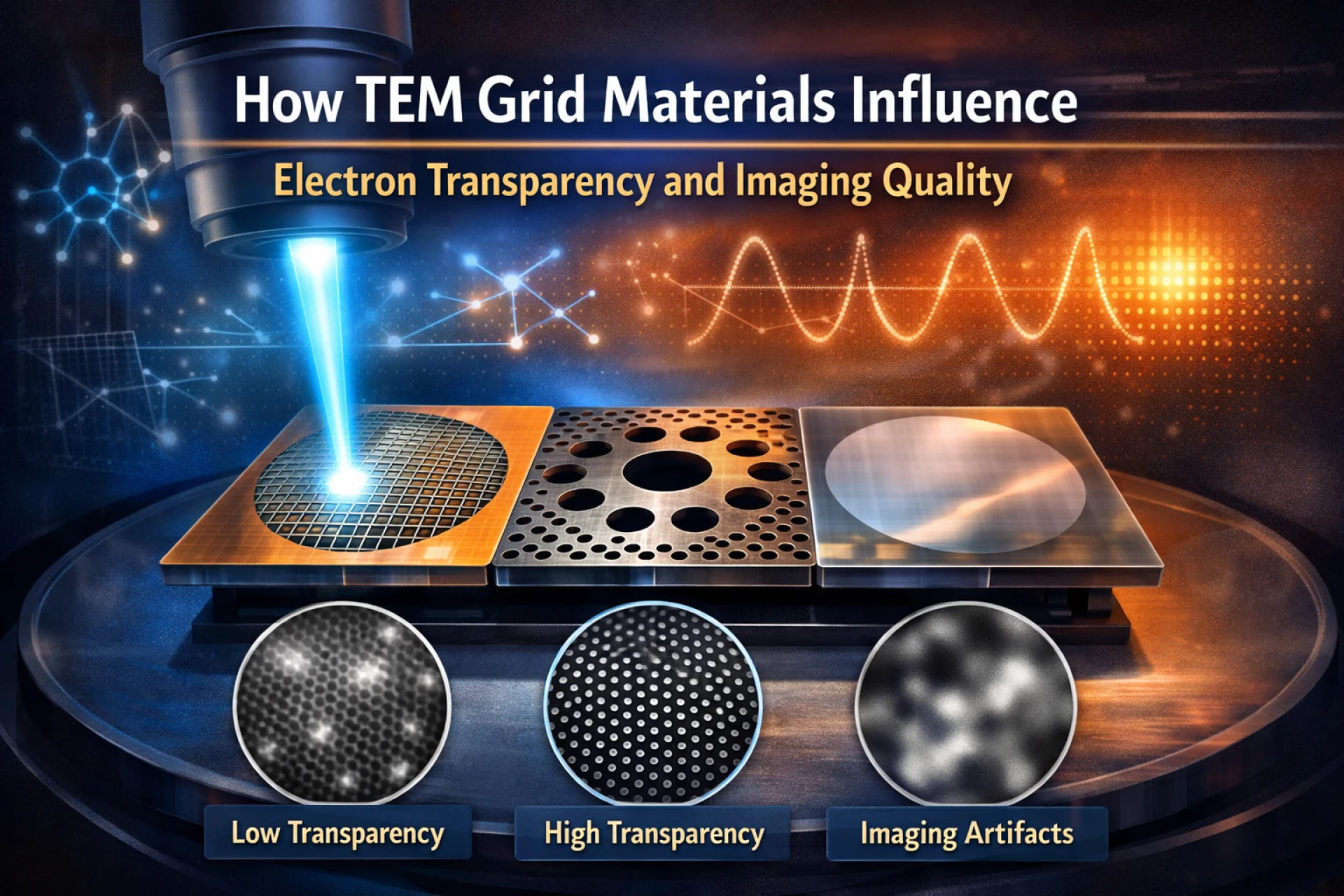

Transmission Electron Microscopy (TEM) is one of the most powerful tools for nanoscale and atomic-scale imaging. While much attention is often given to accelerating voltage, detectors, and sample preparation techniques, one critical component is frequently overlooked: the TEM grid material.
The choice of grid material directly affects electron transparency, signal-to-noise ratio, background contrast, beam stability, and overall imaging quality. In this blog, we explore how different TEM grid materials influence imaging performance and how to choose the right one for your application.
Understanding the Role of TEM Grids
A TEM grid is a thin support structure that holds the specimen in the electron beam path inside a transmission electron microscope such as the JEOL JEM-2100 or Thermo Scientific Talos F200X.
Because electrons must pass through the sample to form an image, the grid material must:
- Provide mechanical stability
- Minimize background scattering
- Withstand high vacuum conditions
- Resist beam-induced damage
- Offer good electrical and thermal conductivity
Each material influences these factors differently.
1. Copper (Cu) Grids: The Standard Choice
Copper grids are the most commonly used TEM grids due to their:
- High electrical conductivity
- Good mechanical strength
- Affordability
- Wide availability
Impact on Electron Transparency:
Copper has a relatively higher atomic number (Z = 29), meaning it scatters electrons more than lighter elements. However, since imaging occurs primarily through the thin film on the grid rather than the grid bars themselves, this is typically acceptable for routine imaging.
Best for:
- General biological TEM
- Polymer and nanoparticle imaging
- Routine materials science applications
Limitations:
- Not ideal for chemical analysis involving copper (e.g., EDS detection of Cu-containing samples)
- Can oxidize over time
2. Gold (Au) Grids: Stability and Corrosion Resistance
Gold grids are chemically inert and highly stable.
Influence on Imaging:
Gold’s higher atomic number (Z = 79) means stronger electron scattering. While this increases background signal if the beam hits the grid bars, gold grids are excellent for:
- Cryo-TEM applications
- Corrosion-sensitive experiments
- Long-duration imaging
Advantages:
- Excellent chemical resistance
- Reduced oxidation
- Better long-term storage stability
Consideration:
Higher cost compared to copper.
3. Nickel (Ni) Grids: Ideal for Elemental Analysis
Nickel grids are often chosen for analytical TEM.
Why?
When performing Energy-Dispersive X-ray Spectroscopy (EDS), copper grids can interfere with Cu peak detection. Nickel avoids this problem.
Imaging Impact:
- Moderate electron scattering
- Good mechanical stability
- Suitable for high-temperature experiments
Best for:
- Catalysis studies
- Metal alloy characterization
- Elemental mapping applications
4. Molybdenum (Mo) Grids: High-Temperature Performance
Molybdenum grids excel in experiments involving elevated temperatures.
Benefits:
- High melting point
- Reduced thermal drift
- Good mechanical rigidity
Imaging Influence:
Their higher atomic mass can contribute to increased background scattering, but in high-temperature in-situ experiments, stability outweighs this limitation.
5. Carbon-Based Supports: Maximizing Electron Transparency
While metal grids provide structure, carbon films (amorphous carbon, lacey carbon, holey carbon) play a crucial role in transparency.
Why Carbon?
- Low atomic number (Z = 6)
- Minimal electron scattering
- Excellent electron transparency
Carbon films significantly improve:
- Contrast
- Signal-to-noise ratio
- High-resolution imaging
These supports are essential in cryo-EM workflows performed on advanced systems like the Titan Krios.
6. Silicon Nitride (SiN) Membranes: Precision and Uniformity
Silicon nitride membranes offer ultra-flat, uniform support surfaces.
Imaging Advantages:
- Extremely thin and consistent
- Minimal thickness variation
- Excellent for in-situ TEM experiments
Ideal Applications:
- MEMS-based heating experiments
- Liquid cell TEM
- Semiconductor device analysis
Key Factors That Influence Electron Transparency
1. Atomic Number (Z)
Higher atomic number materials scatter electrons more strongly.
Lower Z = better electron transmission = clearer imaging background.
2. Thickness
Even a low-Z material can degrade imaging if it’s too thick. Ultra-thin films improve transparency.
3. Electrical Conductivity
Poor conductivity can cause:
- Charging effects
- Image drift
- Beam instability
Metals like copper and gold help dissipate charge effectively.
4. Thermal Stability
For in-situ heating experiments, materials with high melting points (Mo, Ni) maintain structural integrity.
How Grid Material Affects Imaging Modes
Bright-Field TEM
High-Z grids may increase unwanted scattering, reducing contrast if improperly aligned.
High-Resolution TEM (HRTEM)
Requires ultra-thin, low-background supports such as holey carbon films.
STEM-EDS Analysis
Grid material must not interfere with elemental signals.
Cryo-EM
Gold grids reduce beam-induced motion and improve mechanical stability during vitrified imaging.
Choosing the Right TEM Grid Material
| Application | Recommended Material |
| Routine imaging | Copper |
| Cryo-EM | Gold |
| Elemental analysis | Nickel |
| High-temperature studies | Molybdenum |
| In-situ experiments | Silicon nitride |
| High-resolution imaging | Holey carbon |
Final Thoughts
TEM grid materials are far more than passive supports — they actively influence:
- Electron transparency
- Background scattering
- Image contrast
- Thermal stability
- Analytical accuracy
Selecting the right grid material can dramatically improve imaging performance and data reliability. Whether you're conducting routine nanoparticle imaging or advanced cryo-electron microscopy, understanding the interplay between material properties and electron interaction is essential for achieving optimal results.
If you're optimizing a TEM workflow, start by evaluating your grid material — it might be the simplest upgrade with the biggest impact.






























Sign in to leave a comment.