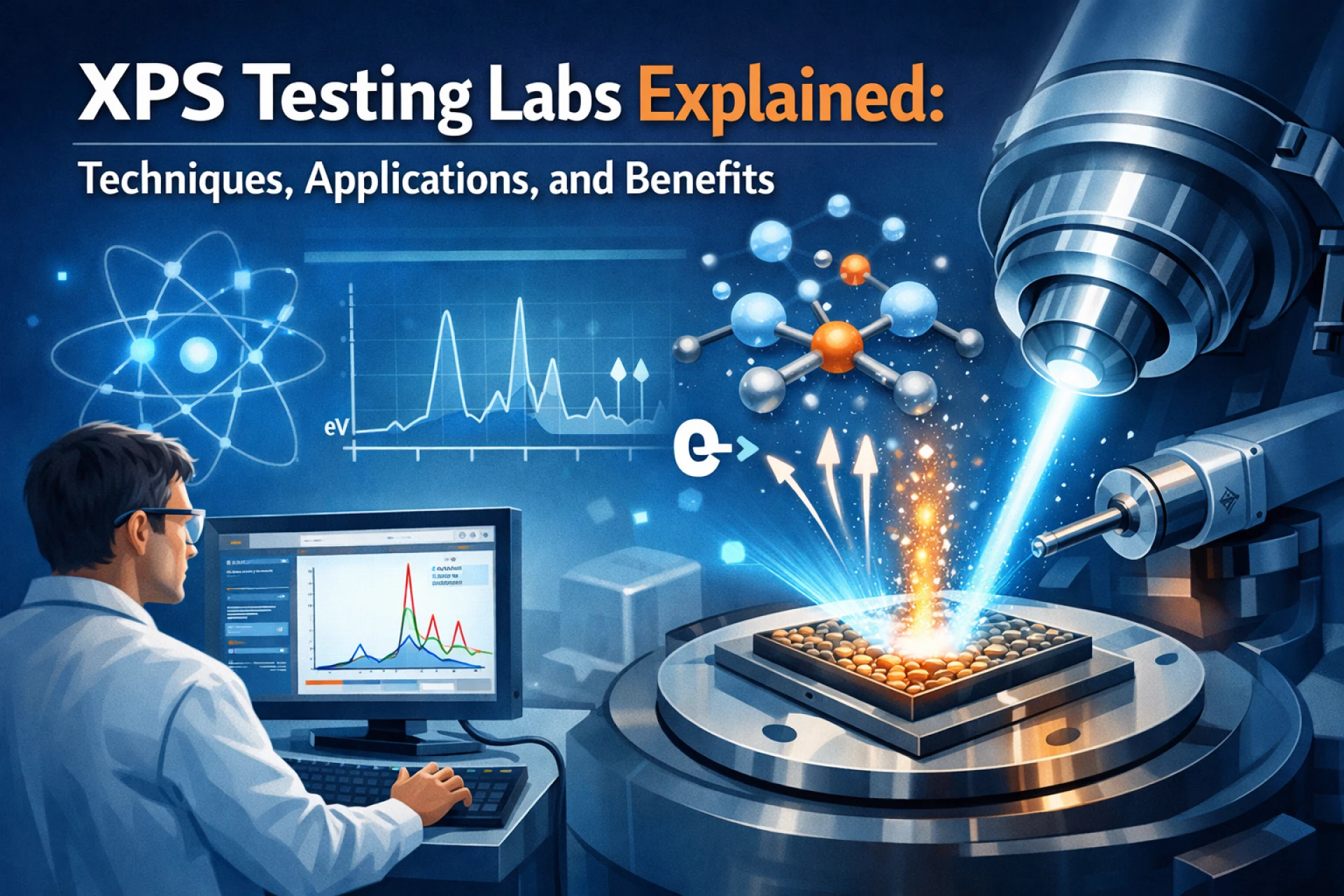

In modern science and industry, the surface of a material often determines its performance—whether it's corrosion resistance, adhesion strength, catalytic activity, or electronic behavior. This is where XPS Testing Labs become indispensable.
X-ray Photoelectron Spectroscopy (XPS) is one of the most powerful and precise techniques for analyzing surface chemistry. From research institutions to high-tech industries, XPS testing labs provide critical insights that help improve materials, ensure quality, and drive innovation.
This detailed guide explores the working principles, techniques, applications, benefits, and future scope of XPS testing labs.
Understanding XPS: The Science Behind the Technique
XPS is based on the photoelectric effect, a fundamental concept in physics where electrons are emitted when a material is exposed to X-rays.
How It Works Step-by-Step
- X-ray Source Activation: The sample is irradiated with monochromatic X-rays (commonly Al Kα or Mg Kα radiation).
- Electron Emission: The energy from X-rays causes electrons to be ejected from the atoms on the surface.
- Energy Measurement: The kinetic energy of these emitted electrons is measured using an electron energy analyzer.
- Binding Energy Calculation: The binding energy is calculated using the equation:
Binding Energy = X-ray Energy − Kinetic Energy − Work Function
- Spectrum Generation: A spectrum is generated showing peaks corresponding to specific elements and their chemical states.
Key Components of an XPS System
A modern XPS testing lab consists of highly sophisticated instrumentation:
1. X-ray Source
- Generates focused X-rays to excite the sample
- Determines resolution and sensitivity
2. Ultra-High Vacuum (UHV) Chamber
- Maintains vacuum levels (~10⁻⁹ mbar)
- Prevents contamination and scattering of electrons
3. Electron Energy Analyzer
- Measures kinetic energy of emitted electrons
- Critical for accurate spectral data
4. Detector System
- Records electron signals and converts them into spectra
5. Ion Gun (for Depth Profiling)
- Removes surface layers gradually
- Enables analysis of subsurface composition
Advanced Techniques Used in XPS Testing Labs
XPS is not just a single method—it includes multiple specialized techniques that enhance its analytical power.
1. Survey Scan (Wide Scan)
Purpose:
- Detect all elements present on the surface (except hydrogen and helium)
Features:
- Fast and broad analysis
- Provides elemental composition overview
Use Case:
- Initial screening of unknown samples
2. High-Resolution (Narrow) Scan
Purpose:
- Detailed analysis of specific elements
What It Reveals:
- Oxidation states
- Chemical bonding
- Functional groups
Example:
Distinguishing between:
- Metallic iron (Fe⁰)
- Iron oxide (Fe²⁺ / Fe³⁺)
3. Depth Profiling
Purpose:
- Analyze composition beneath the surface
How It Works:
- Ion sputtering removes layers step-by-step
Applications:
- Thin films
- Multilayer coatings
- Oxide layers
4. Angle-Resolved XPS (ARXPS)
Purpose:
- Non-destructive depth analysis
Method:
- Varying the angle of electron detection
Advantages:
- No sputtering damage
- Ideal for delicate samples
5. Imaging XPS (Chemical Mapping)
Purpose:
- Visualize spatial distribution of elements
Output:
- Elemental maps across the surface
Applications:
- Detecting contamination
- Studying surface uniformity
6. Quantitative Analysis
Purpose:
- Determine atomic concentration (%) of elements
Key Feature:
- High accuracy compared to many surface techniques
Applications of XPS Testing Labs Across Industries
XPS testing labs are used in a wide range of industries due to their unmatched ability to analyze surface chemistry.
1. Semiconductor and Electronics Industry
- Thin film characterization
- Gate oxide analysis
- Surface contamination detection
- Interface studies in microelectronics
Why It Matters: Even atomic-level impurities can affect device performance.
2. Pharmaceutical and Chemical Industry
- Drug surface characterization
- Coating uniformity analysis
- Packaging material testing
- Stability and degradation studies
Impact: Ensures safety, efficacy, and shelf life of drugs.
3. Materials Science and Nanotechnology
- Nanoparticle surface analysis
- Functional material development
- Polymer surface modification
Example: Studying how surface chemistry affects nanomaterial reactivity.
4. Energy and Battery Research
- Lithium-ion battery material analysis
- Fuel cell catalyst studies
- Solar cell surface optimization
Importance: Surface reactions directly influence energy efficiency and lifespan.
5. Coatings, Paints, and Corrosion Analysis
- Coating thickness and composition
- Corrosion product identification
- Adhesion failure analysis
Use Case: Improving durability of industrial coatings.
6. Environmental and Forensic Analysis
- Airborne particle analysis
- Surface contamination detection
- Chemical residue identification
Example: Identifying pollutants on environmental samples.
Benefits of XPS Testing Labs
1. Extreme Surface Sensitivity
- Analyzes only top 1–10 nm
- Ideal for surface-specific properties
2. Chemical State Identification
- Provides oxidation states and bonding information
- Goes beyond elemental detection
3. Quantitative Accuracy
- Accurate atomic percentage calculation
- Reliable for research and quality control
4. Wide Material Compatibility
- Metals, polymers, ceramics, glass, semiconductors
5. Non-Destructive Analysis Options
- ARXPS allows depth analysis without sputtering
6. High Reproducibility
- Consistent and reliable results
7. Versatility Across Industries
- Applicable in R&D, manufacturing, and failure analysis
Limitations of XPS Testing Labs
Despite its strengths, XPS has certain limitations:
1. Surface-Only Technique
- Cannot analyze bulk properties
2. Vacuum Requirement
- Samples must withstand ultra-high vacuum
3. Cost
- Expensive equipment and operation
4. Sample Sensitivity
- Some materials may degrade under X-ray exposure
5. Data Interpretation Complexity
- Requires skilled experts
Sample Preparation in XPS Testing
Proper sample preparation is critical for accurate results:
- Clean, contamination-free surfaces
- Avoid handling with bare hands
- Mounting using conductive adhesives (if needed)
- Dry and stable samples preferred
How to Choose the Right XPS Testing Lab
When selecting a lab, consider:
Technical Capabilities
- High-resolution instruments
- Depth profiling and imaging options
Expertise
- Skilled analysts for accurate interpretation
Industry Experience
- Experience in your specific application
Turnaround Time
- Speed of analysis and reporting
Data Quality
- Detailed reports with clear spectra interpretation
Future Trends in XPS Testing Labs
The future of XPS testing labs is evolving rapidly with technological advancements:
1. AI-Based Data Analysis
- Automated peak identification
- Faster and more accurate interpretation
2. In-Situ and Operando XPS
- Real-time analysis during reactions
3. Higher Spatial Resolution
- Nanoscale chemical imaging
4. Hybrid Techniques
- Integration with SEM, TEM, and other tools
5. Faster and More Efficient Systems
- Reduced analysis time
- Improved throughput
Conclusion
XPS testing labs are at the forefront of surface science and material characterization. Their ability to provide detailed elemental composition, chemical states, and quantitative data makes them essential across industries.
From improving semiconductor performance to advancing energy storage technologies, XPS continues to drive innovation by offering insights at the atomic level.
As technology advances, XPS testing labs will become even more powerful, enabling deeper understanding and better control of material surfaces—ultimately shaping the future of science and industry.


























Sign in to leave a comment.