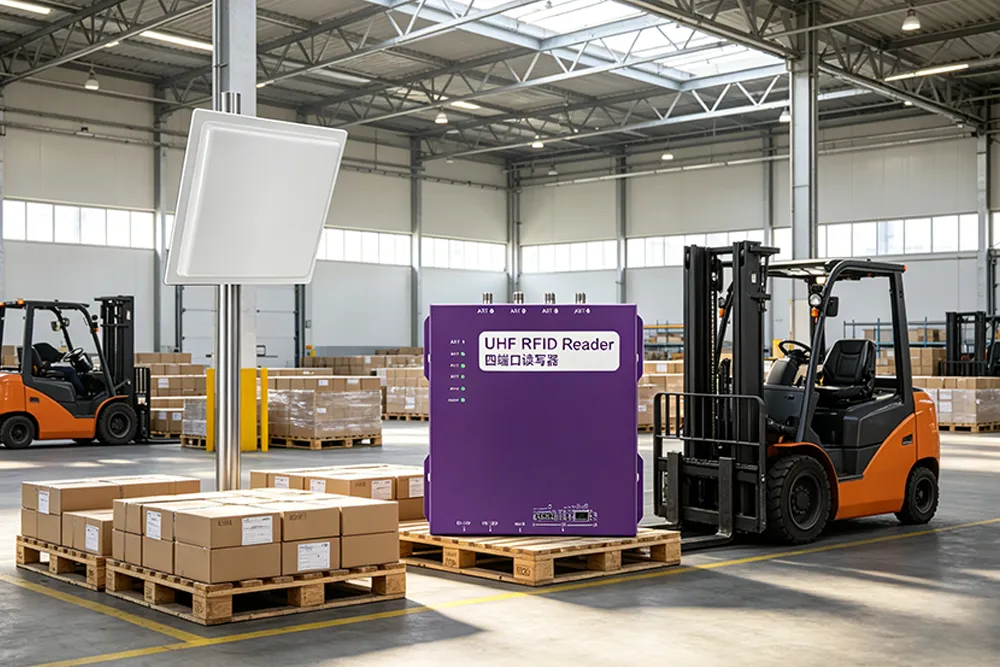

The first industrial rfid reader I ever deployed didn’t fail immediately. That would’ve been easier to diagnose. It degraded slowly—missed reads at first, then entire pallets slipping through invisible gaps. The environment wasn’t extreme by brochure standards: a mid-volume manufacturing line, ambient heat, moderate dust. But the reader was mounted too close to a steel column, and reflections were just enough to distort the field.
We didn’t replace the device. We moved it 40 centimeters.
Performance snapped back.
That moment sticks, because it says something important: an industrial rfid reader is not just defined by specs. It’s defined by how it behaves in imperfect spaces.
What “Industrial” Actually Means (Beyond Marketing)
Everyone uses the term. Few define it properly.
An industrial rfid reader is built for environments where consistency matters more than peak performance. Think vibration, temperature swings, electromagnetic noise, and constant movement. Not ideal labs—real facilities.
From a technical standpoint, most industrial readers operate in the UHF band (860–960 MHz), supporting EPC Gen2 / ISO 18000-63. That’s standard. What separates industrial-grade hardware is durability and signal stability under interference.
Data from the RAIN RFID Alliance shows that UHF RFID systems can achieve read rates exceeding 99% in optimized industrial setups, even with high tag density. But “optimized” is doing a lot of work in that sentence.
Because optimization is where projects succeed—or quietly fail.
A Factory Floor Isn’t RF-Friendly
One deployment I worked on involved tracking metal components moving through an assembly process. The client expected seamless reads. What they got initially was chaos.
Metal surfaces reflected RF signals unpredictably. Tags placed flat against components were unreadable half the time. Forklifts passing nearby introduced intermittent interference.
We didn’t change the industrial rfid reader. We changed everything around it:
- Switched to on-metal tags
- Adjusted antenna angles to reduce direct reflections
- Lowered transmit power to shrink the read zone
- Introduced shielding in specific areas
Within three days, read accuracy climbed from ~78% to 97%.
That aligns with findings from GS1, which emphasizes that tag type and placement are often more critical than reader specifications in challenging environments.
industrial rfid reader for Manufacturing: Precision Over Coverage
In manufacturing, the goal isn’t just to read tags—it’s to read the right tags at the right moment.
We installed an industrial rfid reader for manufacturing to track work-in-progress across multiple stations. Initially, the read zones overlapped slightly. That caused duplicate reads and confusion in the system.
Instead of increasing power for better coverage, we did the opposite. Reduced it. Narrowed the field.
It felt counterintuitive, but it worked.
According to research from Auburn University RFID Lab, controlling read zones is essential for process accuracy, especially in environments where items move through defined stages. Over-reading is just as problematic as under-reading.
Rugged RFID Reader for Warehouse: It’s Not Just About IP Ratings
A rugged rfid reader for warehouse is often marketed with IP65 or IP67 ratings. Dustproof. Waterproof. Good.
But in practice, physical durability is only part of the equation.
In one logistics center, the reader hardware held up perfectly—but performance dropped during peak hours. Why? RF noise from nearby equipment increased dramatically when multiple conveyor lines ran simultaneously.
We ended up enabling dense reader mode (DRM) and fine-tuning frequency hopping patterns. Stability returned.
This is something Impinj technical documentation highlights: interference management is critical in multi-reader or high-noise environments. Without it, even the most rugged hardware underperforms.
UHF industrial rfid reader System: The Hidden Complexity
A uhf industrial rfid reader system is rarely just a reader. It’s a network:
- Reader hardware
- Antennas (often multiple per reader)
- Cabling (which affects signal loss)
- Middleware (filtering and processing data)
- Integration with WMS or ERP systems
In one project, everything looked fine at the hardware level. But data inconsistencies kept appearing in the system.
The issue wasn’t RF—it was middleware filtering. Duplicate reads weren’t being consolidated properly, leading to inflated inventory counts.
Fixing that didn’t require touching the industrial rfid reader at all.
industrial rfid Asset Tracking Solution: When Accuracy Matters More Than Speed
Asset tracking changes the priorities.
You’re not reading hundreds of tags per second. You’re identifying specific assets with certainty.
We deployed an industrial rfid asset tracking solution in a tool management facility. The challenge wasn’t read range—it was preventing cross-zone reads between adjacent storage areas.
We used directional antennas and carefully controlled power levels. Read zones became precise, almost surgical.
The result: tools stopped “wandering” in the system. Not because they moved less—but because the data became reliable.
According to Deloitte reports on supply chain digitization, improved asset visibility can reduce operational losses by up to 20–30% in complex environments. That’s not just efficiency—that’s cost control.
Small Adjustments That Change Everything
Some of the biggest improvements I’ve seen came from minor tweaks:
- Rotating an antenna by 10 degrees
- Raising a reader by 15 centimeters
- Replacing a low-quality coaxial cable
- Changing tag orientation relative to polarization
In one case, simply moving a reader slightly off-center from a conveyor belt eliminated a persistent blind spot.
These are not dramatic interventions. But they matter.
What Experience Teaches (That Manuals Don’t)
After working on dozens of deployments, patterns emerge:
1. There is no universal configuration
Every site behaves differently. RF is situational.
2. More power is rarely the answer
It often creates more problems than it solves.
3. Data quality depends on system design, not just hardware
A perfect read means nothing if the data isn’t processed correctly.
Author Experience & Background
Over the past 10+ years, I’ve been directly involved in RFID system design and deployment across manufacturing plants, warehouses, and asset tracking facilities. My work includes configuring industrial rfid reader systems in high-interference environments and aligning implementations with standards from GS1 and performance benchmarks validated by Auburn University RFID Lab.
At Cykeo, the focus has always been practical performance—what works on-site, not just in theory.
The Part Most People Skip
Testing.
Not a quick demo. Not a one-day validation.
Real testing—over time, under different conditions.
In one facility, everything worked perfectly during installation. Two weeks later, performance dropped. The cause? Increased inventory density changed RF behavior.
We recalibrated. Problem solved.
But it’s a reminder: RFID systems are dynamic. They evolve with the environment.
Closing Observation
An industrial rfid reader doesn’t announce its success. When it works properly, it fades into the background—quietly capturing data, removing friction, and making operations more predictable.
And when it doesn’t, the issue is rarely obvious.
That’s the nature of working with invisible signals in very visible environments.

























Sign in to leave a comment.