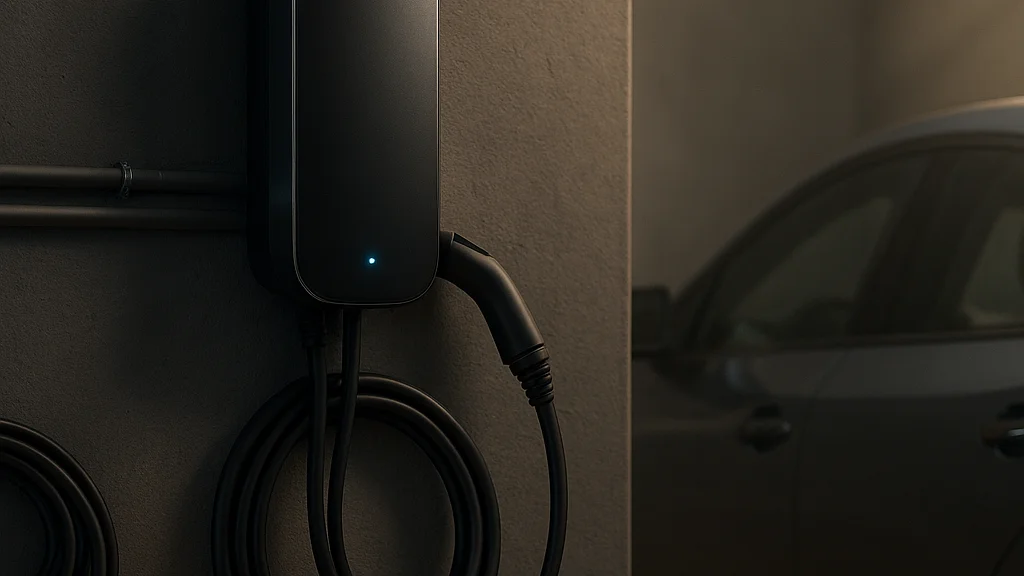

The moment home charging stops being abstract
The first surprise for many new EV owners is how quickly the romance of silent driving turns into a very practical question: where, exactly, will this car charge every night? It usually happens in a garage with a tape measure in one hand and a charging cable in the other, or in a driveway during a cold snap when an extension cord is clearly not the answer. Home charging sounds simple from a distance. Up close, it is an electrical project, a permitting exercise, a safety decision, and often a small lesson in how modern houses handle new demands.
That is why the best installation guide starts inside the home rather than with the charger itself. A charging station is not just a box on a wall. It is part of a circuit that runs back to the service panel, through breakers, wire sizing, grounding, local code rules, and the physical habits of the household. Can the panel support a new 240-volt load? Is the parking spot close enough to avoid awkward cable runs? Will the charger live indoors, under a carport, or fully exposed to weather? Each answer changes the installation path and the total cost.
Recent reporting has sharpened that reality. The Atlanta Journal-Constitution’s look at what home charging really requires focused on a point electricians have been making for years: the charger is often the easy part; the home’s electrical capacity is the real story. That is also the thread running through practical explainers such as this Complete Guide to Home EV Charging Station Installation and the more planning-focused Home EV Charging Station Installation Guide for Smart Owners. If you treat the project like a major appliance installation rather than a gadget purchase, you will make calmer, better decisions.
Home EV charging is most successful when the car, the charger, and the house are planned together rather than purchased one at a time.
That may sound less glamorous than talking about range figures and battery chemistry, but it is where money is saved, frustrations are avoided, and safety is protected. A good installation does not feel dramatic once it is finished. It feels boring in the best possible way. You come home, plug in, go inside, maybe stir a pot of soup, maybe call your mum on Sunday, and the car is ready by morning.
Start with the electrical truth: panel capacity, load, and location
The core technical decision in home EV charging is whether the house can support a dedicated Level 2 circuit without compromising safety or overloading the service. In North America, most homeowners who want faster charging choose Level 2 equipment running on 240 volts. That is a meaningful step up from Level 1 charging on a standard 120-volt outlet, which can be enough for very light daily driving but often adds range too slowly for larger batteries or longer commutes.
Most Level 2 home chargers are installed on circuits in the 40- to 60-amp range, though the charger’s actual output may be lower depending on the unit, the vehicle, and the available electrical capacity. Under common code practice, continuous loads are derated to 80% of breaker capacity, which means a 50-amp circuit commonly supports 40 amps of continuous charging, while a 60-amp circuit commonly supports 48 amps. That distinction matters because it influences charging speed, wire size, and whether a panel upgrade enters the conversation.
According to the Atlanta Journal-Constitution, one of the first questions homeowners should ask is whether their service panel has enough spare capacity for the added load. Older homes with 100-amp service can sometimes accommodate EV charging, but not always, especially if they already run electric dryers, ranges, heat pumps, hot tubs, or other substantial loads. Newer homes with 200-amp service are often in a better position, though even there, a proper load calculation is still required.
- Level 1 charging: typically uses a 120-volt outlet and can add only a modest amount of range per hour, often suitable for low-mileage drivers.
- Level 2 charging: usually requires a dedicated 240-volt circuit and dramatically reduces charging time for overnight replenishment.
- Hardwired chargers: often preferred for higher-amperage setups, outdoor exposure, and cleaner long-term installations.
- NEMA outlet setups: can offer flexibility, but the outlet, breaker, and wiring still need to be correctly matched and professionally installed.
Location shapes cost almost as much as electrical capacity. If the panel is in the garage near the parking spot, installation can be relatively straightforward. If the panel sits in a finished basement on the opposite side of the house, the electrician may need a longer conduit run, drywall access, trenching, or exterior routing. Those details add labor hours quickly. They also affect aesthetics. A charger should be mounted where the cable reaches the vehicle’s port comfortably without stretching across walkways or creating trip hazards.
One of the more useful homeowner checklists published by Online Recruitment in its guide for Pennsylvania homeowners emphasizes an early site assessment. That advice travels well beyond one state. Before buying equipment, stand where the car actually parks, identify the charge port location on the vehicle, note the panel position, and think about weather, lighting, and daily routine. It sounds simple because it is simple. It is also where many avoidable mistakes begin.
Choosing the right charger means matching your life, not chasing maximum amps
There is a quiet pressure in EV buying to assume that more is always better: more range, more power, more charging speed. At home, that instinct can lead to overspending. The right charger is the one that reliably replenishes your typical driving with room for occasional heavier use. For many households, that does not require the highest-amperage wall unit on the market.
Begin with your daily mileage. If you drive 30 to 50 miles a day and can charge overnight for eight to ten hours, a moderate Level 2 setup may be more than enough. If you drive a large electric pickup, do frequent long trips, or share one charger between two EVs, the calculation changes. Still, the answer should come from actual use patterns, not a vague fear of running short.
Vehicle compatibility matters too. Some EVs can accept higher AC charging rates than others. Installing a charger capable of 48 amps does not mean every car will draw 48 amps. The onboard charger in the vehicle is part of the equation. Connector standards also matter. In North America, J1772 remains common for many non-Tesla Level 2 applications, while the broader shift toward the North American Charging Standard has continued to reshape expectations across the industry. Adapters can bridge some gaps, but homeowners should confirm what comes with the vehicle and charger before installation day.
Smart features are another fork in the road. Wi-Fi-connected chargers can schedule charging for off-peak utility rates, track energy use, and integrate with utility demand-response programs where available. Those features can be genuinely useful, especially in regions with time-of-use pricing. They are less compelling if your internet connection is unreliable in the garage or if you prefer a simpler setup with fewer potential software annoyances.
- Estimate your weekly driving, not your once-a-year road trip.
- Check the vehicle’s maximum AC charging acceptance rate.
- Confirm whether you want a hardwired unit or plug-in model.
- Review cable length and whether it comfortably reaches the car’s charge port.
- Ask whether smart charging features align with your utility tariff and habits.
- Choose weather-rated equipment if the charger will be outdoors.
There is also a growing layer of automaker incentives that can tilt the decision. InsideEVs reported that Ford EV purchases still came with a free home charger in 2026, though installation costs remained separate and eligibility details mattered. Offers like that can be valuable, but they do not erase the need to verify amperage, installation requirements, and whether the included hardware fits the home’s electrical reality.
The cheapest charger is not the lowest sticker price. It is the unit that fits the house cleanly, charges the car reliably, and does not force an avoidable panel or wiring redo later.
If you want a broader market scan before deciding, the practical comparisons in Top 7 Home EV Charging Station Installation Guide and the forward-looking context in The Future of Home EV Charging Station Installation: A Comprehensive Guide can help frame the trade-offs. The key is to stay anchored in your own use case. A charger is home infrastructure, not a personality test.
Permits, codes, and why a licensed electrician still matters
Homeowners sometimes ask whether EV charger installation is a doable DIY project. The honest answer is that the stakes are too high for guesswork. A Level 2 charger is a continuous high-load electrical device. Even when the mounting looks straightforward, the work behind the wall or inside the panel demands code knowledge, proper tools, and local permitting compliance. That is why licensed electricians remain central to safe installation.
Permits are not bureaucratic theatre. They create a paper trail, require inspection, and help ensure that conductor sizing, breaker selection, grounding, GFCI requirements where applicable, and equipment placement meet local rules. Requirements vary by jurisdiction, and that variance is one reason generic internet advice can mislead. Some areas have streamlined EV charger permits. Others still move slowly. Homeowners in condominiums or planned communities may also face HOA or strata approval steps on top of municipal requirements.
Another reason professional installation matters is load management. If the panel is near its limit, an electrician may propose alternatives short of a full service upgrade. These can include a lower-amperage charger setting, a load-sharing system, or an energy management device that monitors household demand and allocates charging capacity accordingly. In 2026, these solutions are more visible than they were a few years ago because they help households add EV charging without immediately paying for expensive utility and panel work.
Ask detailed questions during the quote process. Does the estimate include permit filing and inspection coordination? Is trenching extra? Will the charger be hardwired or connected via receptacle? What wire gauge and breaker size are planned? Is surge protection recommended? Will the electrician help configure current limits in the charger software if the circuit requires it? A thorough quote is usually a sign of a careful installer.
- Request at least two or three quotes from licensed electricians familiar with EVSE installations.
- Verify whether permit fees and inspection visits are included.
- Ask for a load calculation if the panel’s spare capacity is uncertain.
- Confirm warranty terms for both labor and installed components.
- Make sure the final setup matches the charger manufacturer’s instructions.
The emotional side of this is easy to overlook. Electrical work can make homeowners feel out of their depth, especially when every answer seems to begin with “it depends.” That is normal. A good electrician explains the trade-offs in plain language. You should leave the conversation understanding not only what will be installed, but why that approach is safer, cleaner, or more cost-effective than the alternatives.
What installation really costs and where budgets tend to drift
There is no single national price for home EV charger installation because the final bill is a bundle of separate variables: charger hardware, labor, permit fees, wire length, panel condition, wall material, distance to the parking area, and whether any service upgrade is required. That said, the most common budgeting mistake is focusing only on the wall unit and treating the rest as minor. Sometimes it is minor. Sometimes it is the whole story.
The charger itself may be one of the more predictable line items. The installation is not. A simple garage install with a nearby panel can be relatively affordable. Costs rise when electricians need to run long conduit routes, cut and repair finished surfaces, install a subpanel, upgrade service, or work around detached garages and outdoor trenching. Homes built decades ago can present additional surprises once the panel is opened. Corrosion, lack of spare breaker space, outdated equipment, or undocumented previous work can all complicate the job.
Utility incentives and local rebates can soften the blow, but they are highly regional and often come with conditions. Some require specific smart chargers, off-peak enrollment, or proof of permit approval. Others are first-come, first-served and can close without much notice. Because those programs change frequently, homeowners should verify current terms with their utility or local energy office before assuming savings. This is one area where recent local reporting, utility websites, and licensed installers often provide more reliable guidance than old forum threads.
Another budget issue is future-proofing. Running slightly larger conduit, choosing a charger location that could serve a second EV later, or installing load-sharing-capable equipment may cost more upfront but avoid a second round of electrical work. That matters more in 2026 than it did even a few years ago because two-EV households are no longer unusual in many markets. If one partner buys electric now and the other follows in two years, a thoughtfully designed first installation can save real money.
Do not ignore operating cost either. Home charging is often cheaper than public fast charging on a per-kilowatt-hour basis, but the difference depends on local electricity rates and charging habits. Time-of-use plans can make overnight charging significantly cheaper if the household can schedule around them. Smart chargers help here, but a simple timer and a disciplined routine can do the job too. The point is not to chase perfection. It is to understand that installation cost and energy cost are part of the same household equation.
2026 changes: smarter load management, automaker bundles, and tougher expectations
The home charging conversation in 2026 is more mature than it was during the early consumer EV boom. Buyers are less dazzled by the basic idea of plugging in at home and more interested in whether the setup is resilient, affordable, and adaptable. Three shifts stand out: load management technology is becoming more mainstream, automakers are using home charging bundles more strategically, and homeowners are asking tougher questions about interoperability and long-term standards.
First, load management. As more households add EVs alongside electric heating, induction cooking, and heat-pump water heaters, electrical capacity is becoming a shared constraint. Energy management systems that dynamically reduce charging current when the house is under heavier demand are increasingly relevant. They can be especially useful in homes with 100-amp service or in properties where a full utility service upgrade would be expensive or delayed. This is not a silver bullet, but it is a practical bridge technology for electrification-heavy households.
Second, bundled hardware offers are shaping buyer expectations. Ford’s continued free home charger offer, as reported by InsideEVs, illustrates how automakers now see home charging as part of the vehicle sale rather than an afterthought. The catch, of course, is that “free charger” does not mean free installation, and the labor can still be substantial. Consumers have become savvier about reading that fine print.
Third, standards and compatibility remain a moving target, though the direction is clearer than it once was. North American Charging Standard adoption has widened across the industry, but millions of existing setups still rely on J1772-based Level 2 charging. For homeowners, the practical takeaway is to buy quality equipment from a reputable manufacturer, confirm connector compatibility, and avoid assuming that every future vehicle purchase will make current hardware obsolete overnight. Adapters and dual-compatibility strategies continue to smooth the transition.
There is also a broader social shift. Home charging is increasingly discussed as part of residential energy planning, not just car ownership. People are pairing EV charging with rooftop solar, battery storage, and whole-home electrification decisions. If that is your path, the more strategic overview in Home EV Charging Station Installation Guide 2026 can be a useful companion read. The charger on the wall is still the visible piece, but the real story is how the home is being rewired for a different energy future.
By 2026, the smartest home charging setups are less about maximum speed and more about flexible integration with the rest of the house.
That trend is likely to continue. Utilities want managed demand. Homeowners want lower bills and fewer upgrades. Automakers want a smoother ownership experience. Those interests do not always align perfectly, but they are moving in the same general direction.
A practical installation roadmap for homeowners who want fewer surprises
If there is one gentle truth I would offer after looking at this space closely, it is that most installation stress comes from sequence, not complexity. People buy the charger first, then discover the panel is full. Or they schedule the electrician before confirming where the vehicle will actually park. Or they assume the automaker’s included cable solves everything. A calmer process starts with the house, moves to the charger, and ends with inspection and routine use.
- Map your parking reality. Identify where the car sits most nights, where the charge port is located, and how the cable will reach it safely.
- Assess electrical capacity. Have a licensed electrician review the panel, service size, and likely load calculation before you purchase equipment.
- Choose charging speed based on actual driving. Match the charger and circuit size to your weekly mileage and overnight dwell time.
- Decide on hardwired versus outlet installation. Hardwired setups are often cleaner and better for higher loads or outdoor locations.
- Get permits and schedule inspection. A compliant installation protects safety, resale value, and insurance clarity.
- Configure smart charging if useful. Set off-peak schedules, current limits, and app controls only after the hardware is correctly installed.
- Test with your actual routine. Plug in for a week, note cable handling, lighting, and parking habits, and make small adjustments early.
For detached garages, multifamily properties, and older homes, add extra patience. Those installations can be excellent, but they often require more coordination and more creative electrical planning. If you live in a condo or rental, the first conversation may not be with an electrician at all. It may be with a property manager, board, or landlord. In those settings, documentation and a clear scope of work become even more important.
The good news is that once a home charger is properly installed, daily life tends to get easier very quickly. Public charging remains essential for road trips and for drivers without home access, but for homeowners, charging while the car is parked overnight is still one of the quiet joys of EV ownership. It turns transportation into something more domestic and less errand-like. You arrive home, plug in, and let the house do a little work while you rest.
If you are at the beginning of the process, keep your standards high and your expectations steady. Ask the extra question. Read the quote twice. Stand in the garage and imagine a wet November evening, grocery bags in hand, trying to plug in with cold fingers. The best setup is the one that works on that ordinary night, not just in a showroom brochure. Be gentle with yourself while you sort the details. Good infrastructure is built one careful decision at a time.


































Sign in to leave a comment.