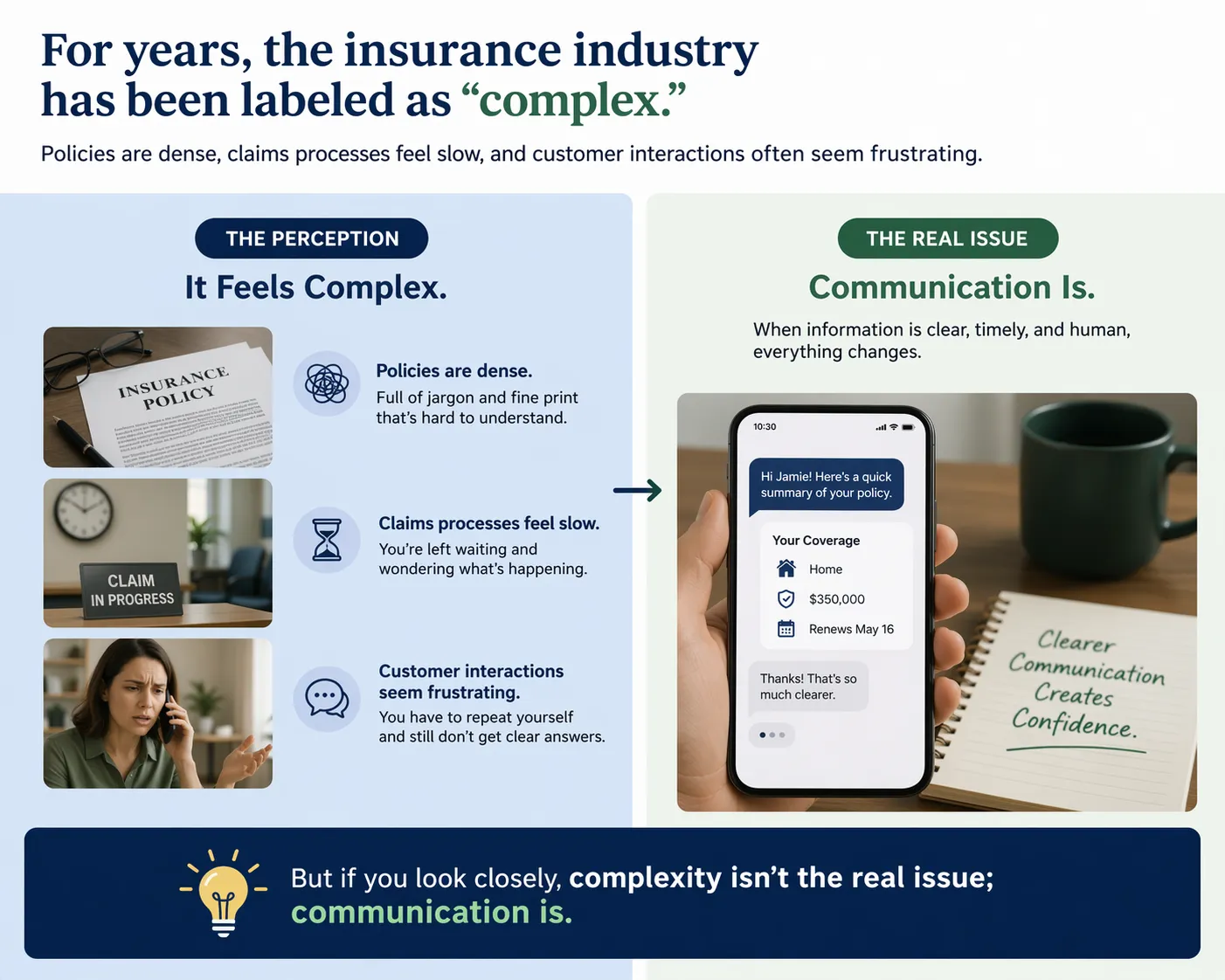

Most customers don’t struggle because insurance is inherently difficult. They struggle because information is poorly delivered, inconsistently explained, and often delayed. In an industry built on trust, this communication gap becomes the single biggest barrier between insurers and their customers.
So instead of simplifying products endlessly, insurers need to rethink how they communicate. That’s where the real transformation lies.
Why Insurance Feels More Complicated Than It Actually Is
Insurance products are designed to cover risks, which naturally involves some level of detail. However, the perception of complexity often comes from how this information is shared.
1. Information Overload Without Context
Customers are often presented with large volumes of information without clear guidance.
- Policy documents are long and filled with technical terms
- Key benefits are buried under legal language
- Customers don’t know what actually applies to them
This leads to confusion, even when the product itself is straightforward.
2. Lack of Timely Communication
Communication delays create unnecessary friction.
- Claim updates take too long to reach customers
- Renewal reminders are inconsistent
- Queries often go unanswered for hours or days
When customers are left waiting, even simple processes feel complicated.
3. One-Size-Fits-All Messaging
Insurance companies often communicate the same way with every customer.
- No personalization based on customer history
- Generic responses that don’t address specific concerns
- Limited multilingual or regional support
This disconnect makes customers feel unheard and misunderstood.
The Real Cost of Poor Communication
When communication fails, the impact goes beyond inconvenience. It directly affects business outcomes.
1. Lower Customer Trust
Trust is the foundation of insurance, but unclear communication erodes it.
- Customers doubt claim decisions
- Policy terms feel misleading
Transparency becomes questionable
2. Increased Operational Load
Poor communication leads to more inbound queries.
- Repeated customer calls for the same issue
- Overloaded call centers
Higher support costs
3. Reduced Customer Retention
Confused customers are less likely to stay.
- Missed renewals due to lack of reminders
- Switching providers after poor claim experiences
- Negative word-of-mouth
In short, communication gaps translate directly into lost revenue.
Where Traditional Communication Models Fall Short
Most insurance companies still rely on outdated communication systems that were not built for today’s expectations.
1. Call Centers as the Primary Channel
Call centers remain the backbone of customer interaction.
- Long wait times frustrate customers
- Limited availability outside business hours
- Inconsistent quality of responses
2. Static Digital Interfaces
Websites and apps often lack real-time responsiveness.
- Limited self-service capabilities
- No proactive communication
- Dependence on manual follow-ups
3. Fragmented Communication Channels
Customers interact across multiple touchpoints, but systems don’t talk to each other.
- Email, phone, and chat operate in silos
- No unified customer history
- Repetition of information across channels
This fragmentation amplifies confusion rather than reducing it.
Rethinking Insurance Communication for the Modern Customer
Today’s customers expect fast, clear, and personalized communication similar to what they experience in other industries.
1. Clarity Over Complexity
The focus should shift from simplifying products to simplifying explanations.
- Break down policies into easy-to-understand summaries
- Highlight key benefits and exclusions clearly
- Use conversational language instead of jargon
2. Proactive Engagement
Instead of waiting for customers to reach out, insurers should take the first step.
- Real-time claim status updates
- Automated renewal reminders
- Alerts for missing documents
3. Personalization at Scale
Every customer interaction should feel tailored.
- Context-aware responses based on customer history
- Language preferences and regional adaptability
- Customized policy recommendations
The Role of Technology in Fixing the Communication Gap
Technology is now enabling insurers to move from reactive support to proactive communication.
1. Intelligent Automation
Automation helps handle repetitive queries efficiently.
- Instant responses to common questions
- Reduced dependency on human agents
- Faster resolution times
2. Real-Time Communication Systems
Modern platforms enable immediate interaction.
- 24/7 availability for customer support
- Consistent messaging across channels
- Faster turnaround for requests
3. Scalable Customer Engagement
Technology allows insurers to communicate with thousands of customers simultaneously without compromising quality.
- Bulk notifications with personalization
- Continuous engagement throughout the policy lifecycle
- Seamless integration with existing systems
This is where solutions like Voice AI for Insurance start making a measurable impact, enabling insurers to deliver consistent, human-like communication at scale without increasing operational costs.
How Voice-Led Communication is Changing the Game
Voice technology is emerging as one of the most effective ways to bridge communication gaps in insurance.
1. Natural and Intuitive Interaction
Voice feels more human than text-based interfaces.
- Customers can speak naturally instead of navigating menus
- Faster query resolution
- Improved accessibility for non-tech-savvy users
2. Instant Response and Availability
Voice systems eliminate waiting time.
- 24/7 support without queues
- Immediate answers to policy-related questions
- Real-time claim updates
3. Consistency Across Interactions
Unlike human agents, voice systems maintain consistency.
- No variation in responses
- Accurate information delivery every time
- Reduced risk of miscommunication
A robust Voice AI Platform enables insurers to implement these capabilities seamlessly, ensuring that communication remains clear, timely, and reliable across all customer touchpoints.
Key Shifts Insurers Need to Make
To truly solve the communication problem, insurers must adopt a mindset shift rather than just new tools.
1. From Reactive to Proactive
- Don’t wait for customers to ask questions
- Anticipate needs and provide information in advance
2. From Generic to Personalized
- Treat every customer as unique
- Use data to tailor communication
3. From Complex to Clear
- Focus on simplicity in messaging
- Prioritize understanding over completeness
4. From Human-Dependent to Hybrid Models
- Combine human expertise with AI-driven communication
- Use automation for scale and humans for critical interactions
The Future of Insurance Communication
The future of insurance will not be defined by simpler policies, but by smarter communication. Companies that invest in clear, proactive, and personalized interactions will stand out in an increasingly competitive market.
Customers don’t expect insurance to be effortless; they expect it to be understandable. They don’t mind complexity if it is explained well. What they truly value is transparency, speed, and clarity at every step of their journey.
Conclusion
Insurance has never truly had a complexity problem; it has always had a communication problem. When customers feel confused, it’s rarely because the product is too difficult; it’s because the information wasn’t delivered in a way they could understand or trust.
By focusing on better communication, learner messaging, faster responses, and more personalized interactions, insurers can transform the entire customer experience. This shift doesn’t just improve satisfaction; it builds long-term trust and loyalty.
In the end, the companies that win won’t be the ones with the simplest policies, but the ones that communicate the best.

























Sign in to leave a comment.