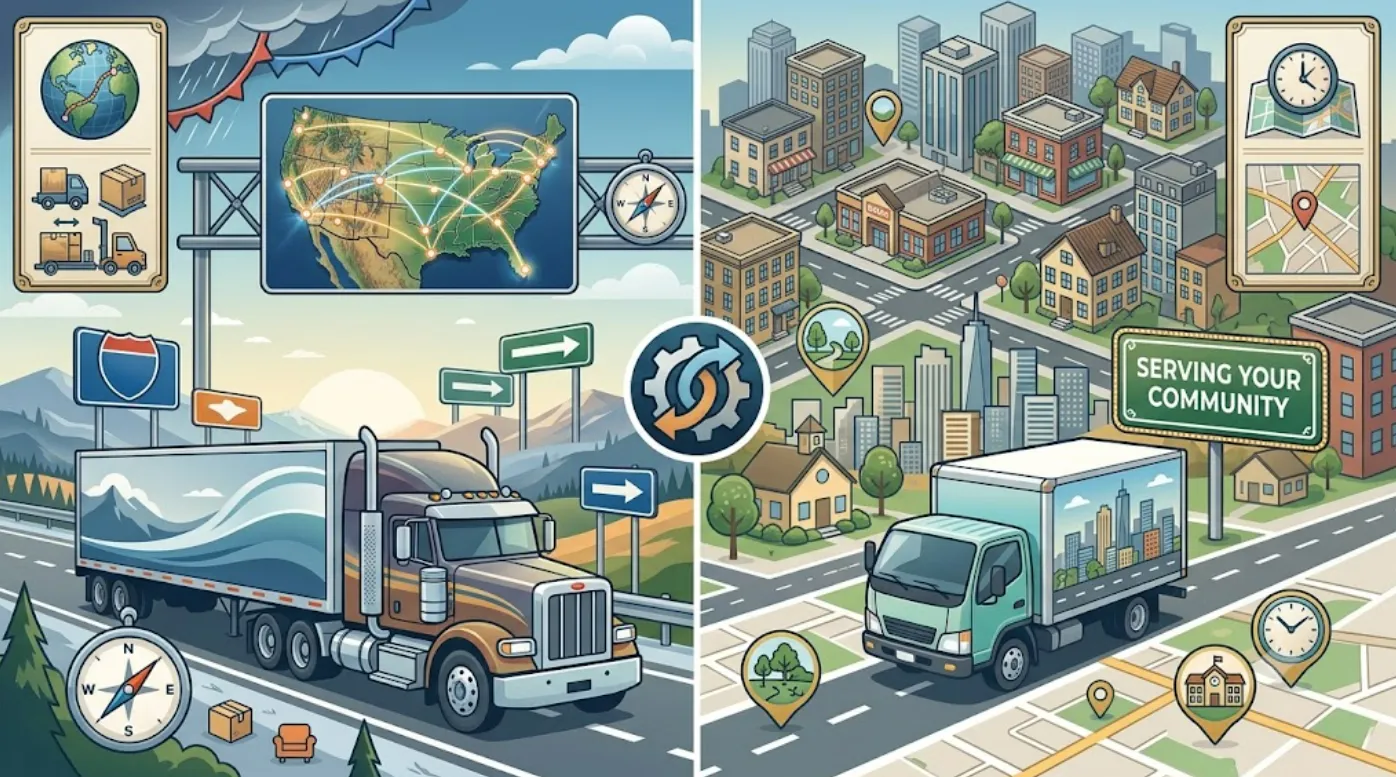

Choosing a moving company can feel complicated, especially when you're planning a move across state lines. You may come across large interstate van lines, national moving brands, local independent carriers, moving brokers, and companies that offer a combination of these services.
Two options that are often compared are interstate van lines and local independent moving carriers.
Both can transport household goods, but their operating models, service areas, pricing structures, scheduling processes, and customer experience can be very different.
Understanding these differences can help you choose a mover based on the type of relocation you're planning rather than simply choosing the company with the lowest quote.
What Is an Interstate Van Line?
An interstate van line is generally part of a larger transportation network designed to handle moves across state lines.
Van lines typically have broader geographic coverage and may use a combination of company-owned operations, affiliated agents, terminals, warehouses, and transportation networks.
This structure can be useful for customers moving long distances because a larger network can coordinate transportation across multiple regions.
For example, someone moving from Washington to Florida may need transportation across several states. A large interstate network may have established routes and facilities that support this type of shipment.
However, customers should always understand who will actually perform each part of the move.
What Is a Local Independent Moving Carrier?
A local independent moving carrier is usually an independently operated moving company that owns or directly controls its trucks and crews.
Some independent carriers focus primarily on local and regional moves, while others are authorized to perform interstate transportation as well.
A local carrier may have a smaller service area than a national van line, but it can offer a more direct relationship with the customer.
You may communicate with the same company that:
- Provides your estimate
- Schedules your move
- Sends the moving crew
- Loads your belongings
- Transports your shipment
- Coordinates delivery
- Handles questions about your move
This direct structure can be especially appealing to customers who prefer dealing with one local team.
Interstate Moves Are Governed by Federal Rules
Before comparing movers, it is important to understand what makes a move interstate.
A move is generally considered interstate when household goods are transported between different states. A move can also qualify as interstate when the shipment travels through another state, even if the origin and destination are within the same state.
Interstate household-goods carriers are subject to Federal Motor Carrier Safety Administration (FMCSA) requirements. FMCSA requires interstate movers to be registered and properly authorized to transport household goods.
This means a local-looking company can still be an interstate carrier if it has the appropriate authority and performs interstate moves.
The Biggest Difference: Network vs. Direct Service
One of the most important differences between a van line and an independent carrier is the operational structure.
A large van line may have access to a broad transportation network.
A local independent carrier may handle more of the move directly.
Neither structure is automatically better.
The right choice depends on your destination, shipment size, schedule, budget, and preference for local service versus a larger transportation network.
Geographic Coverage
Interstate van lines usually have an advantage when it comes to geographic coverage.
Their networks can make it easier to coordinate moves involving:
- Multiple states
- Long-distance destinations
- Cross-country routes
- Storage locations in different regions
- Complex delivery schedules
An independent carrier may have a more limited service area.
However, some independent movers are fully equipped for long-distance and interstate transportation, so geographic coverage should be verified rather than assumed.
Personal Service From Local Carriers
One reason customers choose independent movers is the possibility of a more personal experience.
A local carrier may be more familiar with:
- Local neighborhoods
- Building requirements
- Parking restrictions
- Local traffic patterns
- Regional weather
- Apartment and condominium procedures
- Local loading and unloading challenges
This knowledge can be valuable when moving from one nearby community to another.
It can also be helpful during the origin portion of a long-distance move.
Network Support From Interstate Van Lines
Large van line networks can provide advantages of their own.
They may have access to:
- Regional terminals
- Larger transportation networks
- Multiple storage facilities
- Long-distance routes
- Specialized equipment
- Broader scheduling resources
For a complicated interstate relocation, this infrastructure can be useful.
However, a large network does not automatically guarantee a better moving experience.
The important question is how the network is structured and who is responsible for your shipment.
Don't Confuse a Van Line With a Moving Broker
This is an especially important distinction.
A moving carrier actually transports household goods.
A moving broker arranges transportation but does not assume responsibility for transporting your household goods.
FMCSA explains that brokers act as intermediaries and arrange for an authorized mover to perform the transportation. Interstate brokers must be registered with FMCSA and are required to use registered interstate movers.
When you receive a quote, ask:
"Are you the carrier that will actually transport my shipment, or are you arranging the move through another company?"
That one question can prevent considerable confusion.
Who Will Actually Move Your Belongings?
This is one of the most important questions to ask any moving company.
Don't assume that the company providing the quote will necessarily be the company performing every part of your move.
Ask:
- Who will pick up my belongings?
- Whose truck will be used?
- Who employs the moving crew?
- Who will transport my shipment?
- Will another carrier handle delivery?
- Will my shipment be transferred between trucks?
- Will my belongings be stored?
- Who should I contact if there is a problem?
The answers can help you understand the actual moving process.
Pricing Differences
Price comparisons between interstate van lines and independent carriers aren't always straightforward.
A quote can depend on:
- Shipment weight
- Distance
- Origin and destination
- Packing services
- Number of movers
- Stairs
- Elevator access
- Long carries
- Storage
- Shuttle services
- Specialty items
- Moving dates
- Additional services
A larger company isn't necessarily more expensive, and an independent carrier isn't necessarily cheaper.
The most important comparison is between similar services and terms.
A low quote may not remain low if important services are excluded.
Binding vs. Non-Binding Estimates
The type of estimate you receive can also affect your moving budget.
A binding estimate establishes a specific price for the services and shipment described in the estimate, subject to applicable conditions.
A non-binding estimate is an approximation, and the final charges can change based on the actual services and shipment.
For an interstate move, make sure you understand:
- What is included
- What isn't included
- Whether the estimate is binding or non-binding
- Additional charges
- Weight assumptions
- Access conditions
- Packing charges
- Storage costs
- Special handling fees
Never rely solely on a verbal price.
FMCSA advises consumers to obtain and understand written moving documents before their move.
How Shipment Handling Can Differ
Another consideration is how your shipment moves through the transportation network.
With some long-distance moving models, shipments may travel through terminals or be transferred as part of the transportation process.
A direct carrier may offer a more straightforward transportation path for certain moves.
Ask whether your belongings will:
- Remain on one truck
- Be transferred between trucks
- Share trailer space
- Enter a warehouse
- Go into storage
- Be handled by another carrier
There is nothing inherently wrong with transfers or shared transportation, but knowing what to expect can help you make an informed decision.
Storage Considerations
Storage can become important when your new home isn't ready immediately.
For example, you might sell your current home before your new property is available.
In that situation, you may need:
- Short-term storage
- Long-term storage
- Storage-in-transit
- Pickup from storage
- Delivery after storage
Larger van line networks may have access to multiple facilities.
Independent carriers may also offer warehouse storage or work with storage partners.
Ask where your belongings will be stored and who will be responsible for them during that period.
Customer Service and Communication
Communication can have a major impact on your moving experience.
With a large organization, you may interact with different departments for:
- Sales
- Estimating
- Dispatch
- Customer service
- Transportation
- Claims
- Delivery
A smaller independent carrier may offer a more direct communication structure.
This doesn't mean one is automatically better.
What matters is whether the company clearly explains who your point of contact will be and how you can reach them during the move.
Local Knowledge Can Be a Major Advantage
For moves involving Seattle, Kirkland, Bellevue, Tacoma, or other communities in the Pacific Northwest, local knowledge can make the origin or destination process easier.
A local carrier may understand issues such as:
- Narrow streets
- Steep driveways
- Limited parking
- Apartment loading zones
- Elevator reservations
- Building rules
- Seasonal traffic
- Neighborhood access
These details can affect how long loading and unloading takes.
Larger Networks Can Help With Cross-Country Moves
If you're moving several thousand miles, a larger transportation network may provide useful infrastructure.
For example, a move from Washington to:
- Texas
- Florida
- New York
- Arizona
- California
- North Carolina
may require extensive transportation coordination.
A van line with established interstate operations can be attractive for customers who want access to a broader network.
Still, an independent carrier with interstate authority may also be perfectly capable of completing a long-distance move.
The key is verifying the carrier's actual capabilities rather than choosing solely based on its size.
Moving Protection and Valuation
Your belongings also need protection during transportation.
For interstate household-goods moves, federal regulations require movers to offer different levels of liability protection, including Full Value Protection and Released Value. Released Value generally limits liability to 60 cents per pound per article, while Full Value Protection provides broader protection under its applicable terms.
Ask every mover:
- What valuation options are available?
- What does each option cost?
- Is there a deductible?
- What is covered?
- What is excluded?
- How are high-value items handled?
- How are claims submitted?
Don't assume that a company's size determines the level of protection you receive.
Verify FMCSA Registration
Before hiring an interstate mover, verify the company's registration and authorization.
FMCSA recommends checking the mover's information, including its U.S. DOT number, registration, insurance information, and complaint history.
This is especially important when comparing companies that you have never used before.
Don't rely only on:
- Online advertisements
- Search rankings
- Social media
- Review scores
- A low quote
Do your own verification.
When an Interstate Van Line May Be a Better Fit
An interstate van line may be worth considering when:
- You're moving across the country
- Your destination is far from your current home
- You need extensive transportation coverage
- You need storage in another region
- Your move has complex logistics
- You prefer a larger transportation network
- Your shipment requires multiple stages of transportation
The network infrastructure can make certain long-distance moves easier to coordinate.
When a Local Independent Carrier May Be a Better Fit
A local independent carrier may be attractive when:
- You prefer direct communication
- You want a local point of contact
- Your move involves a smaller shipment
- You value local knowledge
- You want to work directly with the carrier
- You're moving regionally
- You want a more personalized experience
For interstate moves, however, confirm that the independent company has the required federal authority.
Questions to Ask Before Hiring Either Type of Mover
Before signing a contract, ask:
- Are you the actual carrier or a broker?
- Will your own employees perform the move?
- Who will transport my belongings?
- Is another carrier involved?
- Will my shipment be transferred?
- Will my belongings go into storage?
- Where will they be stored?
- Is my estimate binding or non-binding?
- What services are included?
- What additional charges could apply?
- What valuation options are available?
- How are high-value items handled?
- What is the claims process?
- What is your FMCSA registration information?
- Can I review the moving documents before moving day?
A professional mover should be willing to explain the process clearly.
How to Compare Quotes Properly
Don't compare only the final price.
Instead, compare the entire service package.
For example, one quote might include:
- Full packing
- Loading
- Transportation
- Unloading
- Basic furniture setup
Another might only include:
- Loading
- Transportation
- Unloading
The first quote could look more expensive but actually provide better overall value.
Make sure you're comparing apples to apples.
Interstate Van Lines vs. Local Independent Moving Carriers: The Bottom Line
There isn't one universal answer to whether an interstate van line or local independent moving carrier is better.
An interstate van line can provide the advantage of a broader transportation network, regional infrastructure, and long-distance logistics.
A local independent carrier can provide direct communication, local expertise, and a more personalized moving experience.
The best choice depends on your specific relocation.
For a cross-country move, consider the company's interstate authority, transportation network, storage capabilities, crew structure, estimate, valuation options, and delivery process. For a regional move, a qualified independent carrier may offer the local knowledge and direct service you're looking for.
If you're comparing professional movers in the Pacific Northwest, Jordan River Moving & Storage is one option to consider when evaluating interstate and local moving services, particularly if you want to discuss your move directly with a company that handles household relocation services.
Ultimately, don't choose a mover simply because it is large or because its quote is cheap.
Choose the company that can clearly explain who is transporting your belongings, how your shipment will be handled, what your estimate includes, what protection is available, and who will be responsible for your move from pickup through delivery.
That clarity can be just as important as the price when you're trusting a moving company with everything you own.




























Sign in to leave a comment.