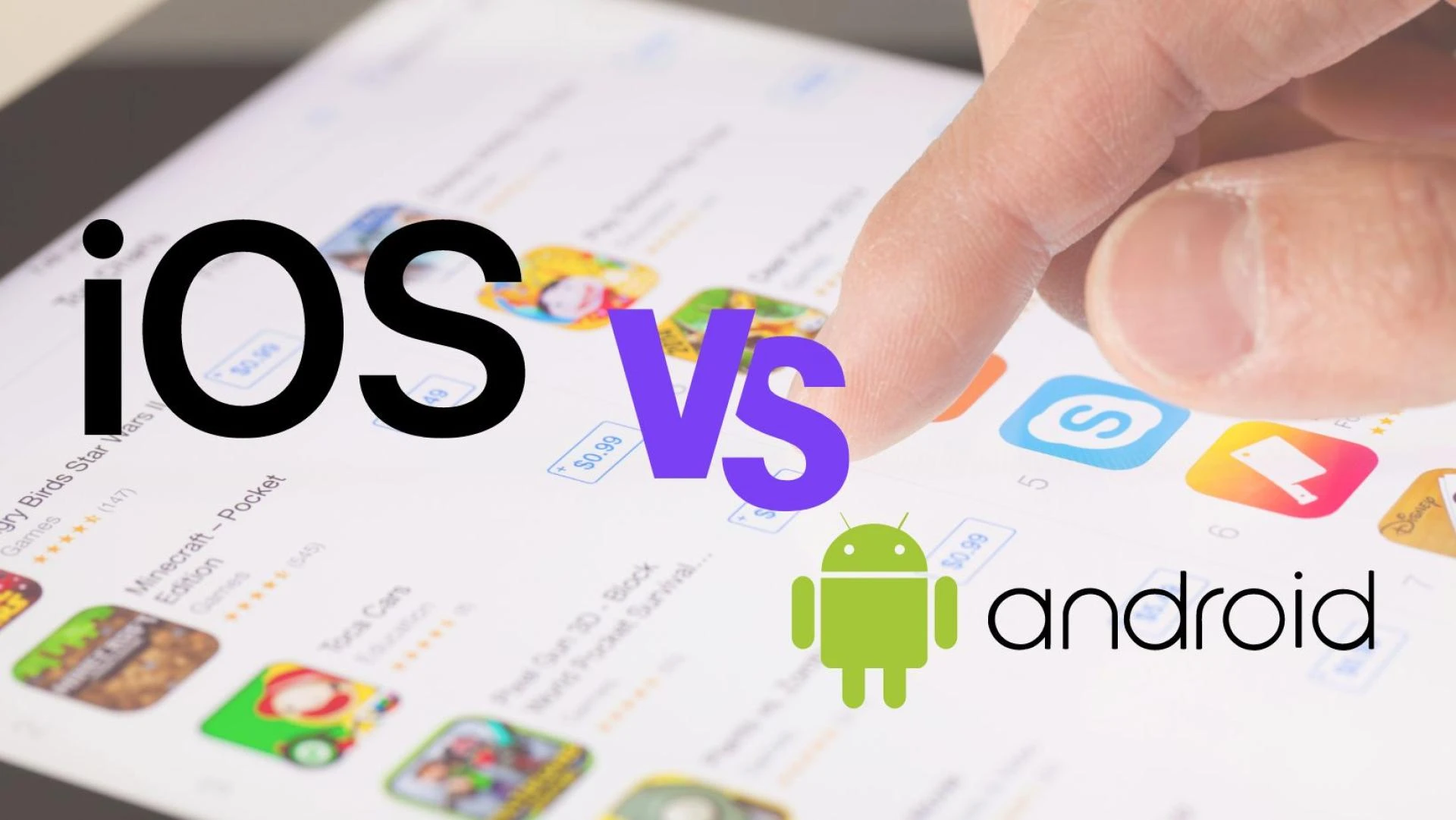

As a small or large business owner, developing a mobile app is the best marketing strategy to generate sales and bring customers to your business. According to statistical data, there are more than 30 billion global app downloads, with the mobile app industry continuing to grow.
Despite the thriving mobile app market, it has been challenging for a business to find the right platform for app development. Android vs. iOS has been in stiff competition in the market, ruling the mobile app development industry.
Although both systems serve the same purpose to bring you the best version of the mobile app, the approach to development and maintenance differs.Even the design and marketing strategies of the two systems are different. With the best iOS and Android app development services provider at your disposal, you can get the most of both worlds.
Both platforms are fantastic, but choosing between them can be challenging. To make the decision easy for you, we have put together an article covering the key differences between the two.
Read on!
iOS/Android: Market report
The number of Android users worldwide exceeds 3 billion, and the number of iOS users exceeds 1 billion. As smartphone sales grow to around 1.56 billion units worldwide each year, this number is expected to increase by huge margins.
Among the global mobile operating system market, Android is in first place with a 71.45% share, while iOS is in second place with 27.83%.
Overall, they have over 6 billion users worldwide, making them the most popular operating system in the world. $85.1 billion was spent on Apple's App Store in 2021, while $47.3 billion was spent on Google Play Store. Android accounts for over 70% of the world's operating system market share. Second place goes to iOS, with a market share of almost 25%.
How Do iOS and Android Application Development Differ?
It is essential to make sure that the platform you choose when developing a mobile application will benefit your business significantly. As a result, there are significant differences in Android and iOS app development methods and outcomes.
Let's get a deeper understanding of key differences between them.
Programming languages
The technology stacks used by iOS and Android are different. In the iOS platform, a proprietary language known as Swift is used for app development, while in the Android platform, Java or Kotlin are heavily used as alternatives.
How do you decide which stack is more efficient and easier to master? Most Android and iPhone application development company, find creating an iOS app easier than creating an Android one. Since Swift is a highly readable language, getting around it takes less time than Java.
Development environment
The Android Studio tool was introduced by Google in 2013 and has been upgraded with a more comprehensive set of features. As well as cross-platform support and high readability, this integrated development environment offers extensive development features and debugging assistance.
For iOS developers, XCode is the preferred tool. Several bug-fixing tools are part of Apple's solution, which is one of the easiest to use, fast, and supports the entire range of iOS devices.
App Development Tools
It is well known that Android offers an open-source platform that supports many third-party applications and tools. As a result, developers can experiment with various features and add more functionality to their applications. This is good because they can experiment with a broader range of features.
Besides Apple, other software vendors have their platforms for developing applications, but these tools are limited in scope. The iOS App Development Company can use external tools to develop apps, but this limits their ability to experiment with new ideas for app development.
App Testing
With the Android development platform, software developers can test their projects ahead of time using the best environment and a wide range of testing tools. There is also a testing platform included in Apple's Xcode, but it is less robust than Android's.
App Design
Apple prioritizes content over design in its apps. Thus, it is advisable to use a lot of white space and to be clear. Users interface designers commonly use contrast and gradients. In general, a multilayered application design conveys depth.
Designing for Android is influenced by real-life experiences; thus, color and motion play an important role. Android designers generally have more tools, such as visual effects, animation, and color.
App Publishing
Play store apps are very easy to publish. Following approval, an app typically goes live within a few hours. Before approving your application, though, the Apple store will test it thoroughly for any possible bugs. In addition to taking a long time, it costs more than what you would pay in the Play store.
Multitasking
Despite its uniqueness and stability, Apple's app development platform has several restrictions and tools specifically tailored for its users. Furthermore, Android OS allows for dynamic application development for all purposes, including multitasking. In addition to being useful, multitasking in apps can also present difficulties to beginners.
Conclusion
Choosing between Android and iOS app development for your new startup can be tricky, as you need to consider factors such as speed, cost, functionality, design, security, and the level of development complexity. Ultimately, your business's goals determine what platform you should use.
It is usually the best choice for those seeking a low-cost system that is easy to develop and has a low learning curve, that Android is the best option. Undoubtedly, iOS is one of the best platforms for those who want a platform that offers more security and a more appealing design.






















Sign in to leave a comment.