
Introduction
Before you deposit a single rupee into any crypto trading platform, there is one question you absolutely must ask: Is this platform safe?
In the world of cryptocurrency, this question matters more than anywhere else. Unlike traditional banks, crypto exchanges are not covered by deposit insurance. If an exchange is hacked, goes bankrupt, or turns out to be fraudulent, your money can be gone forever — with little to no legal recourse.
This is why choosing a regulated, secure, and transparent crypto exchange is not just important — it is essential.
Delta Exchange has emerged as one of India's most trusted crypto derivatives platforms — not just because of its trading features, but because of its robust security infrastructure, regulatory compliance, and transparent fund protection mechanisms.
In this comprehensive guide, we will break down everything you need to know about Delta Exchange's safety — its FIU registration, security features, fund protection measures, and how it compares to other exchanges in terms of trustworthiness.
Part 1: Regulatory Compliance — Is Delta Exchange Legal in India?
What is FIU-IND Registration?
The Financial Intelligence Unit — India (FIU-IND) is a government body under the Ministry of Finance that is responsible for collecting, processing, and analysing financial intelligence related to money laundering, terrorist financing, and other financial crimes.
In 2023, India's government mandated that all Virtual Digital Asset Service Providers (VDASPs) — including crypto exchanges — must register with FIU-IND to operate legally in India. This was a landmark regulatory step that separated legitimate, compliant platforms from unregulated, offshore operators.
Exchanges that are not registered with FIU-IND are operating outside Indian law and cannot legally serve Indian customers.
Is Delta Exchange Registered with FIU-IND?
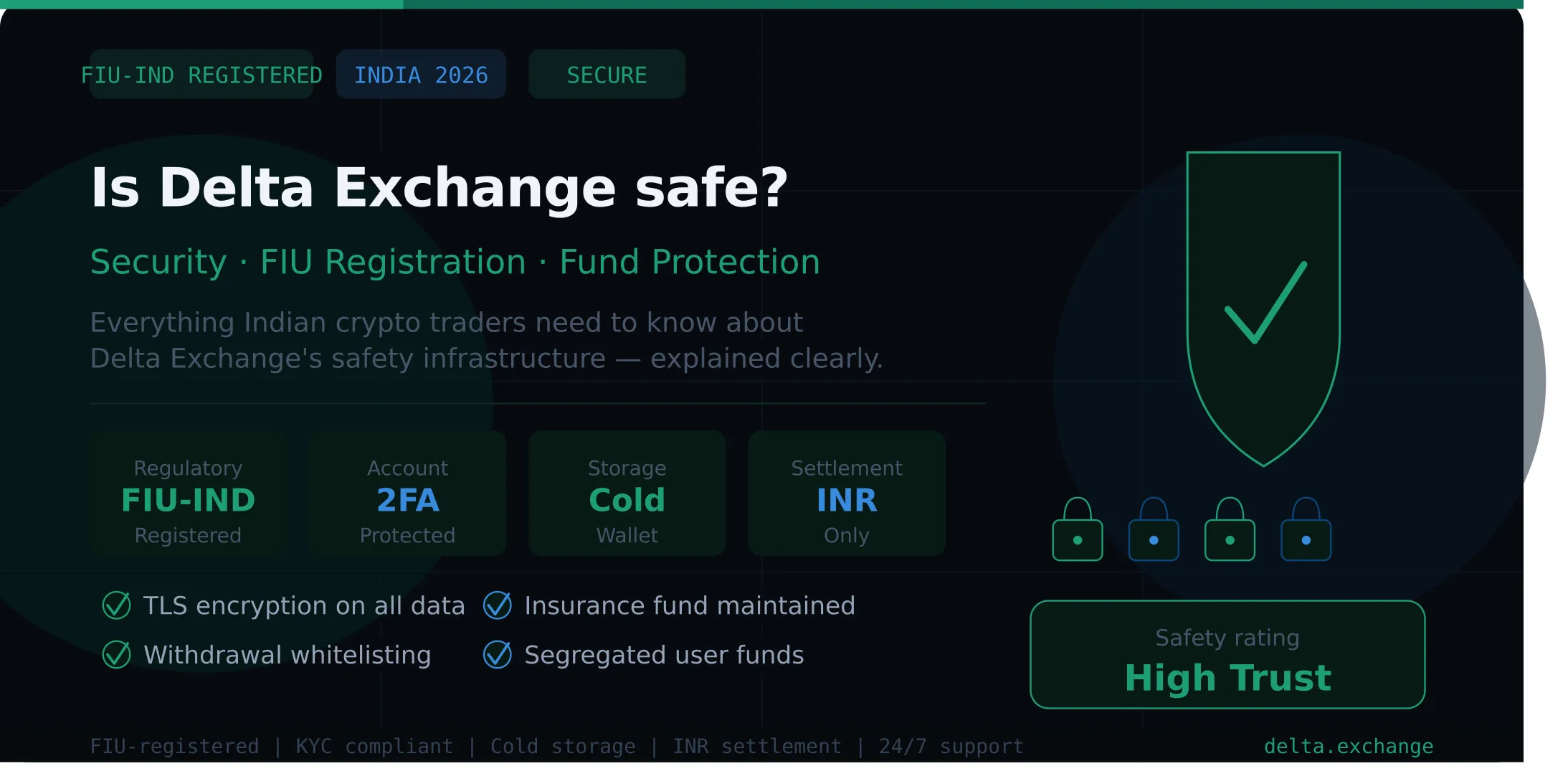
Yes. Delta Exchange is fully registered with FIU-IND and operates in complete compliance with Indian financial regulations.
This registration means:
Legal operation — Delta Exchange is legally authorised to offer crypto trading services to Indian residents. You are not breaking any law by using it.
KYC/AML compliance — Delta Exchange is required by law to verify the identity of all users (Know Your Customer) and monitor transactions for suspicious activity (Anti-Money Laundering). This protects the platform and all users from fraud and criminal activity.
Transaction reporting — Delta Exchange reports suspicious transactions to FIU-IND as required by law. This makes the platform less attractive to money launderers and more secure for legitimate traders.
Regulatory oversight — Being FIU-registered means Delta Exchange is subject to government oversight and must maintain compliance standards. This accountability is a significant safety signal for users.
How to Verify Delta Exchange's FIU Registration
You can verify Delta Exchange's registration status directly on the official FIU-IND website (fiuindia.gov.in). Look for Delta Exchange or its parent company, Excelium Technologies Private Limited, in the list of registered VDASPs.
This is something every Indian crypto trader should verify before using any platform. If an exchange is not on this list, do not use it.
What FIU Registration Means for Your Taxes
Being on a FIU-registered platform also has important tax implications. Delta Exchange automatically maintains transaction records that align with Indian tax reporting requirements. This makes it significantly easier to file your crypto taxes correctly and avoid penalties from the Income Tax Department.
Part 2: Security Infrastructure — How Delta Exchange Protects Your Account
Beyond regulatory compliance, Delta Exchange has invested heavily in technical security infrastructure to protect user accounts and funds from hackers and unauthorised access.
1. Multi-Factor Authentication (MFA / 2FA)
The first and most important layer of security for your Delta Exchange account is Multi-Factor Authentication (MFA), also known as Two-Factor Authentication (2FA).
When you enable 2FA on your Delta Exchange account, logging in requires two things:
- Your password (something you know)
- A one-time code from an authenticator app like Google Authenticator or Authy (something you have)
Even if a hacker somehow obtains your password, they cannot log into your account without the second factor — which is generated on your physical device.
Delta Exchange strongly recommends all users enable 2FA immediately after creating their account. In fact, for withdrawals and other sensitive actions, additional verification steps may be required.
How to Enable 2FA on Delta Exchange
Step 1 — Log in to your Delta Exchange account. Step 2 — Go to Settings → Security. Step 3 — Click "Enable Two-Factor Authentication". Step 4 — Download Google Authenticator or Authy on your phone. Step 5 — Scan the QR code shown on Delta Exchange. Step 6 — Enter the 6-digit code from the app to confirm. Step 7 — Save your backup codes in a secure location.
From this point forward, every login will require both your password and the authenticator code.
2. Enterprise-Grade Encryption
All data transmitted between your browser or app and Delta Exchange's servers is encrypted using TLS (Transport Layer Security) — the same encryption standard used by banks and major financial institutions.
This means:
- Your login credentials are encrypted in transit
- Your trade data is encrypted in transit
- Your personal information is encrypted in storage
- Communication between Delta Exchange's internal systems is encrypted
Even if someone intercepts your network traffic (for example, on a public Wi-Fi network), they cannot read your account data because it is encrypted.
3. Cold Wallet Storage for Crypto Assets
One of the most important security practices for any crypto exchange is how it stores user funds. The gold standard in the industry is cold wallet storage — keeping the majority of crypto assets in wallets that are completely disconnected from the internet.
Hot wallets (connected to the internet) are necessary for processing withdrawals quickly, but they are also more vulnerable to hacking. Cold wallets (completely offline) are virtually impossible to hack remotely.
Delta Exchange follows industry best practices by keeping the majority of user crypto assets in cold storage, with only a small percentage kept in hot wallets for day-to-day withdrawal processing.
This means even in the event of a cyberattack on Delta Exchange's online systems, the vast majority of user funds stored in cold wallets would remain safe.
4. Withdrawal Whitelisting
Delta Exchange offers a withdrawal address whitelisting feature that adds a powerful layer of security to your account.
When you enable withdrawal whitelisting:
- You pre-approve a list of wallet addresses to which withdrawals are allowed
- Any withdrawal to an address not on your whitelist is blocked automatically
- Adding a new address to the whitelist requires email confirmation and a 24-48 hour waiting period
This means even if a hacker gains access to your account, they cannot withdraw your funds to their own wallet — because their address is not on your whitelist, and adding it triggers a time delay that gives you time to detect and respond to the breach.
5. High-Performance Security Monitoring
Delta Exchange's security team continuously monitors the platform for:
- Unusual login attempts (logins from new devices or locations)
- Abnormal trading patterns that may indicate account compromise
- Suspicious withdrawal requests
- DDoS (Distributed Denial of Service) attacks on the platform's infrastructure
When suspicious activity is detected, Delta Exchange can automatically freeze accounts and alert users via email and SMS — giving you the opportunity to secure your account before any damage is done.
6. Anti-Phishing Measures
Phishing attacks — where fraudsters create fake websites or send fake emails pretending to be Delta Exchange — are one of the most common ways crypto users lose money.
Delta Exchange protects users through:
Official communication channels — Delta Exchange only communicates through official email domains and verified social media accounts. Always check that emails are from @delta.exchange.
Anti-phishing code — You can set a personal anti-phishing code in your account settings. This code will appear in every legitimate email from Delta Exchange. If an email does not contain your code, it is a phishing attempt.
Login alerts — Every time someone logs into your account from a new device or location, Delta Exchange sends you an email alert so you can immediately take action if it was not you.
7. API Key Security
For traders who use Delta Exchange's API for algorithmic trading, the platform provides granular API key permissions:
- Read-only keys — Can fetch market data and account information but cannot place orders
- Trade keys — Can place and cancel orders but cannot withdraw funds
- Full access keys — Required only if you need withdrawal capabilities via API (use with extreme caution)
Always create API keys with the minimum permissions required for your use case. Never create a full-access API key unless absolutely necessary, and never share your API keys with anyone.
Part 3: Fund Protection — What Happens to Your Money?
The Insurance Fund
Delta Exchange maintains an Insurance Fund — a reserve of capital specifically set aside to cover losses in exceptional circumstances.
The primary purpose of the insurance fund is to cover situations where a liquidated position results in a loss that exceeds the trader's margin — known as auto-deleveraging. In normal liquidations, the insurance fund absorbs these losses, protecting other traders from being affected.
The insurance fund is publicly visible and its balance is displayed on the Delta Exchange platform, providing transparency about the platform's financial health.
INR Settlement — No Crypto Custody Risk for F&O Traders
One of the most unique and underappreciated safety features of Delta Exchange India is that Futures and Options trading is entirely INR-settled.
This means:
- You never actually hold Bitcoin or Ethereum on the platform
- You deposit INR and trade contracts
- Your profits and losses are credited and debited in INR
- You withdraw INR back to your bank account
Since you are not holding actual cryptocurrency on the exchange, you are not exposed to the risk of your crypto being stolen in a hack. Your balance is always INR — a fiat currency — which is far more straightforward to protect and insure than crypto assets.
This is a significant advantage for Indian traders using Delta Exchange for F&O trading compared to global exchanges where you must hold crypto as collateral.
What Happens if Delta Exchange Goes Down?
Delta Exchange has a robust Business Continuity Plan (BCP) in place to ensure that the platform can continue operating even in the event of infrastructure failures, natural disasters, or other disruptions.
Key elements include:
- Redundant server infrastructure — Multiple servers in different locations so that if one goes down, others take over
- Real-time data backups — All trading data is continuously backed up so that no trade history or account data is lost
- Disaster recovery procedures — Tested protocols for restoring full platform functionality as quickly as possible after any disruption
Segregation of User Funds
Delta Exchange maintains segregated accounts — meaning user funds are kept separate from the company's own operating funds. This is a critical safety feature.
If Delta Exchange as a company were to face financial difficulties, user funds in segregated accounts cannot be used to pay the company's debts. Your money belongs to you, not to Delta Exchange's balance sheet.
Part 4: KYC — Why It Protects You
Some users are frustrated by the KYC (Know Your Customer) process — submitting PAN card, Aadhaar, and other identity documents. But KYC is actually one of the most important safety features on the platform.
Here is why KYC protects you:
Prevents account takeover — If someone tries to take over your account and withdraw your funds, they would need to pass identity verification, which is tied to your unique documents.
Prevents fraud — KYC prevents criminals from using Delta Exchange to launder money or conduct fraudulent transactions, making the platform safer for all legitimate users.
Enables account recovery — If you lose access to your account (forgot password, lost 2FA device), your verified identity documents are used to confirm your identity and recover the account. Without KYC, recovery would be nearly impossible.
Regulatory compliance — KYC is required by Indian law for all FIU-registered platforms. Using a platform without proper KYC means you are on an unregulated exchange with no legal protection.
Part 5: What Risks Still Exist?
Being safe does not mean being risk-free. Here are the risks that remain even on a secure platform like Delta Exchange:
Market Risk
The biggest risk in crypto trading is not security — it is market volatility. Crypto prices can crash 20%, 30%, or even 50% in a short period. Leveraged positions can be liquidated. Options can expire worthless.
No exchange security feature protects you from bad trades. This is why risk management is just as important as platform security.
Personal Account Security Risk
Delta Exchange can secure its systems, but it cannot secure your personal behaviour. The most common ways traders lose funds are:
- Weak passwords — Use a strong, unique password for your Delta Exchange account
- Not enabling 2FA — Always enable 2FA immediately after creating your account
- Falling for phishing — Always verify you are on the real delta.exchange website before logging in
- Sharing API keys — Never share your API keys with anyone
- Using public Wi-Fi — Avoid logging in on unsecured public networks
Smart Contract and Technical Risk
While Delta Exchange's core infrastructure is battle-tested, any software system can have vulnerabilities. Delta Exchange regularly conducts security audits and penetration testing to identify and patch vulnerabilities before they can be exploited.
Regulatory Risk
The Indian crypto regulatory landscape is still evolving. Future regulatory changes could affect how Delta Exchange operates, what products it offers, or how Indian traders are taxed. This is a systemic risk that affects all crypto platforms in India, not just Delta Exchange.
Part 6: Delta Exchange Safety vs Other Exchanges
Here is how Delta Exchange's safety profile compares to other options available to Indian traders:
| Safety Feature | Delta Exchange India | Unregistered Offshore Exchange |
|---|---|---|
| FIU-IND Registered | Yes | No |
| Legal in India | Yes | Questionable |
| KYC Required | Yes | Often No |
| INR Withdrawal to Bank | Yes | Often Difficult |
| Tax Reporting Support | Yes | Minimal |
| Cold Storage | Yes | Unknown |
| 2FA Available | Yes | Varies |
| Insurance Fund | Yes | Unknown |
| Regulated by Indian Law | Yes | No |
| User Fund Segregation | Yes | Unknown |
The difference is stark. Using an unregistered offshore exchange exposes Indian traders to regulatory risk, limited legal recourse in case of issues, uncertain fund safety, and potential tax complications.
Part 7: Best Practices for Staying Safe on Delta Exchange
Even on a secure platform, your personal security habits are the last line of defence. Here are the most important practices every Delta Exchange user should follow:
Account Security
Enable 2FA immediately — This is the single most important thing you can do. Do it before you make your first deposit.
Use a strong unique password — Use a password that is at least 12 characters long, contains uppercase and lowercase letters, numbers, and special characters. Never reuse passwords from other websites.
Set up an anti-phishing code — Go to Settings → Security → Anti-Phishing Code and set a unique code. This code will appear in all legitimate emails from Delta Exchange.
Enable withdrawal whitelisting — Add only your personal wallets to the whitelist and enable the security lock.
Save your 2FA backup codes — If you lose your phone, you will need these codes to recover access. Store them offline in a secure location.
Login Security
Always verify the URL — Before logging in, confirm you are on https://www.delta.exchange — not a lookalike phishing domain.
Never log in on public Wi-Fi — Use a VPN if you must access Delta Exchange on a public network.
Check login alerts — Pay attention to login notification emails. If you receive one when you were not logging in, immediately secure your account.
Use a dedicated email — Consider using a separate email address exclusively for your Delta Exchange account that you do not use for any other purpose.
Trading Security
Create minimal-permission API keys — If using the API, create separate keys for reading data and for trading. Never give trading bots withdrawal permissions unless absolutely necessary.
Regularly review active sessions — In your account settings, check which devices are currently logged in and revoke any you do not recognise.
Monitor your account regularly — Check your account balance and trade history regularly. Any unexpected changes should be investigated immediately.
Conclusion
Delta Exchange is one of the safest and most regulated crypto trading platforms available to Indian traders in 2026. Its FIU-IND registration, enterprise-grade security infrastructure, INR settlement model, cold wallet storage, insurance fund, and segregated user accounts combine to create a robust safety framework that gives Indian traders genuine confidence.
However, platform security is only half the equation. Your personal security habits — enabling 2FA, using strong passwords, verifying URLs, and protecting your API keys — are equally important. The best security system in the world cannot protect you if you give your credentials to a phishing website.
The bottom line: Delta Exchange is a legitimate, regulated, and secure platform for Indian crypto traders. Use it with proper security practices and appropriate risk management — and your funds are as safe as they can be in the crypto world.
Disclaimer: This article is for informational purposes only. While Delta Exchange has strong security measures, all investments carry risk. Crypto markets are highly volatile and past security track records do not guarantee future safety. Always conduct your own research and never invest more than you can afford to lose. For the most up-to-date security information, refer to Delta Exchange's official website and help documentation.




















Sign in to leave a comment.