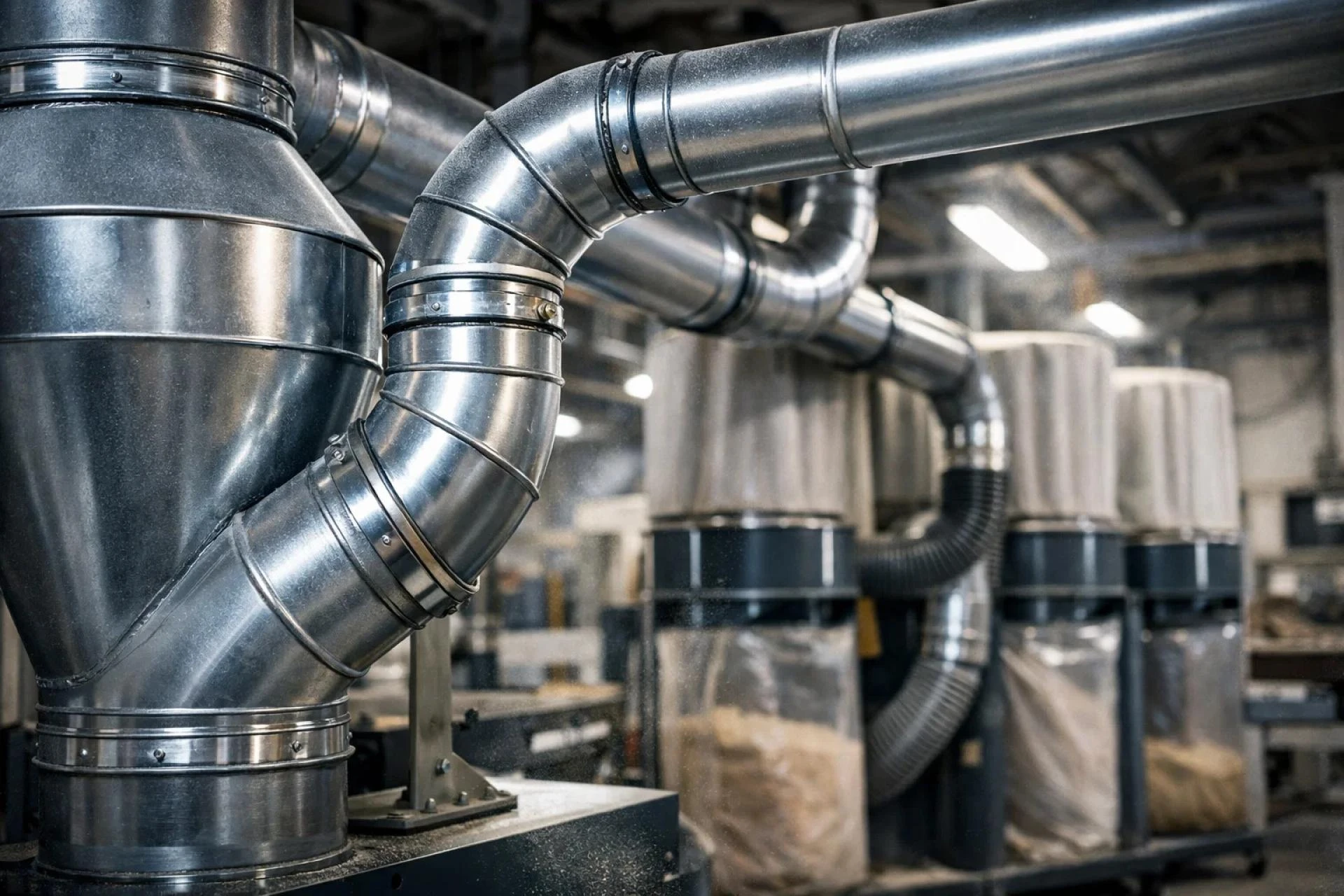

When managers and operators think of cyclone dust collectors, they consider only the visible system – the big vessel, the swirling cyclone action, and clean air separation. But dust collectors are only part of the solution. Dust travels on air, and that means ducting. Ducting equals pipework, and it is often where the performance pitfalls are.
If you consider a dust collection system as a pipeline of extracted air energy, then your cyclone is just one component. Think of the pipework as the pipeline that fuels that solution. That’s why cyclone dust collector performance is only ever as good as the ductwork attached to it.
The invisible performance killer
A cyclone works by creating a predictable airflow at a certain velocity that causes dust particles to separate from the air. If the ducting configuration entering and exiting it creates turbulent airflow velocities that are too slow or unpredictable, performance will suffer. Airflow issues often go unseen until suction drops, dust escapes through blow-offs or ducting frequently blocks.
Your cyclone system has to work harder (meaning more suction energy is expended) to achieve standard flowrates. Your collector may still perform adequately, but it’s less efficient, wears out faster, and is unlikely to maintain optimum hygiene performance.
Poor pressure = poor performance
It should come as no surprise that system pressure loss is another critical factor in overall dust extraction performance. The longer the duct run and the more turbulence created in your pipework design, the harder your extraction system must work to produce adequate suction.
Essentially, if you use the wrong pipework configuration for your cyclone dust collector UK, you can create enough pressure loss to prevent your dust collector from operating under its designed conditions.
Here’s what happens when your system doesn’t have enough pressure:
- Dust cannot lift and flows out of the machine via ducting.
- The system will block more frequently.
- Fans and blowers are forced to work harder which will increase energy bills and reduce service life.
- Operators will often increase fan speeds which can create noise and vibration issues and shorten mechanical lifespan.
The solution to poor system pressure often isn’t as simple as upgrading the cyclone. Instead, it requires examining your entire air flow system starting with the pipework.
Pipe envy
Thankfully, pipework these days is a far cry from simply “fitting some pipes”. Engineered systems these days are designed for performance, hygiene and longevity. A durable modular solution is ideal for use in industrial plants for several reasons. Firstly, it’s built tough. Dust collection isn’t kind on pipework. Vibrations, abrasion, thermal shock and fatigue from constant use are just a few of the stressors pipework will be subjected to.
Here are just some of the benefits of a durable modular approach:
- Elimination of turbulence and airflow restriction through consistent internal diameters.
- Stronger joints and precision-engineered connections drastically reduce leak points.
- Ability to modify and change the pipework system as your production requirements demand.
- Modules with smooth internal surfaces greatly improve the cleanliness of the entire system.
Dirty secrets
Durable pipework also guards your entire system against some of the destructive forces of abrasive dust collection. As particles flow through poor ducting configurations, they can wear away at internal surfaces causing leaks or weak points that are susceptible to rupture. High-grade durable modular systems are designed to limit the amount of wear and tear on your dust extraction system.
While improved performance, ease of cleaning and system durability are benefits in their own right. Manufacturers who process foods or pharmaceutical products have another major consideration – compliance.
Customers do not want dust in their food or medication. Even the smallest particle can ruin an entire production batch, forcing you to recall products and damage your brand. As a result, pipework in food processing and pharmaceutical plants must meet stringent standards.
Not only do customers typically require both European and US FDA food-grade materials. They often specify the system must be designed to be detected by metal detectors or X-ray machines at finished product inspection checkpoints.
Food grade doesn’t always mean stainless steel.
That doesn’t mean pipework can’t be stainless steel. Many customers specify 304L or 316L stainless steel quick-connect pipework for exactly that reason. But there are plenty of non-metallic materials that are just as compliant.
If your dust collection system is struggling to meet its performance targets, or you are moving into a food-grade operation and need to upgrade your existing ductwork, take some time to assess your pipework solution.
Modern engineered systems are designed around whole-of-plant performance. Not only will you notice improved efficiencies throughout your dust extraction network, but you’ll have the peace of mind knowing that your cyclone won’t fail or combust. To learn more about modular dust extraction solutions be sure to work with a reputable and trusted pipework systems manufacturer.





























Sign in to leave a comment.