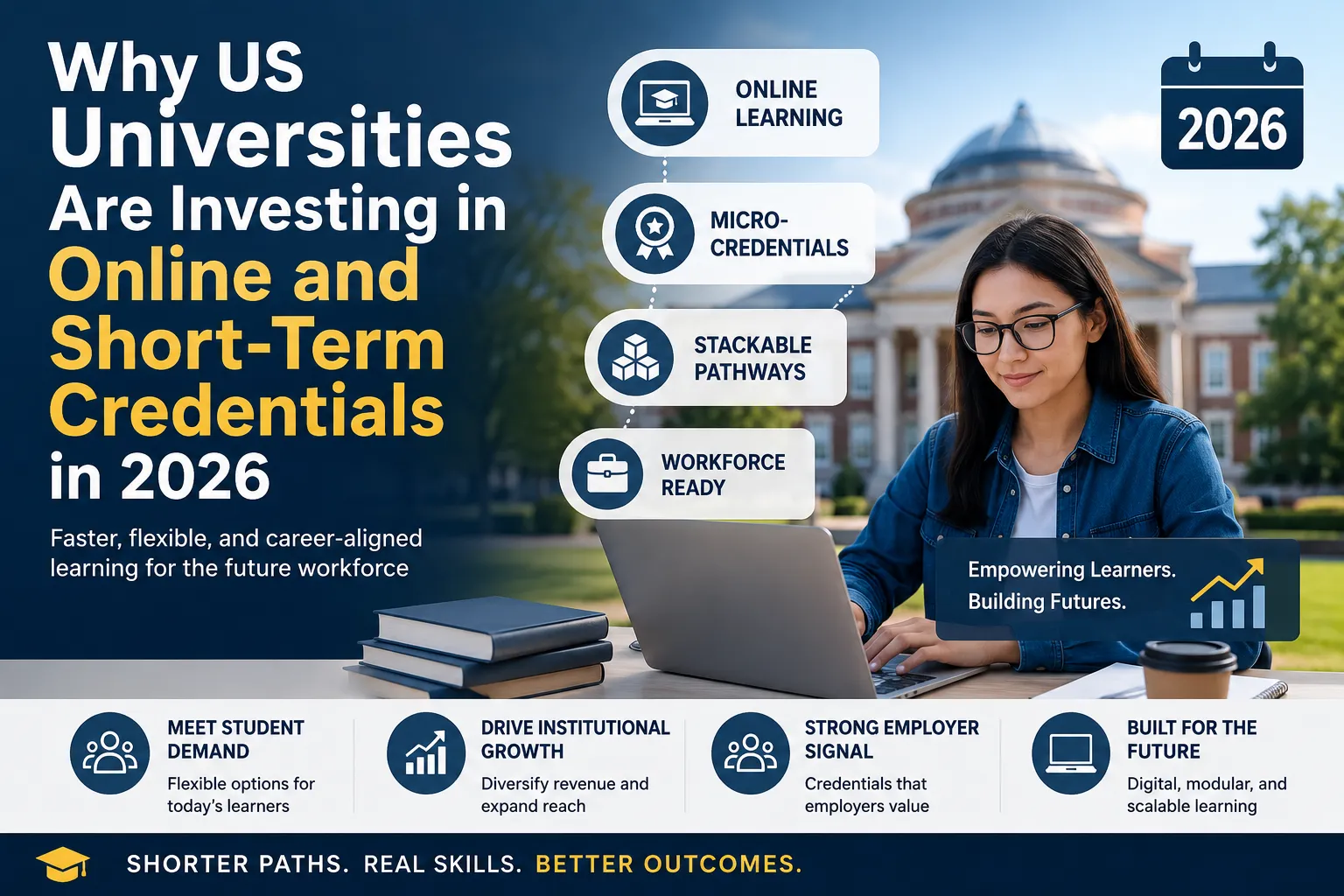

Online and short-term credentials are becoming a major force in higher education. Across the United States, universities are investing heavily in digital learning, micro-credentials, and workforce-focused certificate programs. The shift reflects changing student expectations, employer demand for job-ready skills, and institutional efforts to create more flexible learning pathways.
Students no longer view education as a single four-year journey followed by a lifetime career. Instead, many learners want qualifications that can be earned quickly, applied immediately, and expanded over time. Universities are responding by building online programs and stackable credentials that fit modern career realities.
Why Online and Short-Term Credentials Are Expanding
Universities are investing in online and short-term credentials because workforce alignment has become a top priority. Institutions increasingly design certificates and micro-credentials around practical skills that employers actively seek. This approach helps learners gain targeted expertise while providing universities with new opportunities for growth.
The appeal is simple. A student can complete a short program in data analytics, project management, cybersecurity, or digital marketing without committing to another full degree. These credentials provide visible proof of skills and can often be completed in months rather than years.
Employer acceptance is strengthening this trend. Hiring managers increasingly recognize digital badges, certificates, and industry-focused credentials as valuable indicators of workplace readiness. As a result, US universities are treating these programs as a core part of their academic strategy rather than experimental offerings.
Students Want Flexible Learning Options
Student demand is one of the biggest drivers behind the growth of online and short-term credentials. Many learners balance work, family responsibilities, internships, and financial pressures. Traditional classroom schedules do not always fit these realities.
Online education removes many of those barriers. Students can access coursework from virtually anywhere, study at flexible times, and progress at a pace that matches their personal circumstances. This flexibility is especially attractive to working professionals, adult learners, transfer students, and international students.
Think of higher education today like streaming entertainment. Most people no longer wait for a fixed broadcast schedule. They expect content on demand. Learning is moving in a similar direction, with students seeking education that fits into their lives rather than requiring their lives to revolve around education.
Online Education Is Becoming Mainstream
Online education has evolved from an alternative option into a mainstream delivery model. Leading universities now offer extensive online degrees, certificates, and professional development programs. The growing participation of highly respected institutions has increased the credibility of online learning among both students and employers.
The benefits extend beyond convenience. Digital learning platforms allow universities to reach students across states and international borders. They also support scalable program delivery, making it possible to serve larger and more diverse student populations.
As universities redesign programs for online delivery, they are creating learning experiences built around digital access, modular achievements, and career-focused outcomes rather than simply transferring classroom lectures to a screen.
Micro-Credentials and Stackable Programs Gain Momentum
Micro-credentials have become one of the fastest-growing segments of higher education. Universities are expanding certificate offerings and stackable learning pathways that allow students to build qualifications gradually.
A stackable model enables learners to start with a short certificate, earn additional credentials over time, and potentially apply those achievements toward larger qualifications. This approach creates flexibility while reducing the financial and time commitment often associated with traditional degree programs.
The strategy also helps students remain competitive in industries where knowledge changes rapidly. Technology, healthcare, business, and analytics fields frequently require ongoing skill development. Short-term credentials provide a practical way to stay current without repeatedly returning for full degree programs.
Digital Platforms Are Accelerating Growth
The success of online and short-term credentials depends heavily on digital learning platforms. Universities increasingly partner with learning ecosystems that support online course delivery, assessments, digital badges, and learner analytics.
These platforms make it easier to package educational content into career-focused formats that appeal to modern learners. They also allow institutions to experiment with new credential structures while maintaining quality standards.
As competition grows, universities recognize that students compare educational options not only with other institutions but also with independent online learning providers and employer-sponsored training programs. Strong digital infrastructure has therefore become a competitive necessity.
Student Support Matters More Than Ever
As online learning expands, academic support becomes increasingly important. Short-term programs often move quickly, requiring students to manage deadlines, projects, and assessments within compressed timelines.
Many universities provide tutoring, advising, writing assistance, and library services. However, students frequently seek additional support to strengthen their understanding of complex subjects and manage demanding workloads. Platforms like Expertsmind.com that connect students with verified tutors and academic experts can provide valuable assistance for assignment guidance, concept clarification, and research support within online learning environments.
Effective support systems help students stay engaged, improve performance, and successfully complete accelerated programs.
What the Future Holds for Higher Education
The growth of online and short-term credentials signals a broader transformation in higher education. Universities are adapting to a world where flexibility, employability, and lifelong learning matter as much as traditional degree structures.
Online and short-term credentials are no longer side projects. They have become a central part of how institutions attract learners, respond to workforce needs, and expand educational access. Students now have more pathways than ever to gain valuable skills, advance careers, and continue learning throughout their lives.
The universities that succeed in the coming years will be those that combine strong digital experiences, meaningful credentials, and reliable student support. In 2026, education is becoming less about a single destination and more about building a flexible pathway that evolves alongside changing career goals.




























Sign in to leave a comment.