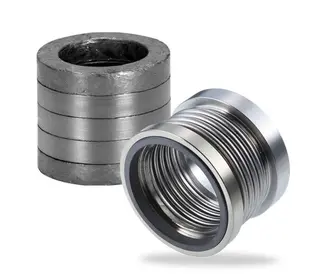

In industrial production, sealing components may be small, but their role is indispensable. Whether in chemical plant reactors, pharmaceutical mixing tanks, or food processing pipelines, seals act as silent guardians—protecting internal media from leaking and preventing environmental contamination, resource loss, or safety hazards. Today, we will explore two common sealing types—packing seals and bellows seals—and compare their principles, advantages, disadvantages, and application scenarios.
Packing Seal: A Traditional Yet Reliable Solution
Packing seals, also known as gland packing seals, are one of the oldest and most widely used sealing methods. Their operation relies on packing material placed inside a stuffing box. When the gland bolts are tightened, the packing is compressed, forcing it to expand radially against both the shaft and the stuffing box wall to form a seal. Think of it like squeezing soft material inside a cavity until it tightly contacts the surrounding surfaces—blocking any gas or liquid from escaping.
1. Advantages of Packing Seals
• Simple structure and easy installation
Packing seals consist of simple components and require no specialized tools. Installation involves placing the packing rings and tightening the gland, making maintenance fast and cost-efficient.
• Wide applicability
With the right packing selection—such as asbestos, PTFE, graphite, or composite materials—packing seals can handle everything from low-pressure water to corrosive chemicals.
• Low cost
Packing materials are inexpensive and readily available. For small and medium-sized enterprises, packing seals offer an economical solution for equipment upgrades or repairs.
2. Disadvantages of Packing Seals
• Higher likelihood of leakage
Because the packing and shaft slide against each other, micro-gaps inevitably form over time. In high-pressure or high-speed systems, these gaps increase leakage risk.
• Shorter service life
Constant friction causes packing to wear out, typically requiring replacement every few months.
• Regular maintenance required
Packing seals must be periodically tightened, inspected, and replaced to maintain reliability—resulting in higher labor demands.
Bellows Seal: A High-Performance Modern Sealing Technology
Bellows seals represent a more advanced sealing method, using a corrugated metal bellows as the key element. The bellows expands and contracts elastically to maintain consistent sealing pressure between the mating surfaces. Functionally, it acts like a precision-built spring that automatically adjusts to pressure and temperature variations.
1. Advantages of Bellows Seals
• Exceptional sealing performance
Bellows seals achieve extremely low leakage—often only 1% of that of packing seals—making them ideal for applications with strict environmental or safety requirements.
• Long service life
With no dynamic O-rings or sliding friction surfaces, bellows seals experience minimal wear and can run stably for one to two years or longer.
• Strong resistance to harsh conditions
Bellows can handle high temperature, high pressure, corrosion, and aggressive media, with material options tailored to specific environments.
• Low maintenance and automation-friendly
Once installed, bellows seals require little manual adjustment—perfect for automated production lines or facilities with limited maintenance personnel.
2. Disadvantages of Bellows Seals
• Higher initial investment
Manufacturing precision and special materials make bellows seals more expensive upfront.
• High installation accuracy needed
Misalignment, improper pin-slot positioning, or poor perpendicularity can lead to sealing failure.
• Limited tolerance for radial movement
Bellows are designed for axial movement only; shaft wobble or eccentricity can damage the bellows.
• Fatigue risk
Repeated pressure and thermal cycling may lead to metal fatigue, especially in demanding services.
Comparison: Packing Seals vs. Bellows Seals
AspectPacking SealBellows SealSealing PerformanceModerate, prone to leakageExcellent, extremely low leakageService LifeShorter, frequent replacementsLong, minimal wearApplicabilityBroad; suitable for general conditionsBest for harsh or high-spec conditionsCostLow upfront costHigh initial costMaintenanceFrequent adjustment neededLittle to no ongoing maintenance
How to Choose the Right Seal?
1. Analyze working conditions
- High temperature/pressure, corrosive media, strict sealing → Bellows seal
- Low complexity environments, general pumps, or pipelines → Packing seal
2. Consider medium characteristics
- Corrosive chemicals → corrosion-resistant packing or bellows materials
- High-temperature steam → metal bellows
- Low-temperature refrigerants → rubber bellows
3. Evaluate cost and long-term economics
- Low initial budget → packing seal
- Lower long-term maintenance cost → bellows seal
4. Assess maintenance capability
- Skilled maintenance team → packing seals manageable
- Limited staff or automated systems → bellows seals preferred
Conclusion
Packing seals and bellows seals both play vital roles in industrial sealing. Packing seals are economical, simple, and widely adaptable, but require frequent maintenance and offer lower sealing performance. Bellows seals, though costlier and more demanding in installation, provide outstanding reliability, long service life, and strong resistance to harsh operating environments.
Choosing the right seal depends on operating conditions, medium type, budget, and maintenance capabilities. With proper installation and maintenance, either sealing method can deliver safe, effective, and stable performance for industrial applications.It's important to know about Google SEO to help your website rank higher in search results.



























Sign in to leave a comment.