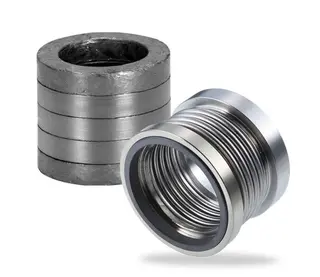

Packing Seals vs. Bellows Seals: A Complete Guide for Industrial Applications
In industrial production, sealing components may be small, but their role is crucial. Whether in chemical reactors, pharmaceutical mixing tanks, or food-processing pipelines, seals act as guardians, protecting the medium inside equipment and preventing leakage that could cause environmental pollution, resource waste, or safety hazards.
Two common types of seals are packing seals and bellows seals. This article explores their features, advantages, disadvantages, and ideal applications to help guide industrial sealing decisions.
Packing Seals: A Traditional and Reliable Choice
Packing seals, also called gland packing seals, are a long-established sealing method. Their core principle lies in the packing material:
- The packing is placed into a stuffing box, and axial pressure applied by the gland bolts compresses it.
- This compression forces the packing to adhere tightly to the shaft and the inner wall of the stuffing box, preventing liquid or gas from escaping.
Think of it like stuffing a soft material into a cavity and squeezing it until it forms a tight seal around the shaft.
Advantages of Packing Seals
- Simple structure and easy installation:
Packing seals have a straightforward design. Installation involves placing the packing in the stuffing box and tightening the gland bolts. This simplicity allows quick installation, even by non-specialists, saving time and labor costs. - Wide applicability:
Packing seals can accommodate a range of media and operating conditions. Ordinary asbestos packing suits small water pumps, while corrosion-resistant packing handles strong acids and alkalis in chemical applications. - Low cost:
Packing materials are inexpensive and widely available, making this method cost-effective for small and medium-sized enterprises or budget-limited projects.
Disadvantages of Packing Seals
- Prone to leakage:
Relative motion between the shaft and packing creates unavoidable micro-gaps, which may enlarge over time, especially in high-pressure or high-speed equipment. In chemical plants, leaks could release toxic or hazardous media. - Short service life:
Friction from shaft rotation gradually wears the packing, requiring replacement every few months to a year. - Regular maintenance needed:
Maintaining sealing effectiveness requires periodic tightening of gland bolts and inspection of wear, which can be labor-intensive for facilities with many installations.
Bellows Seals: A Modern, High-End Option
Bellows seals employ a metal bellows as the core sealing element. A bellows is a corrugated metal tube that can expand and contract axially. Through elastic deformation, it maintains tight contact between two sealing surfaces, functioning like a flexible spring that automatically adjusts sealing force in response to pressure or temperature changes.
Advantages of Bellows Seals
- Excellent sealing performance:
Leakage rates are extremely low—often only about 1% of packing seals—making bellows ideal for high-temperature, high-pressure reactors, sterile environments, and other demanding applications. - Long service life:
Bellows seals contain no sliding parts or dynamic O-rings, minimizing friction and wear. They can operate continuously for one to two years or more, reducing maintenance frequency and cost. - Strong adaptability:
Different bellows materials suit diverse conditions. Metal bellows handle high-temperature steam, while rubber bellows work for low-temperature refrigeration systems. - Automation-friendly:
Bellows seals require minimal manual adjustments, making them ideal for automated production lines.
Disadvantages of Bellows Seals
- Higher cost:
Precision manufacturing and high-quality materials make bellows seals more expensive. - Installation accuracy required:
Proper alignment of anti-rotation slots and sealing faces is critical. Misalignment can reduce performance or cause failure. - Limited tolerance for radial movement:
Bellows seals are designed for axial movement. Shaft wobble or eccentricity can accelerate wear or lead to failure. - Susceptible to fatigue:
Repeated pressure fluctuations, thermal cycles, or high-speed shaft motion may cause metal fatigue, potentially resulting in cracks and leakage.
Comparing Packing Seals and Bellows Seals
| Feature | Packing Seal | Bellows Seal |
|---|---|---|
| Sealing performance | Moderate; micro-gaps may cause leakage | Excellent; extremely low leakage |
| Service life | Short; requires frequent replacement | Long; minimal maintenance required |
| Applicability | Broad; suitable for general conditions | Ideal for harsh conditions and critical applications |
| Cost | Low; economical | High; upfront investment higher |
| Maintenance | Regular tightening and inspection | Minimal; supports automated systems |
How to Choose the Right Seal
Selecting the appropriate sealing method depends on working conditions, media characteristics, budget, and maintenance capability:
- Working conditions:
- High temperature, high pressure, corrosive media, or stringent sealing → Bellows seals
- Low pressure, low speed, simple media → Packing seals
- Medium characteristics:
- Corrosive media → corrosion-resistant packing or bellows
- High-temperature steam → metal bellows
- Low-temperature media → rubber bellows
- Budget considerations:
- Packing seals → lower upfront cost, more frequent replacement
- Bellows seals → higher initial cost, lower long-term maintenance
- Maintenance capabilities:
- Skilled maintenance staff → packing seals manageable
- Limited maintenance resources → bellows seals reduce operational risk
Conclusion
Both packing seals and bellows seals have important roles in industrial production:
- Packing seals: Simple, cost-effective, and versatile, but prone to leakage, short-lived, and maintenance-intensive.
- Bellows seals: High-performance, long-lasting, and adaptable, but require higher investment and precise installation.
Choosing the right seal requires careful assessment of operating conditions, media properties, budget, and maintenance resources. Proper installation and maintenance are equally crucial to ensure effective sealing and safe, efficient industrial operation.China manufacturer offers high-quality industrial products with competitive pricing and advanced production capabilities.



























Sign in to leave a comment.