

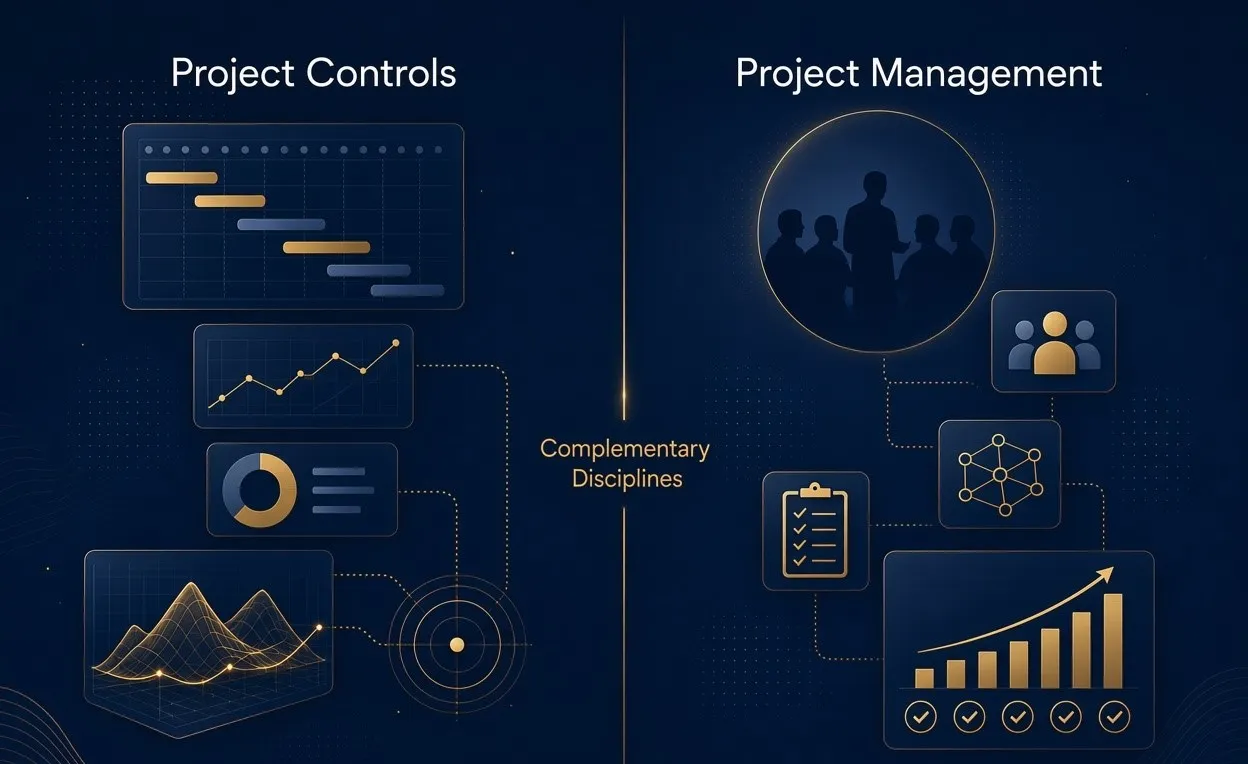
Project controls and project management work closely together, but they are not the same discipline. A project management certification generally focuses on leading people, managing delivery, stakeholders, scope and business priorities, while a project controls certification focuses more deeply on planning, scheduling, cost, forecasting, earned value, risk and performance measurement. Project Controls Institute positions project controls as an integrated discipline designed to help professionals understand and control the numbers, schedule and risks behind project delivery.
Project Controls Certification vs Project Management Certification
A project management certification is generally better suited to professionals responsible for leading and delivering projects. A project controls certification is more specialized for professionals working with schedules, costs, forecasting, earned value, risk and performance data. If your career is moving toward planning, cost control or project controls leadership, a controls-focused certification may be the more relevant choice.
What Is a Project Management Certification?
A project management certification validates knowledge and competence in managing projects from initiation through delivery and closure.
Project management typically covers areas such as:
- Project scope and objectives
- Planning and execution
- Team leadership
- Stakeholder management
- Communication
- Risk and issue management
- Change management
- Project governance
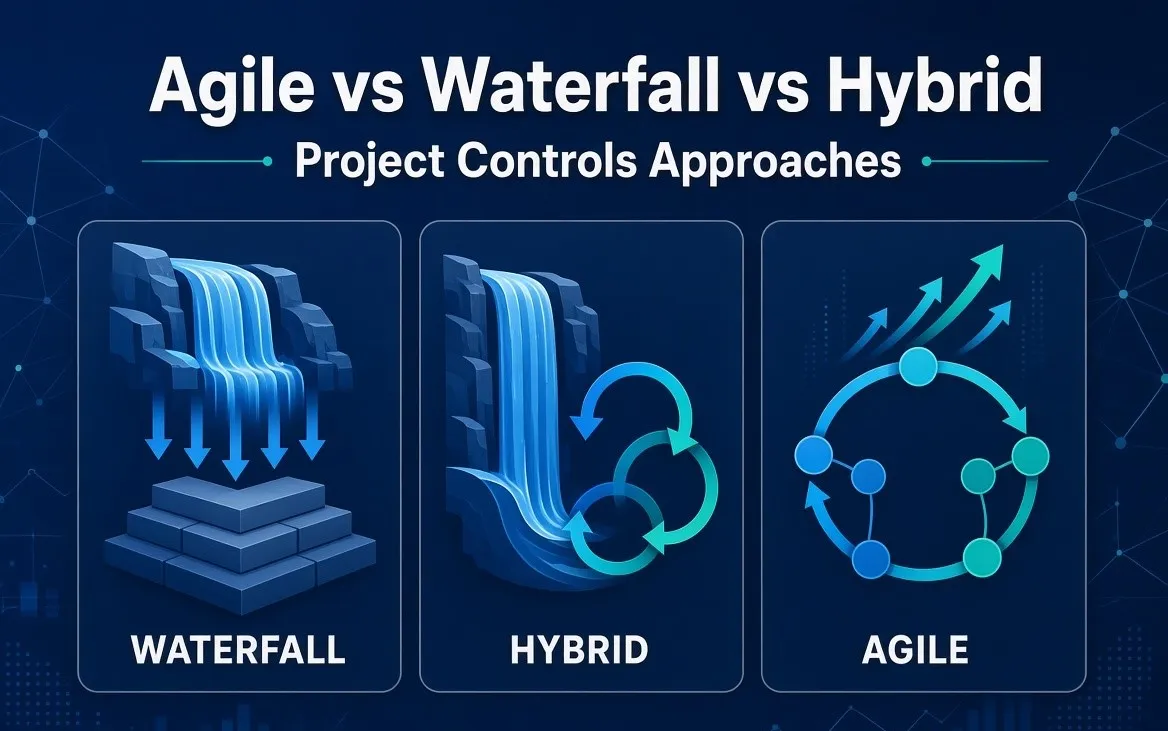
- Delivery methods such as predictive, agile or hybrid approaches
For example, PMI describes project management as applying knowledge, skills, tools and techniques to project activities to meet project requirements. Its PMP certification focuses on the ability to lead projects, including people, processes and business priorities.
This makes project management certification particularly relevant for project managers, delivery managers, program professionals, PMO professionals and people responsible for overall project outcomes.
What Is a Project Controls Certification?
A project controls certification focuses on the systems, processes and analytical techniques used to understand whether a project is performing according to its approved plan.
Project controls commonly includes:
- Planning and scheduling
- Cost management
- Budgeting and forecasting
- Earned Value Management
- Variance analysis
- Risk management
- Progress measurement
- Performance reporting
- Commercial and contract controls
- Project finance
- Data and analytics
The objective is not simply to deliver a project. It is to provide reliable information that helps project teams understand where the project stands, where it is heading and what corrective action may be needed.
Modern project controls are also becoming more integrated with AI. This creates demand for professionals who understand not only traditional controls techniques but also how AI-generated forecasts, reports and analysis should be validated and governed.
Project Controls vs Project Management: The Main Difference
The easiest way to understand the difference is to look at the primary question each discipline helps answer.
Project management asks:
“How do we lead and deliver this project successfully?”
Project controls asks:
“Are we performing according to plan, what is changing, what will happen next, and what should we do about it?”
The two functions overlap significantly, but their depth and day-to-day responsibilities can be different.
Project management focuses more on:
- Leadership
- Teams
- Stakeholders
- Scope
- Delivery
- Governance
- Communication
- Strategic objectives
Project controls focuses more on:
- Schedule
- Cost
- Budget
- Forecasts
- Earned value
- Variances
- Risk
- Performance data
- Project reporting
Neither discipline is inherently better. The right certification depends on the role you want to perform.
Also read: WBS vs Project Schedule: Understanding the Difference
Project Controls Certification vs Project Management Certification: Quick Comparison
For someone comparing the two certification paths, the most important differences are:
Project management certification
Best suited for professionals who want to:
- Lead project teams
- Manage stakeholders
- Coordinate project delivery
- Manage scope and change
- Work across different project methodologies
- Progress toward project or program management roles
Project controls certification
Best suited for professionals who want to:
- Manage project schedules
- Control project costs
- Build and review forecasts
- Analyse project performance
- Work with earned value
- Manage project risks
- Support project decision-making with data
- Progress toward project controls leadership
This distinction is useful because a certification should match the work you actually want to perform rather than simply having a popular name.
Which Certification Is Better for Engineers?
Engineers often work between technical delivery and project management, so either certification can be useful.
A project management certification may be appropriate if the engineer wants to move toward:
- Project manager
- Engineering project manager
- Delivery manager
- Program management
- Project leadership
A project controls certification may be more relevant if the engineer works primarily with:
- Planning
- Scheduling
- Cost control
- Progress measurement
- Estimation
- Forecasting
- Earned value
- Risk analysis
This is why a project controls certification for engineers can make sense for professionals who want to develop deeper commercial and performance-control skills without moving entirely away from technical project environments.
Which Certification Is Better for Planners and Schedulers?
For planners and schedulers, a project controls certification is often more directly aligned with their technical responsibilities.
Scheduling is only one part of the broader controls discipline. A controls professional may need to understand how schedule performance connects with:
- Cost
- Earned value
- Forecasting
- Risk
- Productivity
- Contracts
- Cash flow
- Management reporting
This broader understanding can help planners move from producing schedules to interpreting what the schedule means for the overall project.
What About Project Managers?
Project managers do not necessarily have to choose one path exclusively.
A project manager may benefit from project management certification when the primary goal is leadership and delivery. However, adding project controls knowledge can strengthen the ability to understand cost and schedule performance.
This is particularly relevant for project controls certification for project managers when a project manager wants stronger analytical skills or is moving toward an integrated project controls leadership role.
Where Does AI Fit Into Both Certifications?
AI is changing both project management and project controls, but the practical applications can differ.
In project management, AI can assist with:
- Meeting summaries
- Communication
- Risk identification
- Planning
- Stakeholder analysis
- Scenario development
- Project documentation
In project controls, AI can assist with:
- Schedule forecasting
- Cost forecasting
- Anomaly detection
- Variance analysis
- Risk analysis
- Performance reporting
- Data interpretation
However, AI output should not automatically be treated as fact. Professionals need to understand the source data, assumptions, limitations and appropriate level of human review.
This is one reason an AI project controls certification can be relevant to professionals working in modern controls environments. Project Controls Institute integrates governed AI into its PCL-AI credential, covering planning, cost engineering, earned value, forecasting, risk and project finance alongside responsible AI use. Its published examination structure includes project accounting and finance, project management principles and AI knowledge and practical application.
How to Choose the Right Certification
Before choosing between project controls and project management certification, ask yourself five questions.
1. What is your current role?
If you are a project manager, delivery lead or team leader, project management certification may align more naturally with your current responsibilities.
If you are a planner, scheduler, cost engineer or controls specialist, project controls certification may be more closely related to your daily work.
2. What role do you want next?
Think beyond your current job title.
If your goal is to become a:
- Project Manager → project management certification may be appropriate.
- Senior Planner → project controls may be valuable.
- Cost Controller → project controls is directly relevant.
- Project Controls Manager → a controls-focused credential may provide stronger alignment.
- Program Manager → project/program management certification may be more suitable.
3. Do you prefer leadership or analytical control?
Project management tends to emphasize leadership, coordination and delivery.
Project controls tends to emphasize measurement, analysis, forecasting and performance control.
Of course, experienced professionals often need both.
4. What does the certification actually assess?
Do not choose a credential based only on its title.
Review:
- Eligibility
- Exam structure
- Competency areas
- Experience requirements
- Assessment method
- Renewal or CPD requirements
- Recognition within your target industry
- Whether the content matches your career direction
For example, the current PCL-AI examination is described as a scenario-based assessment rather than a simple definition-recall test.
5. Does it match your career market?
Consider the sectors and regions where you want to work.
For example, professionals targeting infrastructure, engineering, construction, energy or major capital projects may find strong value in combining project management knowledge with specialized controls capabilities.
Project Controls Certification Eligibility: What Should You Check?
Certification eligibility varies significantly between providers, so candidates should always check the current requirements directly with the certifying organization.
For example, the current PCL-AI eligibility route is based on professional experience rather than requiring a specific university degree. PCI states that the experience route is open to candidates with three years of experience in any field, with a foundation pathway available for newer candidates.
By comparison, PMP has specific education, project leadership experience and training requirements. PMI currently lists several eligibility routes, including a bachelor's degree or higher plus three years of project leadership experience, along with 35 hours of project management education.
This illustrates why project controls certification eligibility and project management certification eligibility should be evaluated separately.
Which One Should You Choose?
A simple decision framework can help.
1. Choose project management certification if:
- You want to lead projects and teams.
- You manage stakeholders and project delivery.
- You want broader project leadership recognition.
- You plan to move toward project, program or portfolio management.
2. Choose project controls certification if:
- You work in planning, scheduling or cost control.
- You enjoy project data and performance analysis.
- You want deeper forecasting and earned-value knowledge.
- You want to specialize in integrated project controls.
- You want to work with AI-enabled controls and forecasting.
3. Consider both if:
- You are moving into senior project leadership.
- You manage complex capital projects.
- You need both delivery and performance-control expertise.
- Your career goal is project controls or project leadership at a senior level.
Final Takeaway
Project controls certification and project management certification are complementary rather than competing choices. Project management focuses more on leading and delivering projects, while project controls focuses more on measuring, forecasting and controlling project performance. The right choice depends on your current role and career direction. Project Controls Institute offers PCL-AI, PFL-AI and PML-AI credentials, with PCL-AI focused on integrated project controls and governed AI, while the broader market includes established project management credentials such as PMP. Review the competency areas and eligibility requirements carefully before deciding which path best supports your next career move.
FAQs
Q1. Is project controls the same as project management?
No. Project management focuses on leading and delivering projects, while project controls focuses more deeply on planning, cost, schedule, forecasting, risk and performance measurement. The disciplines work together but have different primary responsibilities.
Q2. Is PMP a project controls certification?
No. PMP is a project management certification. It validates project leadership and management capabilities rather than serving as a specialized project controls credential.
Q3. Is project controls certification useful for project managers?
Yes. Project controls knowledge can help project managers better understand cost, schedule, forecasting, earned value and project performance.
Q4. Is project controls certification good for engineers?
It can be particularly relevant for engineers working in planning, scheduling, cost, estimation, project performance or controls roles.
Q5. Which certification is better for a planner?
A project controls certification is generally more closely aligned with a planner's technical responsibilities because planning and scheduling are core parts of project controls.
Q6. Does project controls include project management?
Project controls and project management overlap, and project controls professionals need an understanding of project management principles. However, project controls goes deeper into measurement, cost, schedule, forecasting, risk and performance control.
Q7. Does AI make project controls certification more valuable?
AI is increasing the importance of skills such as data interpretation, forecasting, validation and AI governance. A certification that integrates these capabilities can be relevant for professionals preparing for modern controls roles.
Q8. How should I compare project controls certifications?
Look at the competency framework, eligibility, exam method, assessment depth, cost, renewal requirements, industry relevance and whether the credential matches the work you want to perform. Do not choose solely based on the certification title.
























Sign in to leave a comment.