

As the UAE cements its position as a regional hub for cloud computing, finance, and digital government services, robust Data Center Security has become non-negotiable for any organization storing or processing sensitive data within the country. A single breach, whether physical or digital, can compromise not just one company's data, but the trust of every client and partner relying on that infrastructure.
Modern data centers sit at the intersection of two very different risk categories: physical intrusion by unauthorized individuals, and digital attacks aimed at the networks and systems housed within the facility. Protecting either layer in isolation leaves a meaningful gap, which is why leading UAE facilities now design their Data Center Perimeter and their network defences as a single, coordinated, defence-in-depth strategy spanning both the fence line and the firewall.
Why Data Centers in the UAE Are Prime Targets for Threats
The UAE's growing digital economy, cloud service expansion, and government digitization initiatives have made local data centers increasingly attractive targets for both physical intrusion and cyberattack. These facilities often house data belonging to financial institutions, healthcare providers, and government entities, making a successful breach potentially far more damaging than a typical corporate office intrusion.
At the same time, data centers face a unique operational challenge: they must remain accessible to authorized technicians and engineers around the clock while remaining completely impenetrable to everyone else. Balancing this constant accessibility against an airtight Perimeter Data Center defence requires a deliberately layered approach rather than a single control point.
What is Data Center Security and Why a Layered Approach Matters
Data Center Security encompasses every measure protecting a facility's servers, network infrastructure, and stored data, spanning physical perimeter defences, building access control, surveillance, and the cybersecurity systems guarding the network itself. No single technology can address every threat vector, which is why effective strategies layer multiple, independent safeguards.
This layered model, often described as defence-in-depth, ensures that even if one control is bypassed, additional barriers remain in place before an attacker, physical or digital, can reach critical systems or data.
Perimeter Data Center Protection: Securing the Outer Boundary
Before an intruder ever reaches a server room, the Perimeter Data Center boundary is the first and most fundamental line of defence. A properly engineered Data Center Perimeter combines anti-climb fencing, vehicle barriers, buried cable detection, and thermal or radar-based intrusion sensors to detect and delay an approach long before it reaches the building envelope.
Facilities that treat the Perimeter Data Center zone as an afterthought, relying only on building-level access control, leave a significant gap: by the time an intruder reaches the front door, the outer detection window has already been lost. A layered Data Center Perimeter strategy instead pushes detection outward, giving security teams several extra minutes of response time before any physical entry point is tested.
Cybersecurity for Data Center: Defending the Digital Perimeter
Cybersecurity for Data Center environments covers the network-level protections guarding servers and stored data from remote attackers, including intrusion prevention systems, network segmentation, and continuous vulnerability monitoring. Because data centers often host infrastructure for multiple client organizations, a single compromised system can create exposure well beyond the original target.
Facilities operating in the UAE increasingly align their cybersecurity posture with National Cybersecurity Authority guidance, ensuring network defences meet both international best practice and locally mandated standards for critical digital infrastructure.
Data Center Encryption: Protecting Data at Rest and in Transit
Data Center Encryption ensures that stored data and data moving across the network remain unreadable to anyone without the correct decryption keys, even if physical storage media or network traffic is somehow intercepted. Strong encryption practices cover both data at rest on storage systems and data in transit between servers, applications, and end users.
For organizations handling regulated data, such as financial records or healthcare information, robust encryption is often a mandatory compliance requirement rather than an optional safeguard, making it a foundational element of any credible data center security strategy.
Data Center Firewalls: Filtering Traffic at the Network Edge
Data Center Firewalls inspect and filter incoming and outgoing network traffic, blocking malicious or unauthorized connections before they can reach internal systems. Modern next-generation firewalls go beyond simple port filtering, incorporating deep packet inspection and behavioural analysis to catch sophisticated attacks that older firewall generations would miss.
Properly configured firewalls also enforce network segmentation within the facility itself, ensuring that even if one client environment or system is compromised, the breach cannot easily spread laterally to unrelated infrastructure hosted in the same facility.
Data Center Access Control: Securing the Physical Perimeter
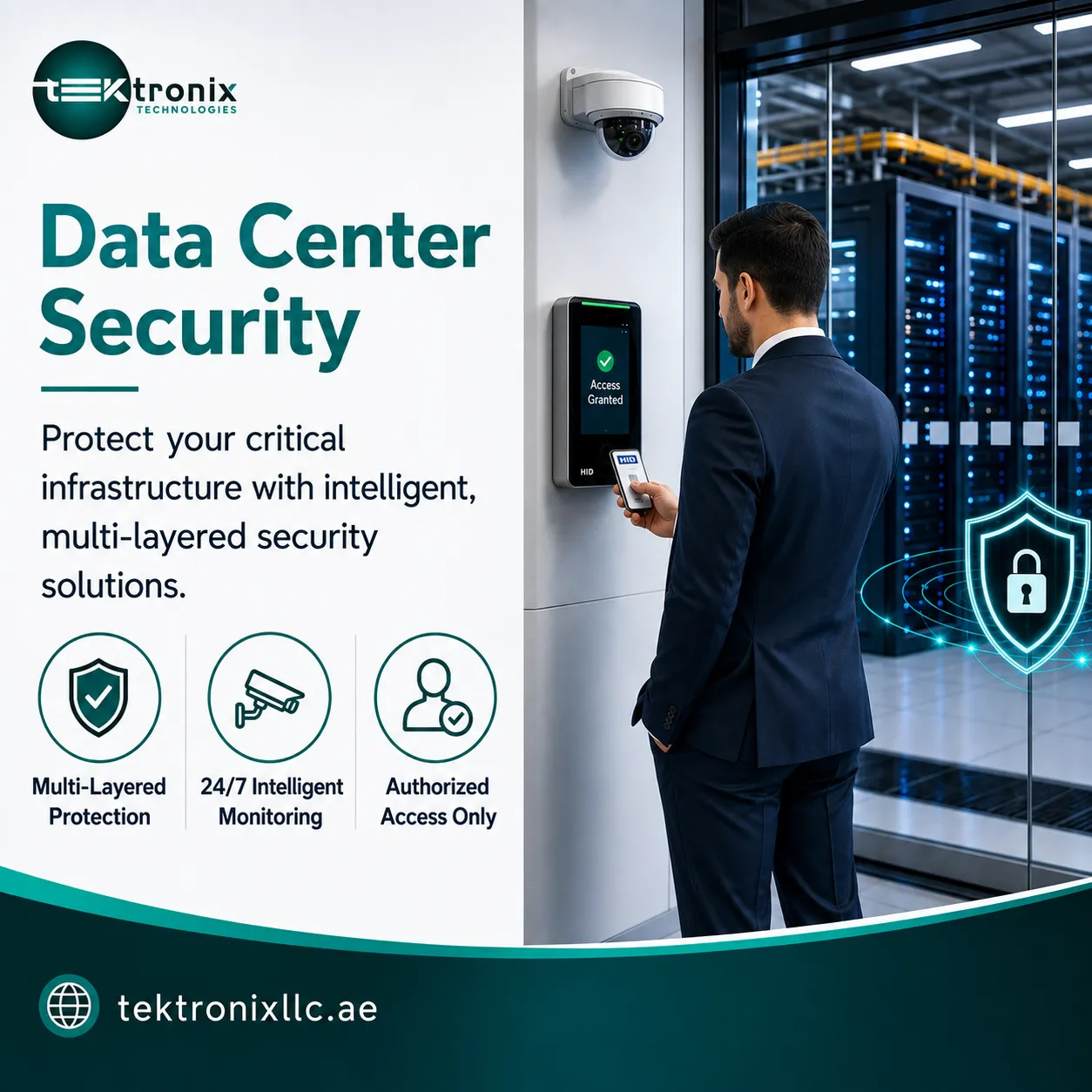
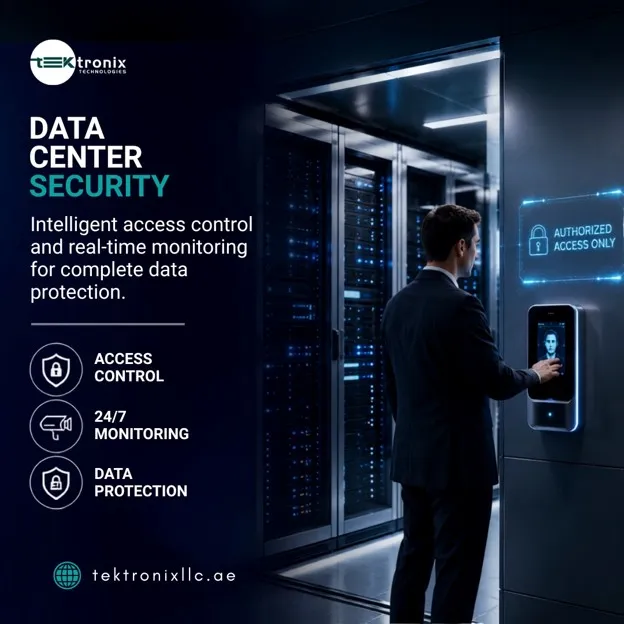
On the physical side, Data Center Access Control governs exactly who can enter the building, specific server rooms, and individual equipment racks, typically enforced through multi-factor credentials combining a card, PIN, and biometric verification. High-security facilities often implement mantrap entry vestibules that prevent tailgating, ensuring only one verified individual pass through at a time.
Granular, zone-based permissions also allow facilities to restrict technician access to only the specific racks or rooms relevant to their assigned work, rather than granting broad facility-wide entry that increases the risk surface unnecessarily.
Data Center Surveillance: Continuous Eyes on Every Critical Zone
Data Center Surveillance combines high-resolution cameras, video analytics, and continuous recording to maintain visibility over every entry point, server room, and equipment aisle within a facility. Modern systems increasingly incorporate AI-driven analytics capable of automatically flagging unusual movement or unauthorized presence in restricted zones, rather than relying solely on human operators monitoring live feeds.
Comprehensive surveillance coverage also supports incident investigation and compliance reporting, giving facility operators a complete, timestamped visual record that can be reviewed instantly if a security event occurs.
Data Center Intrusion Detection: Identifying Threats Before They Escalate
Data Center Intrusion Detection systems monitor both the physical perimeter and internal network traffic for signs of unauthorized access attempts, alerting security teams the moment a suspicious event occurs. Physical intrusion detection typically includes Perimeter Data Center fencing sensors, motion detectors, and door-forced alarms, while network intrusion detection monitors traffic patterns for signs of an active attack.
Rapid detection dramatically reduces the window an intruder, physical or digital, has to cause damage before security personnel or automated response systems can intervene, making detection speed just as critical as prevention.
Data Center Threat Detection: Proactive Monitoring Across Physical and Digital Layers
Data Center Threat Detection extends beyond simple intrusion alerts to identify emerging risks before they materialize into a full security incident, using behavioural analytics, anomaly detection, and correlated data from both physical and cyber security systems. This proactive approach allows security teams to respond to unusual patterns, such as a repeated failed badge attempt combined with abnormal network activity, as a single coordinated threat rather than two unrelated events.
Facilities managing both physical and cyber threat detection through a unified platform gain a significant advantage, since correlating data across both domains often reveals coordinated attacks that would be missed if each system operated in isolation.
Data Center Security UAE: Regional Compliance and Infrastructure Standards
Data Center Security UAE deployments increasingly need to align with National Cybersecurity Authority guidance and broader UAE data protection expectations, particularly for facilities hosting government, financial, or healthcare data. Local compliance requirements often extend to physical security standards as well, covering Data Center Perimeter fencing specifications, access logging retention, and incident reporting timelines.
Organizations evaluating a security upgrade can explore Tektronix's data center perimeter security solutions built for the UAE market to understand how physical and digital protections can be coordinated within a single, locally compliant security strategy.
Data Center Security Dubai: Securing the Region's Commercial and Cloud Hub
Data Center Security Dubai deployments sit at the center of one of the region's densest concentrations of cloud providers, fintech firms, and multinational enterprise tenants, which makes both physical and digital resilience a commercial priority rather than a purely regulatory one. Facilities in Dubai's free zones and business districts typically pair a hardened Perimeter Data Center boundary with 24/7 monitored access control, since colocation clients increasingly audit a provider's physical security posture before signing a hosting agreement.
Operators running multi-tenant facilities across Dubai also benefit from scalable, zone-based access permissions, allowing them to demonstrate to individual clients that their servers, racks, and cages are isolated from neighbouring tenants at both the physical and network level.
Data Center Security Abu Dhabi: Protecting the Capital's Growing Digital Infrastructure
As Abu Dhabi expands its role as a hub for government digitization and financial services, Data Center Security Abu Dhabi deployments face particularly stringent requirements given the sensitivity of data hosted for public sector and financial clients. Facilities in the capital increasingly implement layered perimeter security combined with advanced cyber defences to meet the expectations of both regulators and high-profile institutional tenants.
Operators managing multiple facilities across Abu Dhabi and the wider Emirates benefit from a unified security platform that maintains consistent standards and centralized monitoring across every site.
Data Center Security Sharjah: Supporting Industrial and Logistics-Driven Growth
Data Center Security Sharjah requirements are shaped by the emirate's concentration of industrial zones, logistics operations, and light-manufacturing enterprises that increasingly depend on local or regional data hosting rather than sending everything offshore. Facilities here often need a Perimeter Data Center design that accounts for adjacent industrial traffic and warehouse activity, favouring ruggedized perimeter sensors and vehicle barriers alongside standard building access control.
As Sharjah continues to attract SME and logistics-sector tenants seeking cost-effective hosting close to Dubai's commercial core, facility operators are extending the same layered Data Center Perimeter and cybersecurity standards seen in larger Dubai and Abu Dhabi deployments, ensuring smaller facilities are not left with a lower security baseline simply because of scale.
Key Features to Evaluate in a Data Center Security Partner
Facility operators comparing vendors should assess a shortlist against several criteria: the ability to coordinate physical and cybersecurity layers under one strategy, compliance alignment with UAE regulatory standards, response time guarantees for detected incidents, integration depth between surveillance, access control, and network security systems, and a proven track record securing critical digital infrastructure specifically.
Coordinated Physical and Cyber Défense
A security partner capable of designing both perimeter protection and network defences ensures the two layers work together rather than operating as disconnected systems managed by separate vendors with no shared visibility.
Scalable Monitoring Across Multiple Facilities
Organizations operating more than one data center benefit from centralized monitoring that consolidates alerts, access logs, and incident reports across every site into a single operational view.
Best Practices for Strengthening Data Center Security
A comprehensive security review should assess both physical and digital layers together, since gaps often emerge at the intersection of the two, such as a technician's access badge also serving as a network login credential. Regular penetration testing and physical security audits, including a dedicated review of the Data Center Perimeter, help uncover weaknesses before they can be exploited.
Clear incident response protocols are equally important, ensuring that both physical security staff and IT teams know exactly how to respond when an alert is triggered, and that lessons from each incident feed back into strengthening future defences.
Why Tektronix: Experience, Expertise, and Trusted Critical Infrastructure Security
Tektronix has delivered perimeter and facility security solutions for data centers and critical infrastructure sites across the UAE, giving the engineering team direct, hands-on insight into the unique operational demands of facilities that must remain secure around the clock without disrupting authorized technician access. That experience shapes every deployment, from Perimeter Data Center sensor placement to access control zoning within server halls.
The team works closely with facility operators and IT security leads to design layered protection suited to each site's specific risk profile and regulatory obligations, backed by ongoing technical support and regional maintenance coverage. Organizations planning a security upgrade can get in touch with Tektronix's data center security specialists to discuss a strategy suited to their facility.
Conclusion
Protecting digital assets in the UAE demands a coordinated, layered Data Center Security strategy, anchored by a hardened Perimeter Data Center boundary and a well-engineered Data Center Perimeter. Strong Cybersecurity for Data Center environments, dependable Data Center Encryption, and vigilant Data Center Firewalls protect the digital perimeter, while Data Center Access Control, Data Center Surveillance, Data Center Intrusion Detection, and Data Center Threat Detection secure the physical facility.
Whether deploying Data Center Security UAE-wide or focused on a specific emirate, Data Center Security Dubai, Data Center Security Abu Dhabi, and Data Center Security Sharjah installations all benefit from the same unified strategy, the foundation of resilient digital infrastructure.
FAQs
1. How does Cybersecurity for Data Center differ from physical facility security?
Cybersecurity for Data Center environments protects networks and systems from remote digital attacks, while physical facility security, starting at the Perimeter Data Center boundary, guards against unauthorized entry, making both layers necessary for complete protection.
2. Why is Data Center Encryption considered a compliance essential?
Data Center Encryption keeps stored and transmitted data unreadable without proper decryption keys, and is frequently a mandatory requirement for organizations handling regulated financial or healthcare data.
3. What role do Data Center Firewalls play in preventing breaches?
Data Center Firewalls inspect and filter network traffic, blocking malicious connections and enforcing segmentation so a breach in one system cannot easily spread to unrelated infrastructure.
4. How does Data Center Access Control prevent unauthorized physical entry?
Data Center Access Control enforces multi-factor verification and zone-based permissions, ensuring only authorized personnel can reach specific server rooms or equipment racks within a facility.
5. What does a well-designed Data Center Perimeter actually include?
A well-designed Data Center Perimeter typically combines anti-climb fencing, vehicle barriers, buried or fence-mounted intrusion sensors, and perimeter lighting, all layered ahead of building-level access control so a Perimeter Data Center breach is detected and delayed long before an intruder reaches the building itself.
For more information contact us on:
Tektronix Technology Systems Dubai-Head Office
+971 50 814 4086
+971 55 232 2390
Office No.1E1 | Hamarain Center 132 Abu Baker Al Siddique Rd – Deira – Dubai P.O. Box 85955
































Sign in to leave a comment.