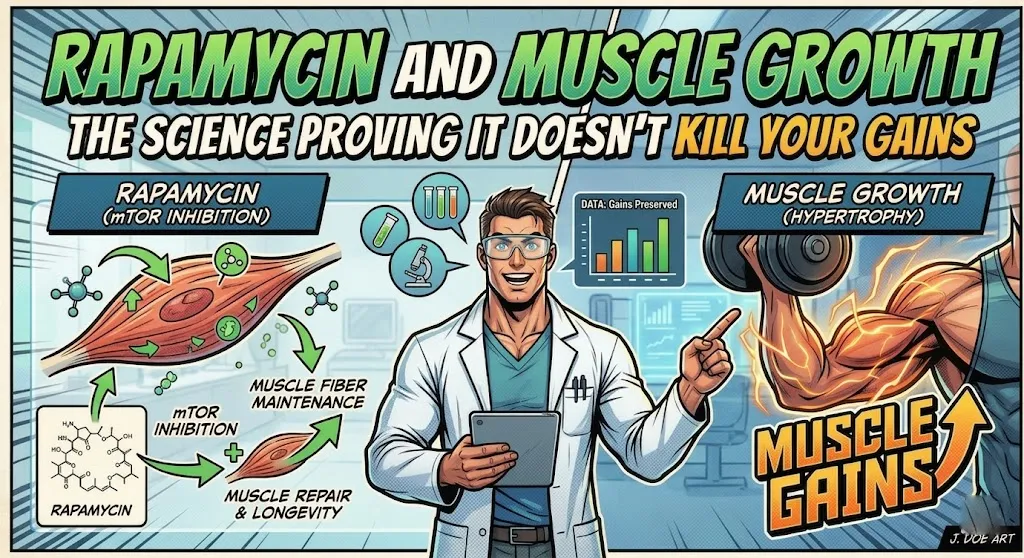


If you have spent any time in longevity or biohacking circles, you have probably come across rapamycin — and you have probably also heard the concern that follows it around like a shadow: "Won't it destroy your muscle gains?"
It is a fair question. The science behind it sounds convincing on the surface. But new research published in 2025 is telling a very different story — and if you care about both living longer and staying strong, this is some of the most encouraging news to come out of longevity science in years.
Let's break it all down.
What Is Rapamycin and Why Is Everyone Talking About It?
Rapamycin is a drug that has been generating serious attention in the longevity world for one simple reason: it extends lifespan in virtually every animal species researchers have tested it on. Not by a small margin — by a meaningful, consistent, reproducible amount. Scientists, doctors, and biohackers have taken notice.
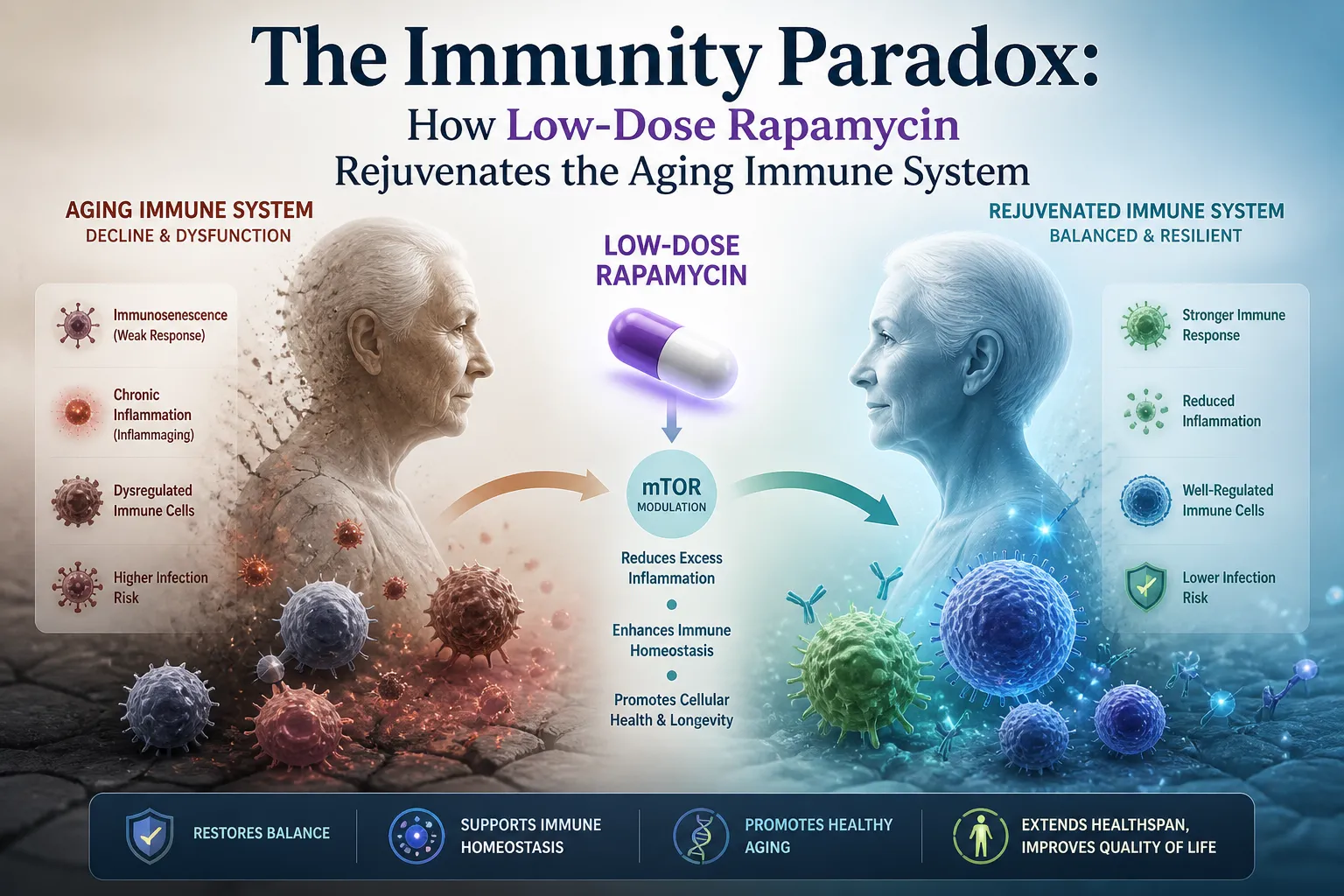
The way rapamycin works is by inhibiting a protein called mTOR, which stands for mechanistic target of rapamycin. Think of mTOR as your body's primary cellular "grow and build" switch. When you exercise — especially resistance training — mTOR activates and tells your muscle cells to synthesize new proteins, repair damage, and grow bigger and stronger. In scientific terms, this process is called hypertrophy, which simply means the physical enlargement of muscle fibers in response to a training stimulus.
Because rapamycin inhibits mTOR, the assumption has long been that it would also inhibit muscle growth. The logic is straightforward: switch off the growth signal, and growth stops.
As it turns out, biology is far more nuanced than that.
Get Rapamycin now
The Fear Was Based on Flawed Science
Before looking at what the 2025 research found, it helps to understand why the concern about rapamycin and muscle loss developed in the first place — and why it was misleading from the start.
The early studies that raised alarm bells shared a significant design flaw. They administered high doses of rapamycin immediately before or during exercise sessions, then observed that muscle protein synthesis — the process by which cells build new muscle proteins — was blunted. Researchers took this to mean that rapamycin and exercise were fundamentally incompatible.
But this experimental design has almost nothing in common with how rapamycin is actually used in longevity practice. Real-world protocols involve low doses taken once per week, typically on a rest day — not high doses injected right before a training session.
It is a bit like concluding that food impairs athletic performance because you force-fed an athlete a large meal mid-sprint. Technically an experiment. Not a useful one.
When researchers began testing dosing strategies that actually reflect clinical reality, everything changed.
What the 2025 Research Actually Found
In July 2025, a landmark study was published in Aging Cell — one of the most respected journals in the longevity field — and its findings were genuinely surprising.
Researchers used a method called PoWeR (progressive weighted wheel running), which is one of the most accurate animal models of human resistance training available. Female mice were divided into three groups: one received rapamycin three times per week, one received it once per week, and one exercised without any drug at all.
The results across all three measured outcomes were striking:
- Endurance capacity improved equally across all exercising groups, including both rapamycin groups
- Grip strength — a widely used and reliable marker of overall muscular health — increased comparably in all groups
- Muscle fiber hypertrophy occurred in key muscles including the soleus and flexor digitorum longus, with the rapamycin groups matching the drug-free controls
To put it simply: the mice on rapamycin built just as much muscle as the mice that were not on it. The drug that was supposed to block gains did not block anything — at least not when used at realistic doses and timing.
Buy Rapamycin online
Why This Makes Biological Sense: The Pulsed mTOR Hypothesis
Understanding why rapamycin does not harm muscle growth requires looking beyond the simple "mTOR on = muscle growth" equation to something more sophisticated.
A 2024 registered clinical trial is now testing what researchers are calling rhythmic mTOR modulation — the deliberate cycling between periods of mTOR activation (driven by exercise) and mTOR inhibition (driven by rapamycin). The idea is that these two states, timed correctly, are not opposites. They are complements.
Here is the part that surprises most people: chronic, uninterrupted mTOR activation — which is exactly what characterizes aging muscle tissue — actually causes muscle loss over time. This happens because sustained mTOR activity suppresses autophagy, which is your cells' built-in cleaning and recycling system. Autophagy removes damaged proteins, worn-out cellular components, and accumulated debris that would otherwise impair muscle function and quality.
When autophagy is persistently suppressed, the cellular environment inside muscle tissue degrades. Damaged material piles up. Growth and repair signals become less effective. This is one of the key reasons why aging muscles — despite having plenty of mTOR activity — still lose mass and function over time. The signal is stuck on, but the maintenance work that makes growth possible has been neglected.
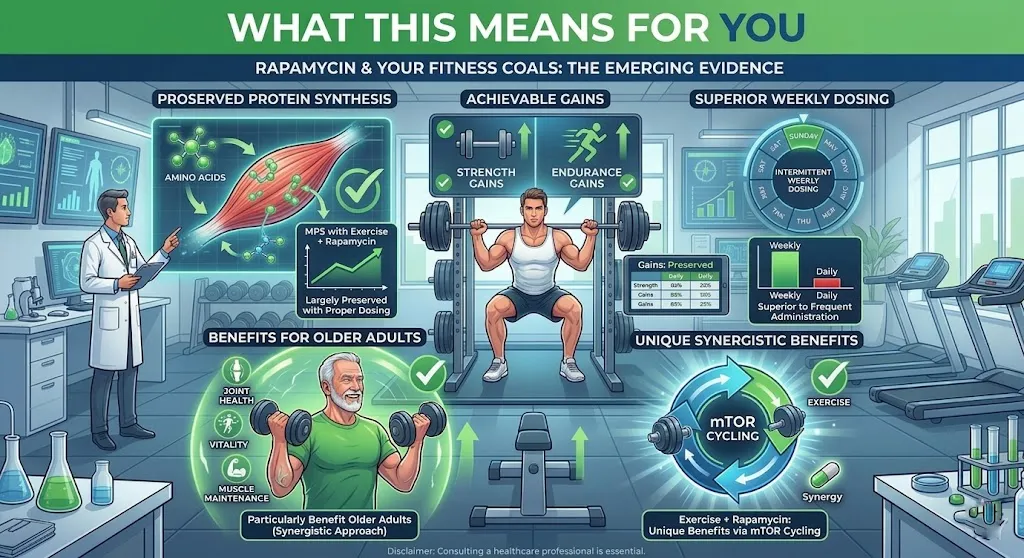
Rapamycin, by periodically quieting mTOR on rest days, creates windows where autophagy can do exactly this housekeeping work. The result is a cleaner, better-maintained cellular environment — one that is primed to respond more powerfully when exercise triggers mTOR activation on training days.
Think of it this way:
Training day → mTOR activates → protein synthesis spikes → muscle grows
Rest day with rapamycin → mTOR quiets → autophagy activates → cellular cleanup occurs Net result → stronger, cleaner, more metabolically resilient muscle tissue
This is not rapamycin blocking your gains. This is rapamycin resetting your cellular environment so your gains can land more effectively.
Get Rapamycin now
The Dosing Detail That Changes Everything
One of the most practically important findings from the 2025 study had nothing to do with muscle fibers directly — it was about metabolism, and it has major implications for anyone using or considering rapamycin.
While both dosing groups preserved muscle adaptations comparably, they diverged on a key metabolic measure. Mice receiving rapamycin three times per week showed impaired glucose tolerance — meaning their bodies became less efficient at managing blood sugar after eating. Mice receiving it once per week showed no such impairment.
Even more telling: the once-weekly group showed greater spontaneous physical activity throughout the study. They moved more on their own, without prompting. This points to better energy levels, better recovery, and better overall metabolic health — the kind of differences you would notice and feel in daily life.
This finding aligns with years of anecdotal observation from longevity practitioners: lower frequency dosing captures the drug's longevity benefits while sidestepping the metabolic costs that come with more frequent use.
The sweet spot that keeps emerging from both the research literature and clinical practice is clear:
6mg of rapamycin, once weekly, taken on a rest day.
This approach captures longevity benefits, preserves muscle adaptations, avoids glucose metabolism issues, and leverages the drug's approximately 64-hour half-life — the time the body takes to eliminate half of a given dose — to create natural cycles of inhibition and recovery without any complex scheduling.
Human Trials Are Already Underway
This is not just animal data. A registered clinical trial — NCT06048360 — launched in 2024 and is currently testing once-weekly sirolimus (sirolimus is the generic pharmaceutical name for rapamycin) at 6mg combined with a structured 13-week exercise program in adults aged 65 to 85.
Crucially, the trial is not just testing whether the combination is safe. It is specifically investigating whether rapamycin plus exercise outperforms exercise alone — a research question that would have seemed almost unthinkable just a few years ago, when the prevailing assumption was that the two were incompatible.
Preliminary results are expected in 2025 or 2026. Given rapamycin's exceptionally consistent track record of translating from animal studies to human outcomes, the positive findings from the 2025 mouse study carry real predictive weight.
Why Older Adults Stand to Benefit Most
While the muscle preservation findings apply across age groups, the evidence strongly suggests that the rapamycin-exercise combination is especially powerful for adults over 60 — and there is a clear biological explanation.
Aging muscles are characterized by chronic mTOR overactivation — a state where the growth-signaling pathway never fully quiets down. Paradoxically, this leads to declining muscle quality and increased sarcopenia (the progressive, age-related loss of muscle mass and strength). It suppresses autophagy, allows cellular damage to accumulate, and gradually reduces the sensitivity of the mTOR pathway itself, so growth signals become less effective over time.
Periodic rapamycin administration addresses this directly. By intermittently inhibiting mTOR, it restores mTOR sensitivity (how strongly cells respond when the pathway is activated), allows autophagy to clear accumulated damage, and creates the biological conditions in which exercise-driven growth signals can be received and acted upon more powerfully.
For younger athletes with healthy, well-regulated mTOR function, the gains-preservation finding still holds and is reassuring. But the magnitude of potential benefit is greatest for those whose cellular machinery most needs this kind of periodic recalibration.
Practical Tips for Combining Rapamycin With Training
If you are considering rapamycin alongside a regular exercise routine, here is what the current evidence supports:
Time your dose on rest days, not training days. Given rapamycin's 64-hour half-life, once-weekly dosing naturally creates the right mTOR cycle. By the time your next training session arrives, the drug's concentration will have declined meaningfully, allowing full mTOR activation in response to your workout. No complex scheduling is required — the pharmacology handles it.
Keep protein intake high. Aim for 1.6 to 2.2 grams of protein per kilogram of bodyweight daily. Pay particular attention to leucine — an essential amino acid (one your body cannot make on its own and must get from food) that is one of the most potent natural mTOR activators. Leucine stimulates mTOR through pathways that partially bypass rapamycin's inhibition, keeping your muscle protein synthesis robust during feeding windows. Rich sources include eggs, chicken, fish, dairy, and red meat.
Monitor your bloodwork regularly. Rapamycin can elevate blood lipids (fats in the bloodstream, including cholesterol and triglycerides) in some individuals. Routine labs every three to four months — covering a lipid panel, fasting glucose, and basic immune markers — provide the oversight needed to catch and address any issues early. This is not a reason for alarm; it is simply responsible use of a prescription medication.
Work with a physician who understands longevity medicine. Rapamycin is a prescription drug. The doses used in longevity protocols (typically 1mg to 6mg once weekly) are substantially lower than those used in transplant medicine, where the drug is administered daily at much higher concentrations. Not all doctors are familiar with this distinction. Seeking out a physician with experience in longevity or preventive medicine will ensure you receive appropriate guidance and monitoring for your specific health profile.

Buy Rapamycin online
Frequently Asked Questions
Will rapamycin stop my muscle growth?
No. The 2025 Aging Cell study showed that mice performing progressive resistance training while on rapamycin achieved muscle fiber hypertrophy comparable to drug-free exercising controls. The theoretical concern — that mTOR inhibition would block muscle growth — does not translate into practice when dosing is realistic and timing is appropriate. Intermittent, once-weekly administration allows exercise to fully activate mTOR on training days while rapamycin provides its longevity and cellular maintenance benefits on rest days.
Will I lose muscle I already have if I start taking rapamycin?
Unlikely, with the right protocol. Most people combining weekly rapamycin with consistent resistance training report maintaining or improving their body composition over time. The scenario that produced negative findings in older research — high doses given immediately before or after exercise — is simply not how anyone should be using the drug for longevity purposes.
When exactly should I take rapamycin around my workouts?
Take it on rest days, as far from a heavy training session as is practical. Given the drug's 64-hour half-life, once-weekly dosing automatically creates the appropriate mTOR cycle. The specific day of the week matters less than the consistent pattern of avoiding training days.
Does it work the same way for women as for men?
The 2025 study was conducted entirely in female mice and showed full preservation of all exercise adaptations — endurance, grip strength, and muscle fiber hypertrophy. This is meaningful early evidence that rapamycin does not uniquely impair female muscle physiology. The ongoing human clinical trial includes both sexes, which will provide much more comprehensive data.
Is rapamycin more beneficial for older people than younger athletes?
The synergy appears strongest for adults over 60, for the reasons detailed above: aging muscles suffer from chronic mTOR overactivation and suppressed autophagy, and periodic rapamycin administration directly addresses both. For younger athletes with healthy baseline mTOR regulation, the gains-preservation finding still applies, but the potential for additional benefits beyond preservation is likely less pronounced.
What dose should someone who exercises regularly take?
The most studied protocol for exercising individuals is 6mg once weekly. The 2025 study found no additional muscle benefit with three-times-weekly dosing — and that higher-frequency regimen actively worsened glucose metabolism. Once weekly is the clear evidence-based choice. Any specific dosing decision should be made in consultation with a physician familiar with longevity medicine.
Does rapamycin affect endurance as well as strength?
Both are preserved. The 2025 study measured both endurance capacity and grip strength, and rapamycin-treated mice improved equally in both metrics compared to drug-free controls. The once-weekly group also showed greater spontaneous movement than the three-times-weekly group — a strong indicator of better overall energy and recovery.
Can rapamycin actually help muscle growth, not just preserve it?
Yes, indirectly. By enhancing autophagy, rapamycin improves the cellular environment inside muscle tissue, clearing out the accumulated damage that impairs growth and repair. The periodic mTOR inhibition may also resensitize the mTOR pathway itself, so that when exercise triggers activation, the anabolic (muscle-building) response is more robust than it would be if mTOR had been chronically and continuously activated.
What should I monitor if I take rapamycin long-term?
Focus on three primary areas: blood lipids (cholesterol and triglycerides), glucose tolerance (how efficiently the body processes blood sugar), and general immune function markers. Routine bloodwork every three to four months covers all of these adequately. The 2025 twelve-week study showed no adverse effects on muscle adaptation, and short-term human data with intermittent dosing indicates generally good tolerability.
When will we have solid human data?
Preliminary results from the 2024 clinical trial (NCT06048360) could be published as early as late 2025 or during 2026. Given rapamycin's strong and consistent track record of translating from animal models to human outcomes, the positive findings from the 2025 mouse study carry meaningful predictive weight even before those results arrive.
Final Thoughts
The story of rapamycin and muscle growth is ultimately a story about science correcting an early misconception — and arriving somewhere far more optimistic in the process.
The fear that rapamycin would destroy your gains was always based on a limited and artificial experimental scenario. When researchers tested protocols that actually reflect how thoughtful practitioners use the drug, the picture changed completely and decisively. Intermittent, low-dose rapamycin and consistent resistance training do not work against each other. They operate on complementary timescales, addressing different but deeply connected aspects of what it means for a muscle to stay healthy across decades.
Exercise builds the muscle. Rapamycin maintains the cellular environment in which muscle can continue to be built — year after year, decade after decade.
For anyone committed to both longevity and physical performance, the message from the 2025 research is genuinely empowering: you do not have to choose between staying strong and living longer. With the right protocol, the right timing, and proper medical oversight, rapamycin and exercise can work together as one of the most promising combinations in modern longevity science.
Your muscles are not at risk. They are invited to the revolution.

























Sign in to leave a comment.