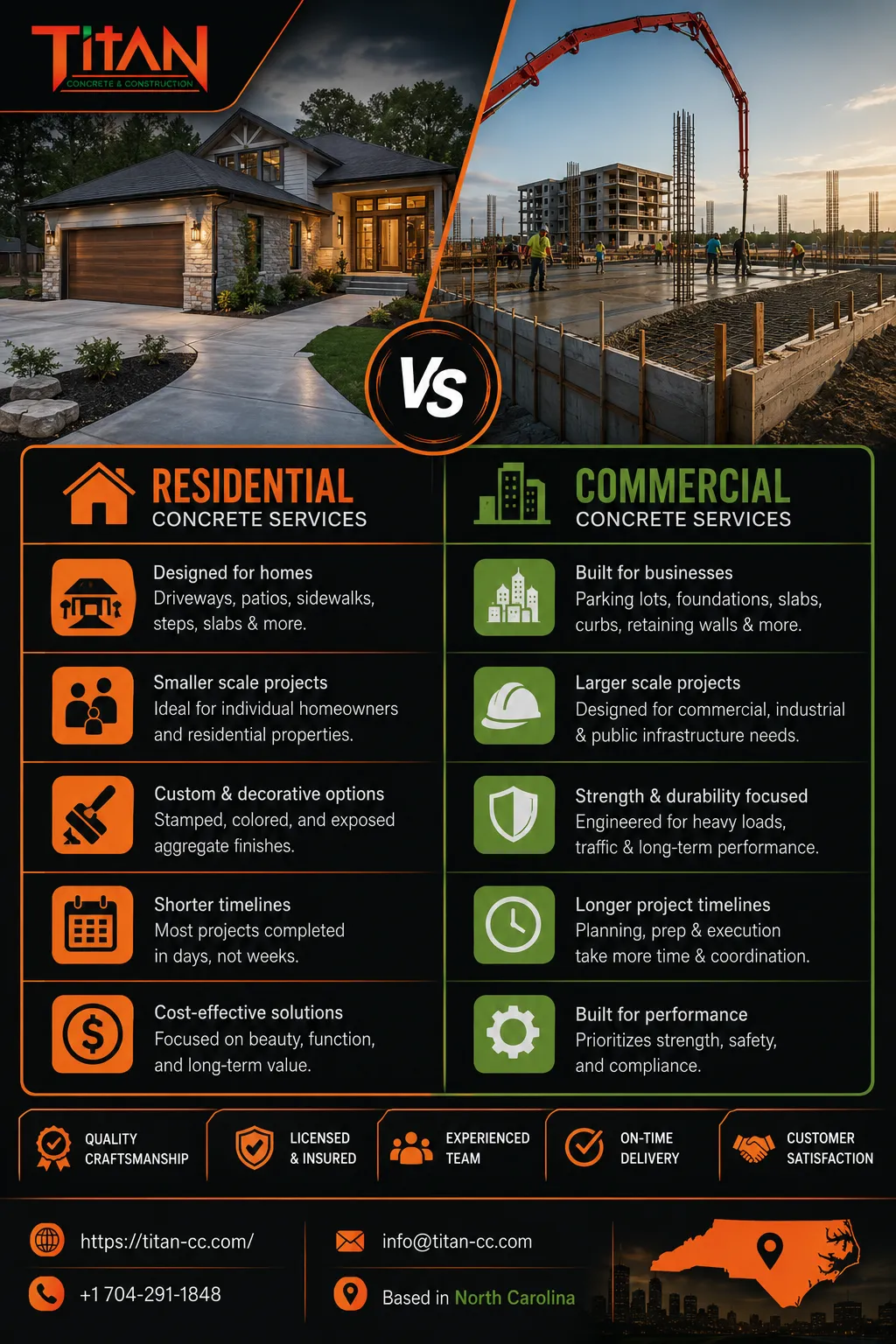

A homeowner watches a crew shape a patio behind a house. Across town, another team coordinates trucks, pumps, inspectors, and multiple trades for a warehouse slab. Both jobs involve concrete, but the work surrounding each pour is different.
That contrast sits at the heart of residential vs commercial concrete services. The design requirements, loads, scheduling, equipment, documentation, and risk can change dramatically from one project to another.
Treating a commercial slab like an oversized driveway can cause delays, weak performance, safety problems, and expensive repairs. Understanding the difference helps owners and builders choose the right scope, crew, and plan before work begins.
Key Takeaways
- Residential concrete usually prioritizes customization, appearance, access, and household budgets.
- Commercial concrete emphasizes load capacity, logistics, safety, coordination, and code compliance.
- Both project types depend on strong preparation, correct materials, controlled placement, and proper curing.
- The right contractor should explain how the project’s use changes the design and execution plan.
What Separates Residential and Commercial Concrete Work?
The biggest difference is not simply project size. It is the level of performance, coordination, and responsibility attached to the finished concrete.
Residential concrete services commonly include driveways, patios, walkways, garage slabs, home foundations, retaining walls, and decorative surfaces. These projects are often designed around private use, household traffic, curb appeal, and a specific homeowner’s preferences.
Commercial concrete services may include warehouses, parking areas, industrial floors, equipment pads, office buildings, retail sites, loading zones, and large foundations. These projects often involve heavier traffic, tighter tolerances, more stakeholders, formal inspections, and strict scheduling.
Residential Concrete:Personal, Practical, and Highly Visible
Residential work happens close to daily life. A family may need access to the garage, a safe walkway for children, drainage away from the home, or a patio that matches the landscape.
Appearance matters. Homeowners may request stamped patterns, colored finishes, exposed aggregate, borders, curved layouts, or custom steps. The concrete must perform, but it also becomes part of the property’s visual identity.
Residential projects require clear communication. Contractors should explain preparation, reinforcement, joints, curing, access limits, and maintenance in plain language.
The best residential concrete work balances three needs:
- Reliable performance
- Attractive design
- Respect for the homeowner’s budget and routine
Commercial Concrete: Built Around Performance and Pressure
Commercial work is usually less forgiving. A floor may carry forklifts, storage racks, machinery, service vehicles, or constant foot traffic. A parking area may need to support turning trucks, drainage systems, accessible routes, and repeated loading.
The team may coordinate with engineers, contractors, inspectors, utility crews, installers, and suppliers. One delayed placement can affect several trades and the wider schedule.
Commercial crews may need specialized equipment, larger teams, concrete pumping, testing, traffic management, and formal safety procedures.
Function leads. Appearance still matters in customer-facing areas, but strength, flatness, durability, access, and schedule usually take priority.
How Do Loads Change the Concrete Design?
Concrete should be designed for how the finished surface will actually be used. A residential patio and a loading dock do not face the same demands.
Residential slabs usually carry people, furniture, passenger vehicles, and occasional service traffic. Commercial slabs may support concentrated rack loads, heavy machinery, delivery trucks, forklifts, or repeated impact.
The design may change in several ways:
- Concrete strength and mix requirements
- Slab thickness
- Reinforcement type and spacing
- Sub-base depth and compaction
- Joint layout
- Edge support
- Surface finish
- Curing and protection plan
A stronger mix alone does not solve every load problem. Thickness, support, reinforcement, joint placement, and drainage must work together.
Project Scale: Bigger Work, Tighter Margins for Error
Large projects require volume, but scale also changes timing, access, quality control, and risk.
A residential driveway may use one controlled pour. A commercial floor may require several placements, construction joints, pump coordination, testing, and backup plans.
Commercial work creates more disruption risk. Trucks must arrive in sequence, weather must be monitored, and safety zones must remain clear. Finishing cannot wait for a late crew.
As architect Ludwig Mies van der Rohe said, “God is in the details.” Concrete proves that point quickly. A small missed elevation or delayed truck can affect drainage, door clearances, equipment installation, or the final surface.
Residential vs Commercial Concrete Services at a Glance
| Project factor | Residential concrete | Commercial concrete |
| Typical use | Homes and private properties | Business, industrial, and public spaces |
| Main priority | Function, appearance, and budget | Performance, safety, and schedule |
| Traffic | People and light vehicles | Heavy, repeated, or specialized loads |
| Customization | Often high | Usually targeted to functional areas |
| Crew and equipment | Smaller and more flexible | Larger and more specialized |
| Coordination | Owner, designer, and local trades | Engineers, contractors, inspectors, and multiple trades |
| Documentation | Proposal, permits, and warranty | Detailed specifications, submittals, testing, and records |
| Scheduling | Often flexible | Usually tied to a larger construction program |
Every project should still be evaluated on its own conditions.
Why Does Site Preparation Matter for Every Concrete Job?
Residential and commercial projects share one non-negotiable truth: concrete is only as dependable as the support beneath it.
Poor soil, buried debris, weak base material, and trapped water can cause settlement and cracking. A patio can fail over soft ground as easily as a warehouse floor.
Preparation should address:
- Excavation depth
- Unsuitable soil removal
- Base material
- Compaction in controlled layers
- Elevation and drainage
- Utility locations
- Form stability
- Access for placing equipment
Commercial work may require more testing, but residential projects should not accept vague preparation because the slab is smaller.
The SCOPE Framework for Choosing the Right Service
The SCOPE framework helps match the project to the right concrete team:
- S: Size. How large is the placement, and can the crew manage the required volume?
- C: Coordination. How many trades, inspections, deliveries, and approvals affect the work?
- O: Operational load. What people, vehicles, racks, machines, or equipment will use the surface?
- P: Performance. What strength, flatness, drainage, finish, durability, or appearance is required?
- E: Exposure. What weather, chemicals, water, heat, abrasion, or impact will the concrete face?
A contractor should be able to discuss all five areas before presenting a final plan. Silence around these questions usually means the proposal is based on assumptions.
Scheduling and Logistics: Where Commercial Work Gets Tougher
Residential scheduling focuses on access, neighborhood rules, weather, and curing. Commercial scheduling may involve delivery windows, closures, pumping locations, inspections, shift work, and ongoing operations.
A commercial placement plan may need to answer:
- Where will trucks queue?
- Who controls access?
- What happens if the batch plant is delayed?
- How will weather affect finishing?
- Which areas must reopen first?
- Who approves changes during the pour?
- How will fresh concrete be protected from other trades?
Residential projects benefit from the same discipline. Clear access and curing rules prevent vehicles, pets, deliveries, or landscapers from damaging new work.
Permits, Compliance, and the Paper Trail That Matters
Both project types may require permits, but commercial work usually faces broader documentation and compliance demands.
Commercial teams may work from engineered drawings, specifications, testing requirements, safety plans, inspections, and formal change procedures. Records may matter later for maintenance, warranties, renovations, or claims.
Residential documentation is often simpler, but it should still be complete. The written scope should define dimensions, preparation, thickness, reinforcement, finish, joints, drainage, cleanup, access limits, payment terms, and warranty coverage.
The smaller contract should not mean smaller accountability.
Smart Moves, Expensive Mistakes
- Do choose a contractor with relevant project experience.
Do not assume success in patios guarantees success in industrial floors. - Do design for real loads.
Do not base the slab only on its square footage. - Do coordinate access before placement.
Do not solve truck and pump locations on pour day. - Do put scope changes in writing.
Do not rely on rushed verbal approvals. - Do protect curing concrete.
Do not let schedule pressure force early traffic. - Do verify preparation.
Do not judge quality only by the finished surface.
The expensive mistakes usually begin before concrete placement, when unclear responsibilities and weak assumptions are still hidden.
When Does a Small Job Become a Commercial Risk?
Consider a property manager planning a concrete pad behind a retail building. The square footage is modest, so the work initially looks residential in scale.
Then the real conditions appear. Delivery trucks will turn across one edge. A grease container will sit nearby. Drainage must avoid a neighboring property. The store must remain open, and the placement cannot block emergency access.
The job is small, but its operating demands are commercial. Treating it like a simple backyard slab would ignore traffic, chemicals, coordination, safety, and business interruption.
This scenario shows why project type should be defined by use and risk, not size alone.
How Should Contractors Price the Two Service Types?
Residential pricing often reflects area, finish, access, demolition, preparation, reinforcement, and customization. Homeowners usually need a clear total and understandable options.
Commercial pricing may include detailed quantities, equipment, pumping, labor phases, testing, traffic control, safety requirements, night work, mobilization, coordination, and schedule risk.
A good estimate should expose exclusions and explain which assumptions could change the cost, including poor soil, utility conflicts, design revisions, restricted access, or weather protection.
The most useful proposal makes responsibility and risk easy to understand.
Conclusion: Match the Concrete Service to the Real Job
Residential and commercial concrete services share the same foundation of quality: good preparation, suitable materials, skilled placement, careful finishing, planned joints, proper curing, and clear communication.
The difference lies in what surrounds the concrete. Residential work often prioritizes personal design, home access, and cost control. Commercial work usually demands heavier performance, larger coordination, formal documentation, and tighter schedule management.
The right choice begins by defining use, load, exposure, logistics, and risk. Clear details help the contractor protect the concrete and the people depending on it.
For dependable residential and commercial concrete work, turn to TITAN CONCRETE & CONSTRUCTION.
Frequently Asked Questions
1. What makes a good residential concrete service?
A good residential service combines strong preparation, clear communication, suitable materials, careful finishing, and respect for the homeowner’s design and budget.
2. What are the best practices for commercial concrete projects?
Define loads, logistics, specifications, inspections, safety responsibilities, testing, access, and schedule requirements before placement begins.
3. When should a builder hire a commercial concrete contractor?
Hire one when the project involves heavy traffic, engineered requirements, specialized equipment, multiple trades, formal inspections, or operational disruption.
4. Can residential concrete include custom finishes?
Yes. Residential projects commonly use stamped patterns, color, borders, scoring, exposed aggregate, and other decorative treatments.
5. Why do commercial concrete services cost more?
They often require stronger designs, larger crews, specialized equipment, detailed coordination, testing, safety controls, and tighter scheduling.























Sign in to leave a comment.