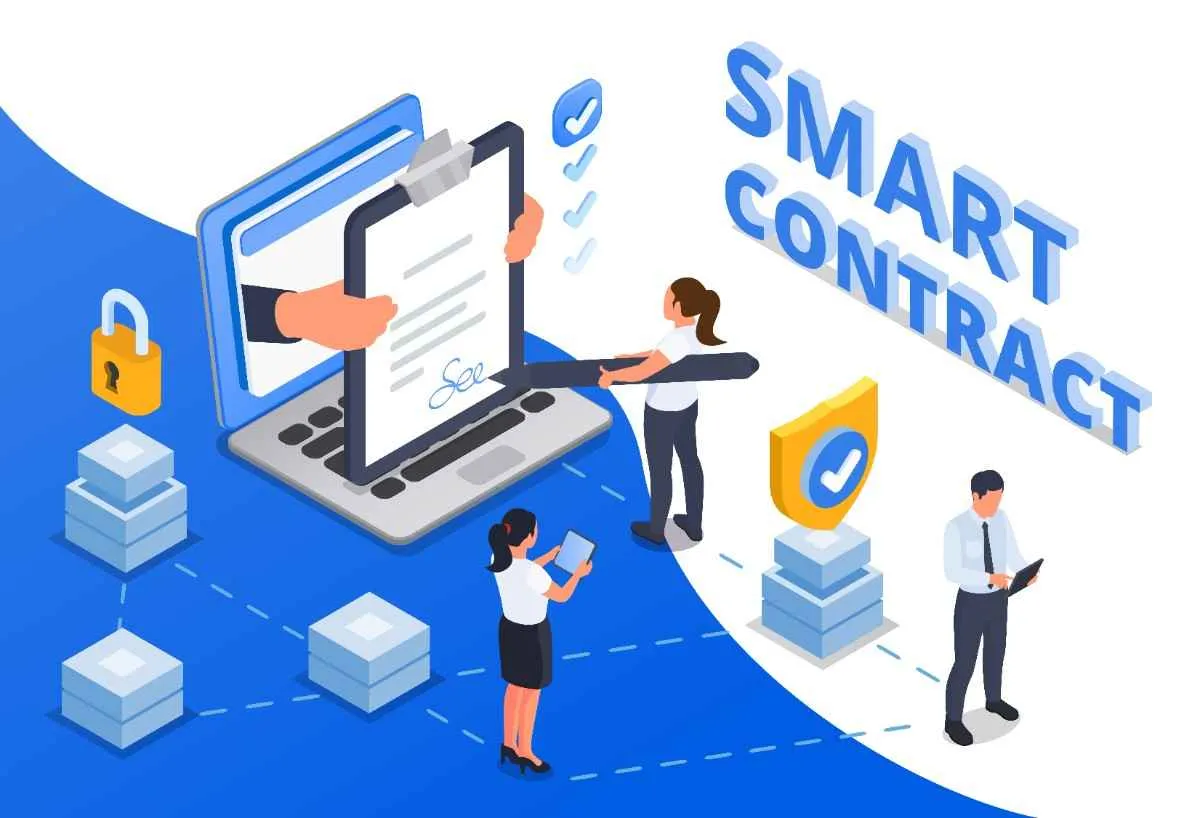

Smart contracts have moved far beyond their early use in cryptocurrency transactions. In 2026, they are increasingly becoming programmable infrastructure for decentralized applications, financial products, tokenized assets, digital identity systems, and automated business processes.
At the same time, new developments such as AI agents, account abstraction, cross-chain applications, and asset tokenization are changing what businesses expect from blockchain applications. A smart contract is no longer simply a piece of code that transfers tokens when certain conditions are met. Modern contracts need to work securely with wallets, protocols, data sources, user interfaces, and increasingly autonomous software agents.
This shift is making Smart Contract Development a strategic consideration for companies building serious blockchain products.
Why Smart Contract Development Is Changing in 2026
Traditional smart contracts generally follow deterministic rules. If a predefined condition is satisfied, the contract executes a predefined action.
That model remains valuable, but blockchain applications are becoming more sophisticated.
Businesses now want applications that can support automated payments, tokenized assets, decentralized financial services, loyalty programs, digital ownership, gaming economies, supply-chain workflows, and enterprise processes.
This creates new development requirements around:
- Security and vulnerability prevention
- Gas efficiency
- Upgradeability
- Multi-chain compatibility
- Wallet integration
- Automated testing
- Data and oracle integration
- User experience
- Account abstraction
- AI-assisted workflows
As a result, modern smart contract architecture has to consider the entire application ecosystem rather than only the contract code.
1. AI Agents Are Creating New Smart Contract Use Cases
One of the most interesting developments in blockchain is the emergence of AI agents capable of interacting with on-chain applications.
An AI agent can analyze information, make decisions according to defined objectives, and potentially initiate blockchain transactions. This creates opportunities for automated trading, payments, treasury management, data services, decentralized applications, and machine-to-machine transactions.
However, connecting AI systems with smart contracts introduces important considerations.
AI models are probabilistic, while smart contracts are generally deterministic. A contract cannot simply trust an AI model to make an unrestricted decision involving valuable assets.
A safer architecture can separate responsibilities:
AI layer → decision or recommendation → validation rules → smart contract → blockchain execution
The smart contract can enforce limits, permissions, spending rules, and other conditions even when an AI system initiates an action.
This makes secure smart contract architecture particularly important as AI agents become more capable of interacting with blockchain networks.
2. Account Abstraction Is Improving Blockchain User Experience
Wallet experience has historically been one of the biggest barriers to mainstream blockchain adoption.
Users often need to manage private keys, seed phrases, network fees, and multiple transaction approvals. Account abstraction is changing this model by allowing more programmable account behavior.
Smart contract wallets can introduce features such as transaction batching, customized authorization rules, recovery mechanisms, and gas-payment flexibility. Ethereum's current account-abstraction roadmap specifically highlights programmable accounts and improved wallet usability.
For developers, this means smart contracts increasingly need to be designed with programmable accounts and different transaction flows in mind.
Instead of assuming that every user interaction begins with a conventional externally owned account, applications can support more flexible authorization and execution models.
This can make blockchain applications feel much closer to familiar Web2 products while retaining blockchain-based settlement.
3. Tokenization Is Expanding the Role of Smart Contracts
Another major development is the tokenization of real-world and financial assets.
Tokenization can represent assets such as funds, securities, real estate interests, commodities, or other rights through blockchain-based representations. Recent institutional activity demonstrates growing interest in using blockchain infrastructure for tokenized financial assets.
Smart contracts are central to many of these systems because they can automate rules associated with token ownership and transfers.
For example, a tokenized asset platform might use smart contracts to manage:
- Ownership records
- Transfer restrictions
- Investor eligibility
- Distribution rules
- Automated settlements
- Compliance-related conditions
- Corporate actions
This creates demand for development teams that understand not only blockchain programming but also the business and regulatory requirements surrounding the asset being tokenized.
4. Cross-Chain Development Requires Better Architecture
The blockchain ecosystem is no longer limited to a single network.
Applications may need to interact with Ethereum, Layer 2 networks, application-specific chains, or other blockchain environments. Users increasingly expect assets and applications to operate across multiple ecosystems.
This creates additional complexity for smart contract developers.
A multi-chain application may need to consider:
- Different transaction costs
- Network-specific limitations
- Cross-chain messaging
- Contract deployment strategies
- Liquidity fragmentation
- Security assumptions
- Chain-specific tooling
- Consistent application logic
Cross-chain architecture therefore needs to be considered early rather than added as an afterthought.
A contract that works perfectly on one network may require significant changes when deployed across different environments.
5. Security Is Becoming Even More Important
More sophisticated smart contracts also mean more sophisticated security requirements.
A vulnerability in traditional software may result in downtime or data exposure. A vulnerability in a financial smart contract can potentially allow unauthorized transactions or permanent loss of digital assets.
This makes security an essential part of the development lifecycle.
A professional development process should typically include:
- Requirements analysis
- Architecture design
- Threat modeling
- Contract development
- Unit and integration testing
- Automated security checks
- Testnet deployment
- Independent review or audit
- Mainnet deployment
- Post-deployment monitoring
Developers should also consider access controls, reentrancy risks, oracle dependencies, upgrade mechanisms, integer-related issues, external calls, and economic attack vectors.
Security should not be treated as something added immediately before launch.
6. AI-Assisted Development Can Improve Productivity—but Not Replace Expertise
AI coding tools are increasingly being used to generate boilerplate, explain code, suggest test cases, and assist developers during the development process.
For smart contracts, however, speed cannot replace engineering judgment.
An AI tool may generate syntactically correct Solidity code while missing a business-logic vulnerability or an economic attack scenario.
Therefore, AI should be treated as a development assistant rather than an autonomous security authority.
Experienced developers still need to evaluate:
- Contract architecture
- Access permissions
- Economic incentives
- External dependencies
- Upgradeability
- Gas consumption
- Failure scenarios
- Security assumptions
The best approach is to combine AI-assisted productivity with human-led architecture, testing, and security review.
7. What Businesses Should Look for in a Smart Contract Development Partner
Companies planning a blockchain product should evaluate more than a developer's ability to write Solidity.
A capable development partner should understand the complete lifecycle of a blockchain application.
Important questions include:
Does the team understand the business use case?
A technically impressive contract can still fail if it does not solve the actual business problem.
How is security handled?
Ask about testing, code review, audit preparation, access controls, and post-deployment monitoring.
Can the architecture scale?
The development team should understand transaction costs, network limitations, and future application requirements.
Does the team support integrations?
Smart contracts rarely operate in isolation. They may need wallets, APIs, front-end applications, oracles, bridges, and external services.
Can the team support future upgrades?
Some applications require upgradeable architecture, while others prioritize immutability. The appropriate approach depends on the product and its risk model.
Businesses evaluating these factors can benefit from working with experienced smart contract development services providers that can connect technical implementation with the application's wider business requirements.
The Future of Smart Contract Development
The next generation of blockchain applications will likely be defined by greater automation, improved user experience, and deeper integration with existing business systems.
AI agents could interact with decentralized applications. Programmable accounts could simplify blockchain transactions. Tokenization could connect traditional assets with blockchain infrastructure. Cross-chain technologies could expand application reach.
But these developments also increase architectural and security complexity.
That is why the future of Smart Contract Development will not simply be about writing contracts faster. It will be about designing reliable systems that can safely interact with users, applications, assets, protocols, and automated agents.
For businesses considering blockchain adoption, choosing the right Smart Contract Development company should therefore involve evaluating architecture expertise, security practices, blockchain experience, testing methodology, and long-term technical support—not just development cost.
Final Thoughts
Smart contracts are becoming an important foundation for the next generation of blockchain applications.
The combination of AI agents, account abstraction, tokenization, cross-chain infrastructure, and stronger security practices is creating new opportunities for businesses across finance, gaming, supply chain, digital assets, and other industries.
However, successful blockchain products require more than deploying a contract to a network. They require careful architecture, security-focused development, appropriate technology selection, testing, and ongoing maintenance.
Businesses that approach smart contracts as long-term application infrastructure rather than simple blockchain code will be better positioned to take advantage of the next stage of Web3 development.
Planning a blockchain product that requires secure, scalable smart contracts? Explore professional Smart Contract Development solutions to discuss your use case, architecture requirements, blockchain platform, and deployment strategy with an experienced development team.























Sign in to leave a comment.