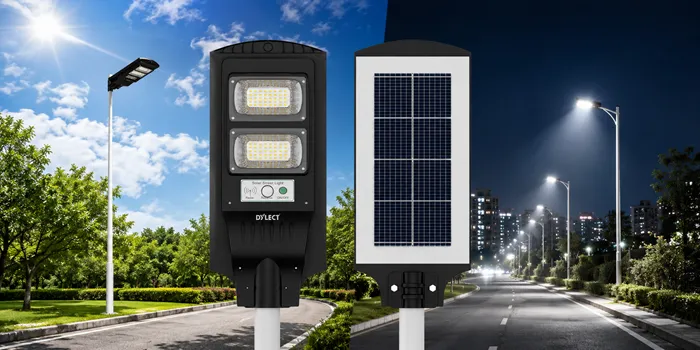

Street lighting plays a vital role in improving visibility, enhancing road safety, and increasing security in public spaces. Today, two of the most popular lighting solutions are solar street lights and LED street lights. While both use energy-efficient LED technology for illumination, they differ significantly in how they are powered, installed, and maintained.
If you're planning to illuminate roads, parking areas, residential communities, campuses, or commercial spaces, understanding the differences between these two options will help you choose the right solution for your needs.
What Is a Solar Street Light?
A solar street light is a self-contained lighting system powered by sunlight. It consists of a solar panel, rechargeable battery, LED light fixture, and an intelligent controller. During the day, the solar panel captures sunlight and converts it into electrical energy, which is stored in the battery. After sunset, the stored energy powers the LED light automatically.
Since solar street lights generate their own electricity, they do not require a connection to the electrical grid.
What Is an LED Street Light?
An LED street light is a lighting fixture that uses Light Emitting Diodes (LEDs) as its light source. Unlike traditional sodium vapor or halogen street lights, LED street lights consume less electricity while providing brighter and more uniform illumination.
However, standard LED street lights depend on electricity supplied through the power grid and require underground wiring and electrical infrastructure to operate.
Solar Street Light vs LED Street Light
1. Power Source
The biggest difference between the two lies in how they receive power.
- Solar Street Lights: Operate using solar energy collected through photovoltaic panels.
- LED Street Lights: Operate using electricity supplied through the electrical grid.
If access to reliable electricity is limited, solar street lights offer a practical alternative.
2. Installation Requirements
Installation varies considerably between both systems.
Solar street lights are relatively easier to install because they function independently and generally do not require trenching, underground cables, or electrical connections.
LED street lights require electrical wiring, poles connected to the power network, and professional electrical installation, which can increase project complexity.
For remote locations, solar lighting is often easier to deploy.
3. Operating Costs
Operating expenses are another important consideration.
Solar street lights generate their own electricity, so ongoing energy costs are minimal after installation. This can lead to significant savings over the long term.
LED street lights, while highly energy-efficient, continue to consume electricity from the grid, resulting in recurring utility bills.
4. Maintenance
Both systems require periodic maintenance, but the nature of maintenance differs.
Solar street lights may require:
- Cleaning of solar panels
- Battery replacement after several years
- Routine inspection of electronic components
LED street lights generally require:
- Electrical system inspections
- Wiring maintenance
- Driver replacement if needed
- Periodic fixture servicing
Modern solar lighting systems are designed to minimize maintenance while offering reliable performance.
5. Brightness
Many people assume solar lighting is less powerful, but advances in LED technology have significantly improved brightness levels.
Both solar street lights and conventional LED street lights can provide excellent illumination when designed correctly.
The actual brightness depends on factors such as:
- LED wattage
- Lumens
- Battery capacity
- Solar panel size
- Lighting distribution
Selecting the appropriate model for the application is more important than simply comparing the technologies.
6. Reliability During Power Outages
One major advantage of solar street lights is their independence from the electrical grid.
During power failures, solar street lights can continue operating using the energy stored in their batteries.
Conventional LED street lights typically stop functioning during outages unless supported by backup power systems or generators.
7. Environmental Impact
Solar street lights are considered one of the more environmentally friendly outdoor lighting solutions because they utilize renewable solar energy and help reduce dependence on fossil-fuel-generated electricity.
LED street lights are also environmentally efficient due to their low power consumption, but they still rely on grid electricity, which may come from a mix of renewable and non-renewable energy sources.
Both options are more energy-efficient than traditional street lighting technologies, but solar street lights have an advantage in terms of renewable energy usage.
8. Best Applications
Solar Street Lights are ideal for:
- Residential communities
- Parks and gardens
- Village roads
- Parking lots
- Farmhouses
- Campuses
- Remote or off-grid areas
- Walking paths
LED Street Lights are ideal for:
- Urban roads
- Highways
- Commercial districts
- Industrial zones
- Areas with established electrical infrastructure
- Locations requiring continuous high-intensity lighting
Which One Should You Choose?
The right choice depends on your project requirements.
Choose solar street lights if you want:
- Lower long-term operating costs
- Renewable energy
- Easy installation
- Off-grid operation
- Backup lighting during power cuts
Choose LED street lights if you need:
- Reliable grid-powered operation
- Existing electrical infrastructure
- Continuous lighting without depending on sunlight
- High-output lighting for busy urban roads
Final Thoughts
Although both solar street lights and LED street lights use energy-efficient LED technology, they differ in how they are powered and where they perform best. Solar street lights offer energy independence, lower operating costs, and easier installation, making them an excellent choice for parks, campuses, residential areas, and remote locations. LED street lights, on the other hand, are well suited for cities and high-traffic areas where a stable electrical infrastructure already exists.
By considering factors such as installation, maintenance, operating costs, and site conditions, you can select the lighting solution that best meets your long-term requirements while ensuring safe and efficient outdoor illumination.
FAQs
1. Are solar street lights brighter than LED street lights?
Both can provide excellent brightness. The illumination level depends on the LED specifications, lumens, battery capacity, and system design rather than the power source.
2. Do solar street lights work during cloudy weather?
Yes. Solar street lights can still charge under cloudy conditions, although charging efficiency may be reduced. Most systems store enough energy to operate for one or more nights.
3. Which is more cost-effective in the long run?
Solar street lights generally have lower operating costs because they do not consume grid electricity, making them a cost-effective option over time.
4. Do LED street lights consume less electricity than traditional street lights?
Yes. LED street lights are significantly more energy-efficient than conventional lighting technologies such as sodium vapor or metal halide lamps.
5. Can solar street lights be installed in areas without electricity?
Yes. Since they operate independently using solar energy, they are ideal for off-grid and remote locations where electrical connections are unavailable.
























Sign in to leave a comment.