

Real estate markets are entering a period where ownership models, investment participation, and property transactions are being reconsidered through blockchain-based systems. Enterprises that once depended only on traditional property financing and asset management structures are now evaluating digital ownership mechanisms connected to tokenized assets. This movement has increased interest in Real Estate Tokenization among property firms, institutional investors, developers, and investment groups seeking new methods to manage property-backed digital assets.
The growing interest in blockchain-backed ownership structures has encouraged enterprises to study how tokenization can support fractional ownership, cross-border participation, faster settlement procedures, and digitized compliance management. In many regions, enterprises are now studying how real estate asset tokenization can support property liquidity while creating additional investment channels for retail and institutional participants.
At the same time, organizations entering this market quickly recognize that success does not come from technology alone. A complete roadmap is required. Legal planning, smart contract architecture, investor onboarding systems, security audits, compliance frameworks, secondary market support, and platform management all influence long-term outcomes. Enterprises that approach tokenization without a structured roadmap often face operational setbacks, regulatory conflicts, or investor trust issues.
This is why many firms now work alongside a Real Estate Tokenization company to organize technical and operational planning before platform deployment begins. Enterprises require a phased approach that aligns blockchain infrastructure with real estate business models, compliance obligations, and investor expectations.
This article explains the enterprise roadmap to real estate tokenization development success and discusses the major phases organizations should evaluate before entering the tokenized real estate market.
Understanding the Enterprise Perspective on Tokenization
For enterprises, tokenization is not merely about converting property ownership into digital tokens. It involves restructuring how ownership rights, investment participation, property revenue distribution, and governance are handled in a digital environment.
In traditional real estate systems, property investments are usually limited by geography, paperwork, intermediaries, and high entry barriers. Real Estate Tokenization introduces digital ownership units connected to physical assets. These digital units may represent equity ownership, revenue participation, debt exposure, or fractional property rights depending on the legal structure selected.
Enterprises often examine tokenization because it can support:
- Fractional ownership participation
- Wider investor accessibility
- Faster fundraising activities
- Digital asset management
- Blockchain-based transaction records
- Secondary market possibilities
- Automated dividend distribution
However, enterprise-level tokenization requires structured planning. Without operational coordination, organizations may struggle with investor onboarding, compliance procedures, or technical integration.
This is where Real Estate Tokenization Development Services become highly relevant for enterprises entering this space.
Phase 1: Defining the Enterprise Tokenization Objective
The first stage of real estate tokenization development begins with identifying the business objective behind the project. Different enterprises pursue tokenization for different reasons.
Some organizations want to digitize commercial properties. Others focus on rental income distribution. Some firms plan to create property investment marketplaces, while others want to improve fundraising efficiency.
A proper objective helps determine:
- The token model
- Blockchain selection
- Legal framework
- Investor structure
- Revenue distribution process
- Secondary trading support
Without a defined objective, platform planning becomes inconsistent.
Common Enterprise Tokenization Goals
Fractional Ownership Programs
Organizations divide ownership into digital shares for investor participation.
Real Estate Fundraising
Developers raise capital for construction or expansion through tokenized assets.
Rental Revenue Distribution
Token holders receive revenue shares from rental income.
Cross-Border Property Investment
Global investors gain digital access to property-backed investment opportunities.
Institutional Asset Digitization
Large property portfolios are converted into blockchain-based investment instruments.
A Real Estate Tokenization Development company generally begins project discussions by identifying which of these business models aligns with the enterprise strategy.
Phase 2: Asset Evaluation and Legal Structuring
Asset evaluation remains one of the most important stages in real estate asset tokenization. Enterprises must confirm ownership records, property valuation, legal documentation, and regulatory eligibility before token issuance begins.
This stage often includes:
- Property due diligence
- Valuation verification
- Ownership confirmation
- Debt analysis
- Tax evaluation
- Jurisdiction review
After evaluation, enterprises select the legal structure for tokenization.
Common Legal Structures
Special Purpose Vehicle (SPV)
A separate legal entity holds the property while investors hold tokens connected to that entity.
Real Estate Investment Trust (REIT) Integration
Tokenized units may represent shares within REIT structures.
Direct Asset Ownership
Tokens directly represent ownership percentages of the property asset.
Debt-Based Tokenization
Tokens represent debt participation or lending exposure.
The legal structure selected directly affects compliance obligations, investor rights, and taxation rules. This is why enterprises typically involve legal teams alongside a Real Estate Tokenization company during planning stages.
Phase 3: Choosing Blockchain Infrastructure
Blockchain infrastructure selection influences security, transaction costs, interoperability, and token management.
Enterprises entering Real Estate Tokenization Platform Development generally evaluate both public and private blockchain environments.
Factors Enterprises Evaluate
- Smart contract compatibility
- Transaction fees
- Security mechanisms
- Regulatory adaptability
- Token standard support
- Ecosystem maturity
- Investor accessibility
Popular Blockchain Networks
Ethereum
Widely used for security token creation and smart contracts.
Polygon
Often selected for lower transaction fees and Ethereum compatibility.
Solana
Used for high-speed transactions and digital asset ecosystems.
Avalanche
Preferred by some enterprises for enterprise-focused blockchain applications.
Hyperledger
Used in private enterprise blockchain systems.
The blockchain environment selected should match the enterprise investment model and projected transaction volume.
Phase 4: Smart Contract Development
Smart contracts manage the operational logic behind tokenized real estate systems. These contracts automate investor activities, ownership transfers, dividend distribution, and compliance restrictions.
Enterprises entering real estate tokenization development must carefully structure smart contract architecture because these contracts directly influence financial operations.
Smart Contract Functions
- Token issuance
- Ownership allocation
- Dividend payments
- Voting rights
- Investor restrictions
- Transfer permissions
- Compliance checks
- Secondary market controls
Poorly written smart contracts may create security risks or operational failures. This is why enterprises usually involve audit teams before deployment.
Enterprise Smart Contract Methods
Automated Dividend Distribution
Rental or profit income is distributed to token holders automatically.
Investor Verification Controls
Wallet access is restricted to verified participants.
Governance Voting Systems
Token holders participate in property decisions.
Transfer Locking Periods
Certain tokens remain non-transferable for regulated periods.
Real Estate Tokenization Development Services often include smart contract auditing as part of deployment preparation.
Phase 5: Regulatory Compliance and KYC Integration
Regulatory planning is unavoidable in tokenized property ecosystems. Since tokenized real estate assets may qualify as securities in many jurisdictions, enterprises must align operations with financial regulations.
Compliance preparation typically includes:
- KYC procedures
- AML verification
- Accredited investor checks
- Securities law adherence
- Tax reporting
- Investor identity verification
Compliance systems are usually integrated directly into the tokenization platform.
Enterprise Compliance Methods
Identity Verification Systems
Investors submit identification documents before participation.
Wallet Screening
Blockchain wallets are checked against sanction lists.
Jurisdiction-Based Restrictions
Participation may be limited in specific regions.
Transaction Monitoring
Large or suspicious activities are flagged automatically.
A Real Estate Tokenization Development company generally works with compliance providers to integrate verification systems into investor onboarding procedures.
Phase 6: Token Economics and Investment Structure
Token economics influence how investors participate within the ecosystem. Enterprises must decide how tokens are distributed, priced, and managed.
This phase includes decisions regarding:
- Total token supply
- Ownership percentages
- Minimum investment levels
- Revenue sharing
- Governance rights
- Lock-in periods
- Secondary trading conditions
Improper token allocation structures can create investor dissatisfaction or regulatory concerns.
Common Enterprise Token Models
Equity Tokens
Represent ownership in the property asset.
Revenue Share Tokens
Provide access to rental income distribution.
Debt Tokens
Represent loan participation or lending exposure.
Governance Tokens
Provide voting rights within the investment ecosystem.
Real Estate Tokenization Platform Development teams generally assist enterprises in creating balanced token models aligned with both compliance and investor participation.
Phase 7: Investor Onboarding Infrastructure
Investor onboarding systems influence user participation and operational efficiency. Enterprises require onboarding procedures that simplify registration while maintaining regulatory compliance.
Components of Investor Onboarding
- User registration
- Identity verification
- Wallet integration
- Payment gateway support
- Investment dashboards
- Investor agreements
- Asset tracking
The onboarding experience affects investor retention and platform credibility.
Enterprise Onboarding Methods
Multi-Currency Payment Support
Investors use fiat currencies or cryptocurrencies.
Digital Wallet Connectivity
Wallet systems support token storage and transfers.
Automated Investor Agreements
Legal documentation is digitally signed during onboarding.
Real-Time Portfolio Tracking
Investors monitor asset performance through dashboards.
Many enterprises entering real estate tokenization development focus heavily on investor experience because participation quality directly affects fundraising performance.
Phase 8: Secondary Marketplace Planning
One of the major reasons enterprises study Real Estate Tokenization is the possibility of increased liquidity through secondary markets.
Traditional real estate investments often involve long holding periods. Tokenized systems may support peer-to-peer transfers or regulated secondary trading environments.
Secondary Marketplace Features
- Token trading systems
- Ownership transfer records
- Investor matching
- Liquidity pools
- Compliance-based transfers
However, secondary trading introduces additional compliance requirements depending on jurisdictional regulations.
Enterprise Trading Methods
Internal Marketplace Systems
Trading occurs within the enterprise platform.
Exchange Integration
Tokens are listed on regulated digital asset exchanges.
OTC Trading Models
Institutional transactions occur privately.
Controlled Liquidity Windows
Trading is allowed only during approved periods.
A Real Estate Tokenization Development company may integrate marketplace modules based on enterprise objectives and legal requirements.
Phase 9: Security Architecture and Risk Management
Security planning remains one of the most critical aspects of enterprise tokenization systems. Since tokenized assets represent financial value, security vulnerabilities may result in operational losses or reputational damage.
Enterprise Security Areas
- Smart contract security
- Wallet protection
- Investor data security
- Infrastructure monitoring
- Access management
- Transaction validation
Security Methods Enterprises Commonly Use
Multi-Signature Wallets
Transactions require approval from multiple parties.
Smart Contract Audits
Independent audit firms review contract logic.
Cold Storage Systems
Large digital asset reserves remain offline.
Role-Based Access Controls
Platform permissions are separated by operational roles.
Continuous Monitoring
Security systems monitor unusual activity patterns.
Real Estate Tokenization Development Services often include infrastructure security planning before public deployment.
Phase 10: Property Management Integration
Enterprises managing physical assets require operational synchronization between property management and blockchain systems.
This phase connects:
- Rental management
- Revenue accounting
- Occupancy reporting
- Maintenance tracking
- Financial reporting
- Investor updates
Without integration between real-world property operations and blockchain systems, investor reporting becomes inconsistent.
Integration Methods
Automated Rental Revenue Updates
Rental income records synchronize with token distribution systems.
Property Performance Dashboards
Investors monitor occupancy and revenue statistics.
Financial Statement Integration
Accounting systems connect with token platforms.
Asset Reporting Modules
Enterprises publish operational reports to investors.
These integrations help enterprises maintain transparency between physical asset operations and digital ownership structures.
Phase 11: Enterprise Marketing and Investor Outreach
Even well-developed tokenization systems require investor participation to succeed. Enterprises therefore prepare investor outreach strategies before platform launch.
Marketing preparation often includes:
- Investor education
- Webinars
- Community development
- Institutional outreach
- Property showcases
- Digital campaigns
Investor education becomes especially important because many traditional real estate investors are still unfamiliar with tokenized ownership systems.
Enterprise Outreach Methods
Educational Content Campaigns
Enterprises explain how tokenized ownership works.
Institutional Investment Networks
Large investors receive private presentations and investment reports.
Community Platforms
Enterprises maintain investor communities and support systems.
Digital Demonstration Platforms
Potential investors review property performance and token structures.
A Real Estate Tokenization company may assist enterprises with launch preparation and investor acquisition planning.
Phase 12: Long-Term Platform Governance
After deployment, enterprises require governance systems for operational continuity. Governance determines how updates, disputes, voting procedures, and operational decisions are handled.
Governance Areas
- Voting rights
- Property sale approvals
- Revenue distribution rules
- Platform upgrade decisions
- Investor dispute resolution
Governance Methods
Token-Based Voting
Investors participate in operational decisions.
Multi-Level Governance Panels
Property managers, legal teams, and investors participate in governance processes.
Proposal Systems
Investors submit operational proposals digitally.
Governance Smart Contracts
Voting outcomes execute automatically through blockchain logic.
Long-term governance planning supports operational consistency and investor confidence.
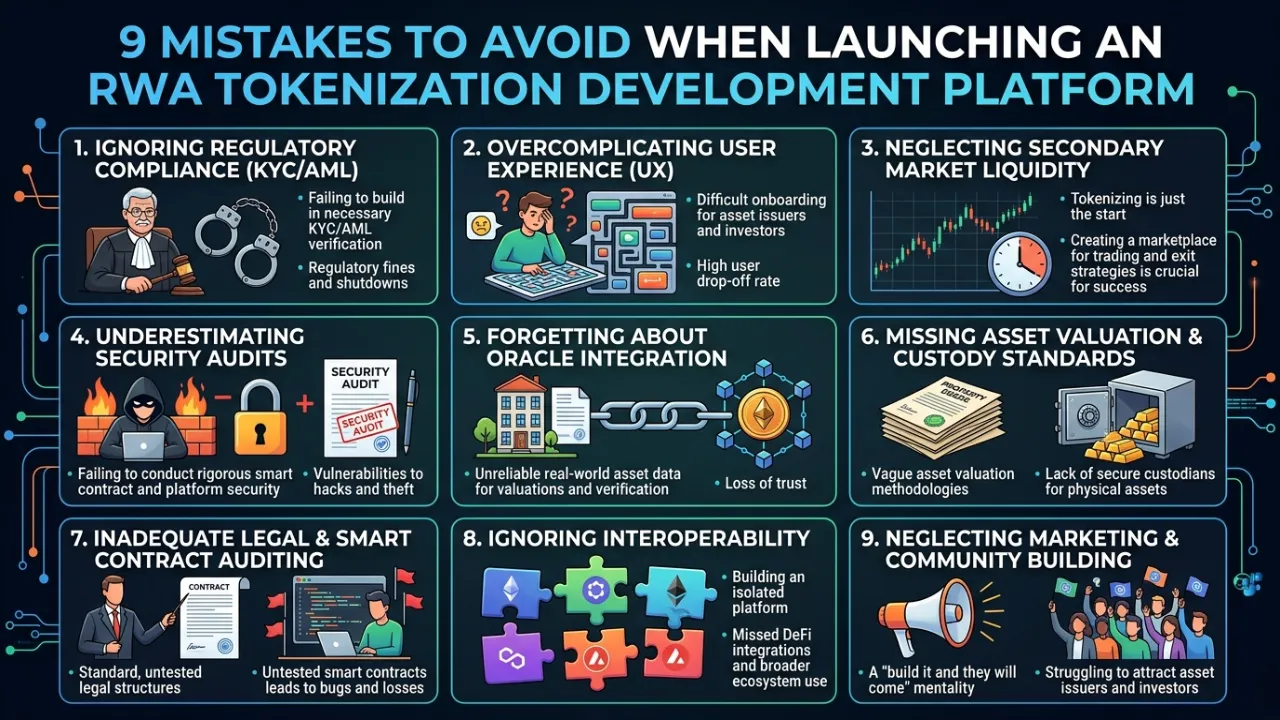
Common Enterprise Mistakes in Real Estate Tokenization
Many enterprises enter the tokenization market without sufficient preparation. Several recurring mistakes often delay project success.
Ignoring Regulatory Complexity
Compliance obligations vary significantly across regions.
Weak Smart Contract Audits
Poor security reviews may create vulnerabilities.
Poor Investor Education
Confused investors often hesitate to participate.
Inadequate Liquidity Planning
Without marketplace support, investor participation may decline.
Overcomplicated User Interfaces
Complex onboarding processes reduce investment activity.
Weak Property Due Diligence
Asset disputes can damage investor confidence.
A structured roadmap helps enterprises reduce these operational risks before launch.
The Future Direction of Enterprise Tokenized Real Estate
Enterprise interest in Real Estate Tokenization continues expanding as blockchain adoption increases across financial sectors. Property developers, investment firms, commercial real estate groups, and institutional asset managers are studying how tokenization may fit into long-term investment strategies.
Several market trends are influencing this direction:
- Increased institutional blockchain adoption
- Digital securities growth
- Fractional investment demand
- Cross-border investment activity
- Regulatory clarification in multiple jurisdictions
- Expansion of digital asset exchanges
As enterprise participation grows, the market may see broader use of tokenized commercial properties, hospitality assets, industrial facilities, and mixed-use developments.
Organizations that prepare operationally, legally, and technically are more likely to maintain sustainable tokenized ecosystems over time.
Conclusion
The enterprise roadmap for real estate tokenization development success involves far more than token creation. It requires legal planning, asset verification, smart contract architecture, compliance preparation, investor onboarding systems, security management, marketplace planning, governance structures, and long-term operational coordination. Enterprises entering the tokenized real estate sector must approach deployment with a complete strategy that aligns blockchain systems with real-world property management requirements and investor expectations. Careful planning during each phase helps organizations reduce operational risks while improving participation and platform credibility. As enterprise interest in real estate asset tokenization continues increasing, organizations are actively seeking experienced technology partners to support platform deployment and operational planning. Blockchain App Factory provides Real Estate Tokenization Services for enterprises seeking blockchain-based property investment platforms and digital real estate ecosystems.

























Sign in to leave a comment.