
Introduction
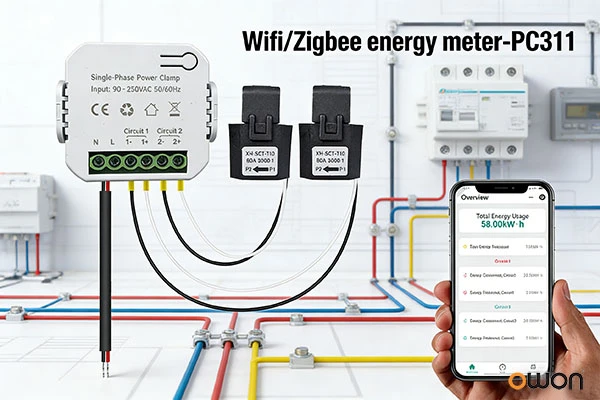
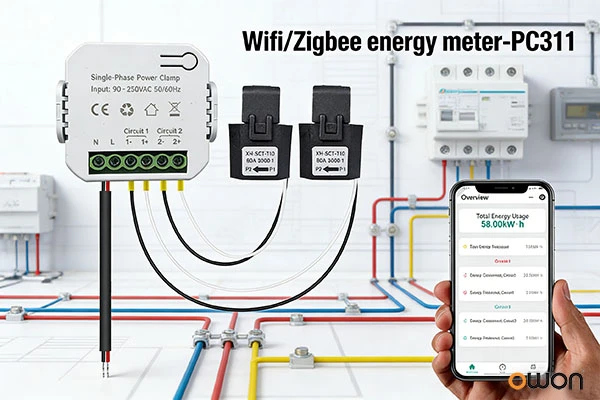
In the rapidly evolving landscape of the Internet of Things (IoT) and smart energy management, the ability to monitor electricity consumption with precision and ease is no longer a luxury—it is a necessity. For businesses, OEM/ODM manufacturers, and homeowners, the WiFi smart energy meter with CT clamp has surfaced as the gold standard for non-invasive, real-time power tracking.
This comprehensive guide explores the intricacies of these devices, from the technical mechanics of CT clamps to the differences between single-phase and three-phase systems, and why the DIN rail format is the preferred choice for industrial and residential integration.
Part 1: What Exactly is a WiFi Smart Energy Meter with CT Clamp?
At its core, a WiFi smart energy meter is an electronic device that measures electrical parameters and transmits them via a $2.4GHz$ or $5GHz$ WiFi network to a cloud server or mobile application.
However, the "CT Clamp" version represents a significant technological leap over traditional "In-line" meters.
Understanding the CT (Current Transformer) Clamp
A CT Clamp is a split-core electromagnetic sensor. Unlike traditional meters that require you to break the circuit and wire the meter in series (which is dangerous and causes downtime), a CT clamp simply snaps around the live wire.
How it works technically:
It operates on the principle of Faraday’s Law of Induction. As alternating current ($AC$) flows through the conductor, it creates a magnetic field. The CT clamp senses this field and induces a much smaller current in its secondary winding, which the meter then calculates into precise $Amps$, $Watts$, and $kWh$.
Part 2: Versatility in Configuration: Single-Phase, Two-Phase, and Three-Phase
One of the biggest advantages of modern smart meter OEMs is the ability to adapt to different global electrical standards.
1. Single-Phase Meters
Most commonly used in residential settings (e.g., Europe, UK, and parts of Asia). A single-phase WiFi meter usually requires only one CT clamp to monitor the main incoming line. It is the perfect entry-point for home energy management systems (HEMS).
2. Two-Phase (Split-Phase) Meters
Common in North America (120V/240V systems). These systems require a meter capable of handling two CT clamps to monitor both hot legs of the power supply, ensuring an accurate reading of the total household load.
3. Three-Phase Meters
The backbone of commercial and industrial (C&I) sectors. These meters come with three CT clamps. They are essential for monitoring heavy machinery, HVAC systems, or entire office buildings. They don't just measure total energy; they provide critical data on load balancing across phases ($L1, L2, L3$), which is vital for preventing equipment overheating and optimizing grid stability.
Part 3: The "DIN Rail" Form Factor: Why It’s the Industry Standard
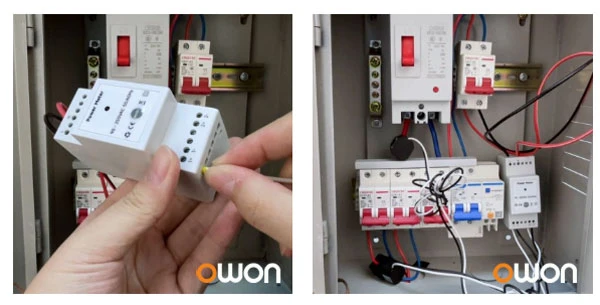
For professional installers and OEMs, the physical design is as important as the software. The DIN Rail (Deutsches Institut für Normung) mount is a standardized 35mm wide metal rail used globally in electrical cabinets.
Why DIN Rail is superior for Smart Meters:
- Space Efficiency: Its compact, modular design fits perfectly alongside circuit breakers.
- Ease of Maintenance: Can be easily swapped or upgraded without redesigning the entire panel.
- Professionalism: Provides a clean, organized look for distribution boards, making it ideal for ODM projects destined for smart buildings.
Part 4: Key Benefits: Why the Industry is Switching to CT-Based WiFi Meters
1. Non-Invasive Safety
Since you don't need to cut cables, there is zero risk of high-voltage arcing during installation. This makes it a favorite for DIY-friendly smart home kits and large-scale industrial retrofitting.
2. High Accuracy and Wide Range
Advanced CT clamps can measure ranges from $0.1A$ to $600A$ and beyond. With high-precision internal chips, these meters often achieve Class 1.0 accuracy, meaning the margin of error is less than $1\%$.
3. Real-Time Data and Analytics
Via WiFi, users can access a wealth of data:
- Active Power ($W$): Instantaneous consumption.
- Reactive Power ($VAR$): Critical for industrial efficiency.
- Voltage ($V$) & Current ($A$): Monitoring for power quality and surges.
- Historical Trends: Exportable data for energy auditing and carbon footprint tracking.
Part 5: Application Scenarios: Where These Meters Shine
- Solar PV Systems: Monitoring the energy produced by solar panels vs. the energy consumed from the grid (Bi-directional metering).
- EV Charging Stations: Tracking exactly how much power an Electric Vehicle is drawing to bill users accurately.
- Smart Factories: Identifying "energy-hungry" machines and scheduling their operation during off-peak hours to save costs.
- Property Management: Sub-metering for apartments or shopping malls where individual tenants need to be billed based on actual usage.
Part 6: Selecting the Right OEM/ODM Partner
When sourcing these devices, look for manufacturers who provide:
- Protocol Flexibility: Support for MQTT, HTTP, and Modbus TCP for easy cloud integration.
- Certifications: Ensure compliance with CE, RoHS, and FCC standards.
- Customization: The ability to customize the App (White-labeling) and the hardware casing.
Conclusion
The WiFi smart energy meter with CT clamp is more than just a measurement tool; it is the bridge between traditional electrical infrastructure and the digital future. By offering a non-invasive, highly accurate, and wirelessly connected solution, it empowers users to take control of their energy destiny.
























Sign in to leave a comment.