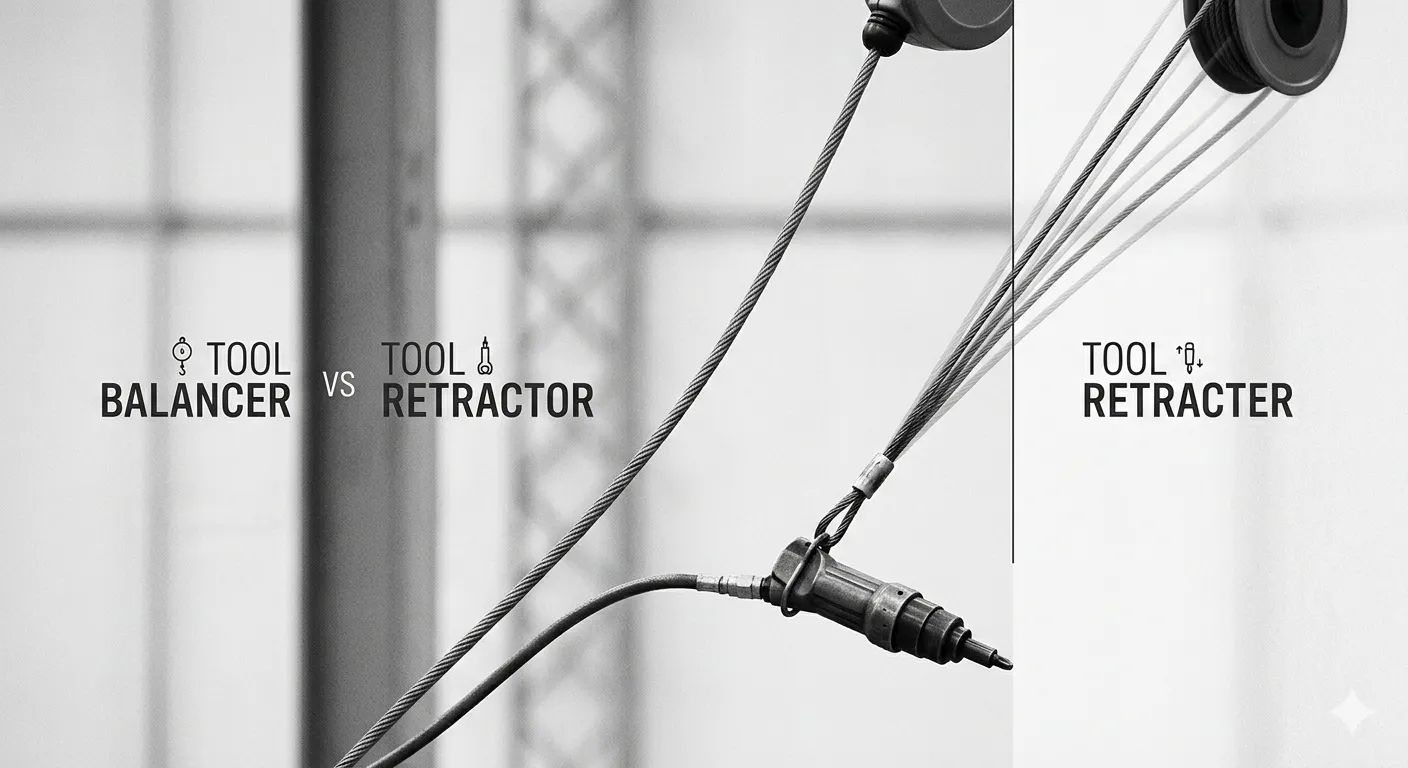

In high-performance manufacturing and industrial assembly environments, ergonomic optimization, operator safety, and workflow efficiency are critical to maintaining productivity and reducing downtime. This is where tool balancers and tool retractors play a vital role. Designed to support heavy hand tools, these devices help create a near weightless handling experience, minimizing operator fatigue and improving precision, but they function through distinctly different mechanisms.
This comprehensive guide explores the key differences between tool balancers and tool retractors, highlights their ideal industrial applications, and outlines essential maintenance best practices to ensure a safe, efficient, and uninterrupted workflow.
The Problem: Handling Heavy, Awkward Tools
Manually lifting, holding, and positioning tools like pneumatic screwdrivers, drills, or even heavier equipment can lead to a host of problems for workers. It’s not just about the immediate physical effort; it's about the long-term impact:
- Operator Fatigue: Constantly supporting the weight of a tool, even for short bursts, is tiring. This fatigue slows down work as the day goes on and can lead to lower-quality work.
- Repetitive Strain Injuries (RSIs): This is the biggest concern. Holding a tool in a static, often awkward position day after day is a recipe for serious RSIs. Carpal tunnel syndrome, tendonitis, and muscle strains are incredibly common in these environments and are a leading cause of missed work.
- Worker Safety: Fatigue and the awkwardness of handling a heavy tool increase the risk of accidental drops. A dropped tool can damage expensive equipment, the product, or even injure the worker or a colleague.
This is exactly where tool support systems like balancers and retractors come to the rescue. They're designed to:
- Make tools virtually weightless: The system bears the primary load, taking the physical burden off the worker.
- Promote an ergonomic workspace: Tools are kept within a comfortable range of motion, minimizing awkward, straining postures.
- Create a safer environment: Dropping a tool becomes nearly impossible with a well-integrated support system.
Tool Balancers: True Weightless Operation
A tool balancer (often called a zero-gravity balancer) is the heavy-hitter of tool support. Its primary goal is to make the tool feel completely weightless throughout its entire vertical travel distance.
How It Works
Balancers achieve this by using a specially designed internal spring mechanism. Unlike a simple tension spring, a balancer uses a conical-shaped cable drum and a spring designed to provide a constant counterbalancing force.
This constant force precisely offsets the combined weight of the tool, its hose or cable, and any attachments. The result is a system in perfect equilibrium.
Key Characteristics
- "Float" and Position: The most important feature of a balancer is that you can position the tool anywhere within its working range, and it will stay there. It doesn't want to pull up or drop down. This allows the operator to move the tool effortlessly and focus entirely on the task at hand.
- Constant Force: The lifting force is the same from the very top of the travel to the very bottom.
- Higher Capacity: Balancers are typically used for significantly heavier tools, from pneumatic tools like nutrunners and grinders to large, industrial-grade equipment. Some large balancers can support tools weighing hundreds of pounds.
When to Use a Tool Balancer
- Very Heavy Tools: When the weight of the tool is too great for a retractor's simple spring tension.
- Precise Positioning is Critical: When an operator needs to position a tool with high accuracy and have it remain perfectly stable (e.g., in aerospace assembly or with heavy robotic-assisted tools).
- Frequent Vertical Movement: When a task requires an operator to move the tool up and down constantly throughout the work cycle.
- Minimizing Fatigue is Paramount: In environments with very high cycle counts or extremely demanding tasks, true zero-gravity is essential to prevent injury and maintain productivity.
Tool Retractors: A Simple, Up-and-Out Solution
A tool retractor is a simpler, more direct device. Think of it as a heavy-duty, spring-loaded reel for your tool's cable. Its primary job is to pull the tool up and out of the way when it's not being used.
How It Works
A retractor uses a simple internal spring mechanism that applies tension to a cable or hose. This spring is under constant tension. As the operator pulls the tool down to use it, the spring is extended further, increasing the tension. When the operator lets go, the spring pulls the cable back in, retracting the tool to its rest position.
Key Characteristics
- Constant Upward Pull: The retractor is always pulling. The operator must work against this tension to pull the tool down. The force required to pull it down increases the further it's extended.
- Rests at the Top: When the operator releases the tool, it will always return to its highest retracted position.
- Lower Capacity: Retractors are designed for much lighter loads, typically for tools that a single operator can lift but would be fatiguing to hold for long periods. Examples include small electric or pneumatic screwdrivers, air blowers, or light hand tools.
When to Use a Tool Retractor
- Lightweight Tools: When the tool's weight is manageable but you want to reduce hand/arm strain during brief use.
- Minimal Vertical Movement: The task is always performed at a single, consistent height or location.
- Space Organization is Key: When the primary goal is to keep tools from cluttering the workbench or dangling in the workspace.
- Cost is a Factor: Retractors are generally simpler in design and less expensive than true zero-gravity balancers.
Head-to-Head Comparison: The Key Differences
| Feature | Tool Balancer | Tool Retractor |
| Primary Goal | Create a weightless tool through its full vertical travel. | Pull the tool up and out of the way when not in use. |
| Core Function | Precise counterbalancing of a specific weight. | Constant spring tension to pull the cable back in. |
| Tool "Floats"? | Yes. Can be positioned anywhere and will stay put. | No. The operator must hold it down against spring tension. |
| Lifting Force | Constant. The same force throughout the entire travel. | Increasing. Tension increases as the cable is pulled out. |
| Ideal for... | Heavier, more critical, precision tools. Frequent vertical movement. | Lightweight tools. Tasks at a fixed position. Keeping the workspace clear. |
| Load Capacity | Medium to Very High. | Low to Medium. |
| Complexity & Cost | More complex design, generally higher cost. | Simpler design, generally lower cost. |
| Rest Position | Anywhere within the travel range. | Always fully retracted (highest position). |
Export to Sheets
Real-World Applications: Seeing Them in Action
Let’s look at a few common workplace scenarios to see how each tool is best applied:
- Assembly Line for Consumer Electronics: Operators are working with lightweight electric screwdrivers at a fixed workbench. They use the tool every minute. A retractor is perfect here. It keeps the screwdriver off the workbench, reduces wrist strain during use, and automatically lifts it up and out of the way for the next work cycle.
- Heavy Duty Truck Engine Assembly: A worker needs to use a large, heavy nutrunner to secure engine components. The task requires them to move the tool to different bolts at varying heights. A tool balancer is the only correct choice. The nutrunner feels weightless, allowing for precise positioning, and doesn't fatigue the worker.
- Metal Fabrication Shop: A worker uses a grinder to smooth welds on large metal frames. The grinder has a medium weight, but they only use it intermittently. A heavy-duty retractor could keep the grinder and its cable off the floor and away from welding splatter, reducing tripping hazards and extending the tool's life.
- Product Testing Station: A high-precision electronic probe needs to be meticulously positioned on a circuit board without any vertical force. A high-quality zero-gravity balancer is essential. The operator can "float" the probe perfectly into position.
Maintenance and Best Practices
To get the most out of your tool support system and ensure a safe, productive workplace, regular maintenance is crucial:
- Read and Follow the Manual: Every balancer and retractor has specific care and maintenance instructions.
- Regular Inspection: Visually inspect the cable/hose, internal spring housing (if visible), hooks, and connectors for any signs of wear, fraying, or damage. Replace any compromised parts immediately. A frayed cable is a major safety hazard.
- Cable Lubrication: Some balancers and retractors require specific lubrication for the cable and drum to prevent wear. Check your manual for recommendations.
- Proper Tension Setting: This is critical. The counterbalancing force must be precisely adjusted to the weight of your tool. A too-light setting on a balancer will allow the tool to drift up, while a too-heavy setting will require the operator to push the tool down. An improperly set retractor can pull the tool with excessive force, causing damage. Most devices have a clear, easy-to-use adjustment mechanism.
- Use a Safety Chain/Cable: Even with a properly adjusted balancer or retractor, using a backup safety chain is a wise safety practice. This would catch the tool in the extremely rare event of a main support failure.
- Secure Mounting: Ensure the device is securely mounted to a structurally sound overhead beam, track system, or workstation. Never use makeshift attachments.
The Latest Trends in Tool Support Technology
While the core principles of balancers and retractors are well-established, technology continues to drive innovation in this space:
- Ergonomic Enhancements: Manufacturers are developing systems with even smoother, more frictionless operation to make tool movement feel completely natural and effortless.
- Integration with Power: New systems often feature integrated power cords or pneumatic hoses within the support cable, reducing clutter and the risk of tangled lines.
- Data and Analytics (The Connected Workstation): Some high-end systems are now incorporating sensors that can track tool usage, cycles, and even torque data. This data can be valuable for:
- Predictive Maintenance: Knowing when to inspect or replace components based on actual usage.
- Workforce Management: Tracking productivity and ensuring ergonomic guidelines are being met.
- Process Control: Ensuring tools are used in the correct sequence or for the correct duration.
- Material Advancements: The use of new, lighter-weight, and durable materials like composite housings is becoming more common, making the support systems themselves lighter and easier to install.
- Modular Systems: There's a growing trend towards modular overhead rail and track systems that make it easy to deploy, move, and reconfigure tool support systems as production needs change.
By understanding the differences between tool balancers and retractors, you can make an informed decision and invest in the technology that will truly improve workplace safety, increase operator comfort, and drive up productivity.

































Sign in to leave a comment.