

Finding a reliable free loan management system can be difficult for NBFCs, banks, MFIs, fintech companies, and other lending businesses. Many lenders search for free software because they want to reduce technology costs while still managing borrowers, loan applications, EMI schedules, repayments, collections, and reports efficiently.
However, “free” does not always mean the same thing.
Some loan management platforms are genuinely open-source and can be downloaded and self-hosted. Others provide a free plan or free core platform but charge for usage, integrations, implementation, support, or additional services. Therefore, lenders should evaluate the complete cost and capabilities of a platform before making a decision.
In this guide, we explore five free or free-to-start loan management systems and explain what each option is best suited for.
What Is a Free Loan Management System?
A free loan management system is software that allows a lender to manage important loan operations without paying a traditional upfront software license fee.
Depending on the platform, free functionality may include:
- Borrower management
- Loan application management
- Loan product configuration
- EMI and repayment schedules
- Interest calculations
- Payment tracking
- Collections management
- Loan portfolio monitoring
- Reports and dashboards
- Document management
- User and role management
- API integrations
- Accounting functionality
The important point is to understand what “free” actually covers.
A self-hosted open-source system may have no software license cost but still require infrastructure, development, security, maintenance, and technical support. A cloud-based platform may have no setup or platform fee while charging based on usage.
For a lending business, the lowest software price is not necessarily the lowest total cost of ownership.
What Should You Look for in Free Loan Management Software?
Before choosing a free LMS, evaluate the following areas.
1. Loan Lifecycle Management
The software should support the complete loan lifecycle, including application, approval, disbursement, servicing, repayment, collections, and closure.
2. EMI and Repayment Management
A good LMS should automatically calculate repayment schedules and track payments accurately.
Look for support for:
- EMI schedules
- Reducing-balance interest
- Flat-rate interest
- Bullet repayments
- Moratoriums
- Prepayments
- Foreclosure
- Rescheduling
- Part-payments
3. Borrower Management
The platform should maintain a centralized borrower profile containing relevant customer, loan, document, repayment, and communication information.
4. Collections
Collections are one of the most important components of lending operations. Look for DPD tracking, collection workflows, payment reminders, collection assignments, and recovery reporting.
5. Integrations
Modern lenders rarely operate with one system. An LMS may need to connect with:
- Credit bureaus
- KYC providers
- Payment gateways
- Banking systems
- Accounting software
- Communication platforms
- eSign providers
- APIs and third-party applications
6. Security and Compliance
Free software should not mean compromising on security.
Before deploying a system for real lending operations, evaluate:
- Access controls
- Audit trails
- Data security
- Backup procedures
- Encryption
- Compliance capabilities
- Data retention
- Regulatory reporting
7. Scalability
A system that works for 100 loans may not work efficiently for 100,000 loans.
Consider whether the platform can support increasing:
- Borrower volumes
- Loan accounts
- Users
- Branches
- Products
- Transactions
- API requests
Top 5 Free Loan Management Systems in 2026
The following options represent different approaches to “free” loan management software. They should not be considered identical products because their deployment models, technical requirements, features, and pricing structures differ.
1. Roopya — Best Free Loan Management Platform for Modern Indian Lenders
Roopya is designed for Indian NBFCs, banks, MFIs, fintech companies, and modern lending businesses.
Roopya's published free LOS & LMS offering states that lenders can use the platform with zero platform fee and zero setup cost, with a pay-per-use model. Its offering includes LOS and LMS capabilities, pre-integrated APIs, repayment management, NACH/eMandate functionality, collections, and portfolio management.
Key Features
- Loan Origination System
- Loan Management System
- Borrower onboarding
- Digital application processing
- Credit bureau integrations
- EMI scheduling
- Repayment tracking
- NACH/eMandate management
- DPD and delinquency tracking
- Collections workflows
- Portfolio analytics
- Configurable business rules
- API integrations
- Cloud-based deployment
Roopya also positions its LMS as a no-code, AI-first, cloud-native platform for modern lenders.
Best For
Roopya is particularly suitable for:
- NBFCs
- Fintech lenders
- MFIs
- Digital lenders
- Banks
- Co-lending businesses
- Growing lending companies
Why Consider Roopya?
The biggest advantage for businesses evaluating “free” loan software is that Roopya's model separates the absence of upfront platform/setup fees from usage-based costs. This can make it easier for a growing lender to start without making a large software investment.
2. Frappe Lending — Best Open-Source Option
Frappe Lending is an open-source loan management system built on the Frappe Framework and ERPNext ecosystem.
Its public repository describes it as an open-source LMS designed to manage the loan lifecycle from origination through closure. It includes loan products, loan operations, collateral management, accounting, risk and compliance capabilities, co-lending, and loan transfers.
Key Features
- Loan product management
- Loan applications
- Disbursement
- Repayment management
- Collateral tracking
- Accounting
- Billing and taxation
- Risk management
- Reporting
- Co-lending
- Loan transfers
Best For
Frappe Lending can be a good option for organizations that:
- Want open-source software
- Have technical resources
- Prefer self-hosting
- Need customization
- Already use ERPNext or Frappe
Important Consideration
Open-source does not necessarily mean zero operating cost.
You may still need to budget for:
- Cloud infrastructure
- Implementation
- Developers
- Security
- Updates
- Backups
- Technical support
For a regulated lending business, these costs should be considered before selecting a self-hosted platform.
3. FreeBird — Best for Smaller Lending Operations
FreeBird positions itself as loan management software for individual money lenders, MFIs, NBFCs, mobile shops, and EMI-based consumer lending businesses. Its website currently offers a seven-day free trial rather than presenting the product as permanently free software.
Key Features
Depending on the business configuration, lenders can use loan software to manage:
- Borrowers
- Loan accounts
- Repayments
- Collections
- Field operations
- Customer information
- Loan servicing
Best For
FreeBird may be worth considering for:
- Small lending businesses
- Individual lenders
- Smaller MFIs
- Consumer-finance businesses
- Businesses migrating from spreadsheets
Important Consideration
A free trial and free software are different.
If your requirement is free forever, verify the commercial terms before migrating your portfolio.
4. Open-Source Loan Management Projects
Another category worth considering is community-developed open-source loan management software.
Public repositories contain several loan management projects that can be downloaded, modified, and deployed depending on their licenses and technical requirements.
For example, public GitHub projects include web-based systems supporting borrower management, loan plans, payment tracking, loan applications, and approval workflows.
Advantages
- No traditional software license fee
- Source-code access
- Customization possibilities
- Self-hosting
- Developer flexibility
Disadvantages
The major challenge is that many community projects are not enterprise-ready.
You may need to handle:
- Hosting
- Security
- Updates
- Bug fixes
- Database administration
- Backups
- API development
- User management
- Compliance
- Technical support
Therefore, a downloadable loan management application can be useful for experimentation or smaller operations, but regulated lenders should perform proper technical and compliance due diligence.
5. Free or Open-Source Lending Platforms for Specific Use Cases
The fifth category includes open-source lending platforms designed around particular lending or financial-services use cases.
Some open-source platforms focus on microfinance, community finance, loan origination, or specific lending workflows rather than providing a complete enterprise LMS.
For example, open-source projects such as DigiFi's Loan Origination System demonstrate how open-source lending infrastructure can provide modular components for different lending verticals.
Best For
These solutions can be appropriate for:
- Developers
- Fintech startups
- Research projects
- Custom lending applications
- Organizations with internal engineering teams
Important Consideration
A Loan Origination System is not the same as a complete Loan Management System.
If you need post-disbursement servicing, EMI processing, collections, reconciliation, portfolio analytics, and regulatory reporting, verify that the platform actually supports those functions.
Free Loan Management System Comparison
| Platform | Free Model | Best For | Technical Requirement | Cloud/Hosted Option |
|---|---|---|---|---|
| Roopya | Zero platform/setup cost; usage-based model | NBFCs, banks, MFIs & fintechs | Low-code/no-code | Yes |
| Frappe Lending | Open source | Technical teams & customizable deployments | High | Self-host/cloud |
| FreeBird | Free trial | Smaller lenders & MFIs | Low | Yes |
| Open-source LMS projects | Depends on project/license | Developers & small organizations | High | Depends on project |
| Open-source lending platforms | Depends on project/license | Custom fintech applications | High | Depends on project |
The key lesson is that “free” has multiple meanings. Always compare licensing, hosting, implementation, support, integrations, maintenance, and usage costs—not just the advertised software price.
Free Loan Management System vs Paid Loan Management Software
A free LMS can be an excellent starting point, but businesses should understand the trade-offs.
Free Software
Advantages:
- Lower initial investment
- Faster experimentation
- Suitable for small portfolios
- Useful for proof-of-concept projects
- Open-source customization may be possible
Potential limitations:
- Limited support
- Fewer integrations
- Technical maintenance
- Security responsibility
- Scalability limitations
- Compliance configuration may require additional work
Commercial Cloud LMS
Advantages:
- Professional support
- Managed infrastructure
- Regular updates
- Better scalability
- More integrations
- Security controls
- Enterprise features
- Faster implementation
The right choice depends on the lender's portfolio size, technology resources, compliance requirements, and growth plans.
Why Roopya Is Different From Traditional Free Loan Software
Traditional free loan applications often focus on basic borrower and repayment tracking.
A modern lending platform needs to go much further.
Roopya combines loan origination and loan management into a unified lending infrastructure. Its published capabilities include digital application processing, credit decisioning, EMI scheduling, payment processing, collections, analytics, and integrations.
This approach is particularly useful for lenders that want to move away from spreadsheets and disconnected systems.
Instead of maintaining separate tools for:
Application → Credit → Approval → Disbursement → EMI → Collections → Reporting
a unified platform can connect these processes into a single workflow.
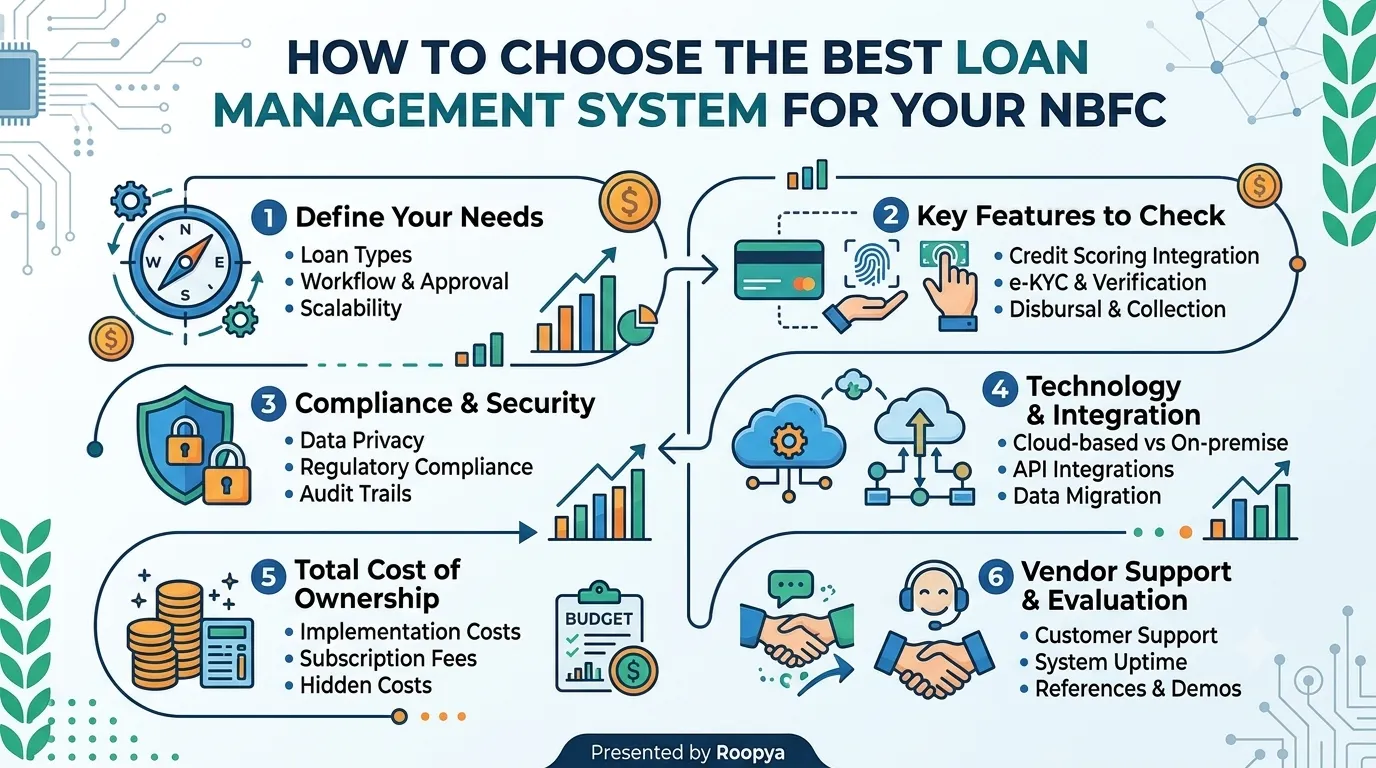
How to Choose the Best Free Loan Management System
Before selecting software, ask these questions:
Does it support your loan products?
Check whether the LMS supports personal loans, business loans, MSME loans, gold loans, vehicle finance, microfinance, consumer finance, or your specific lending product.
Can you automate repayments?
Look for automated schedules, payment tracking, NACH/eMandate, reconciliation, and repayment notifications.
Does it support collections?
A good LMS should provide visibility into overdue accounts and help your team manage collection activities systematically.
Can it integrate with your existing systems?
API capabilities are important if you need connections with banking, accounting, KYC, credit bureau, payment, or communication systems.
Is it scalable?
Think about where your business will be in three to five years, not only how many loans you manage today.
What does “free” actually mean?
Ask whether the provider charges for:
- Users
- Transactions
- APIs
- Hosting
- Support
- Implementation
- Storage
- Integrations
- Reports
- Additional modules
Is a Free Loan Management System Really Free?
Not always.
There are three common models:
1. Open Source
The software source code is available under an applicable license.
You may not pay a software license fee, but you can still incur infrastructure and development costs.
2. Free Plan
The provider gives access to a limited set of features for free, with paid upgrades available.
3. Zero Upfront Cost / Pay Per Use
The provider does not charge traditional setup or platform fees but charges according to usage.
Roopya currently describes its free LOS/LMS model as zero platform fee, zero setup cost, and pay-per-use, making it important to distinguish this model from conventional “free trial” software.
Benefits of Using a Loan Management System
A modern LMS can help lenders:
- Reduce manual data entry
- Automate repayment calculations
- Improve borrower visibility
- Track overdue loans
- Improve collection workflows
- Reduce operational errors
- Centralize loan information
- Generate reports faster
- Integrate third-party services
- Scale loan operations
- Improve borrower servicing
For larger lenders, the biggest benefit may not be simply reducing software costs. It may be creating a more efficient lending operation that can scale without increasing manual work at the same rate.
Who Should Use Free Loan Management Software?
Free or low-cost LMS solutions can be useful for:
- Startup fintech companies
- New NBFCs
- Small lending businesses
- MFIs
- Credit cooperatives
- Individual lenders
- Developers building lending applications
- Businesses replacing spreadsheets
- Companies testing a new lending product
However, regulated lenders should conduct proper security, compliance, data protection, integration, and operational due diligence before deploying any platform in production.
Final Verdict
There is no single “best” free loan management system for every lender.
The right choice depends on your business model, loan volume, technical resources, integrations, compliance requirements, and growth plans.
For developers and organizations that want source-code control, open-source solutions such as Frappe Lending can be attractive. For smaller lending businesses, a free trial can help evaluate a commercial platform before committing. For modern Indian lenders looking for a cloud-based platform without traditional upfront platform and setup costs, Roopya is a strong option to evaluate.
The most important thing is not simply finding software that costs nothing. It is finding a loan management platform that provides the right combination of functionality, security, scalability, integrations, support, and total cost of ownership.
If your lending business is moving beyond spreadsheets or disconnected systems, evaluating Roopya's free LOS and LMS can be a practical next step.
Frequently Asked Questions
1. What is a free loan management system?
A free loan management system is software that allows lenders to manage loan operations without a traditional upfront software license fee. Depending on the platform, it may be open-source, available under a free plan, or offered with zero setup/platform fees and usage-based charges.
2. What is the best free loan management system in 2026?
The best option depends on the lender's requirements. Roopya is designed for Indian NBFCs, banks, MFIs, and fintech lenders and offers a published zero-platform-fee and zero-setup-cost model with pay-per-use pricing.
3. Is Roopya Loan Management System free?
Roopya's published free LOS and LMS offering states that there is zero platform fee and zero setup cost, with a pay-per-use model. Lenders should review the current commercial terms for their expected usage before implementation.
4. Is open-source loan management software free?
Open-source software can be used without a traditional license fee depending on its license, but hosting, development, maintenance, security, implementation, and support can still create costs.
5. Can a free LMS manage EMI payments?
Many loan management systems support EMI scheduling and repayment tracking. However, the exact capabilities vary by platform, so lenders should verify support for their required repayment methods and loan structures.
6. Can free loan software be used by an NBFC?
Yes, depending on the platform. However, an NBFC should verify security, auditability, regulatory reporting, data protection, integrations, scalability, and operational controls before using any free LMS in production.
7. What is the difference between a free LMS and an open-source LMS?
A free LMS is available without a traditional software charge, but the provider may control the source code. An open-source LMS makes its source code available under a particular open-source license, allowing users to inspect and potentially modify it according to that license.
8. Can a free loan management system replace Excel?
For many small lending operations, an LMS can replace spreadsheets for borrower records, loan tracking, repayment schedules, collections, and reporting. The exact benefit depends on the platform's functionality and your operational requirements.
9. Does Roopya provide both LOS and LMS?
Yes. Roopya's published platform combines Loan Origination System and Loan Management System functionality, enabling lenders to manage processes from onboarding and credit workflows through servicing and collections.
10. What should I check before choosing free loan software?
Evaluate features, security, compliance, scalability, integrations, support, hosting, data ownership, customization, migration requirements, and the provider's complete pricing model—not only whether the initial software cost is zero.




























Sign in to leave a comment.