
Most brands at an industry event are fighting the same battle: getting people to stop, engage, and remember something specific about what they offer. The competition is not just other booths. It is an entire room full of noise, movement, free merchandise, and human beings with genuinely finite attention.
Conventional approaches — booth displays, product demos, branded handouts — work to a degree. They get people to stop. They rarely get people to understand.
What actually creates memory is participation. When someone does something — makes a choice, navigates a challenge, earns a reward — they encode the experience differently than passive observers. That is not a philosophical claim. It is how memory and association form.
The interactive experience center built for Amazon Shipping at Sambhav 2025 was designed around exactly this principle — and delivered results in 14 days.
The Brief: Make Logistics Feel Real Without a Lecture
Amazon Shipping needed to communicate three core service areas at Sambhav 2025: air freight, transit cargo, and last-mile delivery. The audience was business decision-makers — people who understand logistics in principle but needed a reason to think specifically about Amazon Shipping.
The conventional approach would have been a product video, a live demo, a representative walking through the service layers. Nothing wrong with that. It just does not stay with people once they leave the booth.
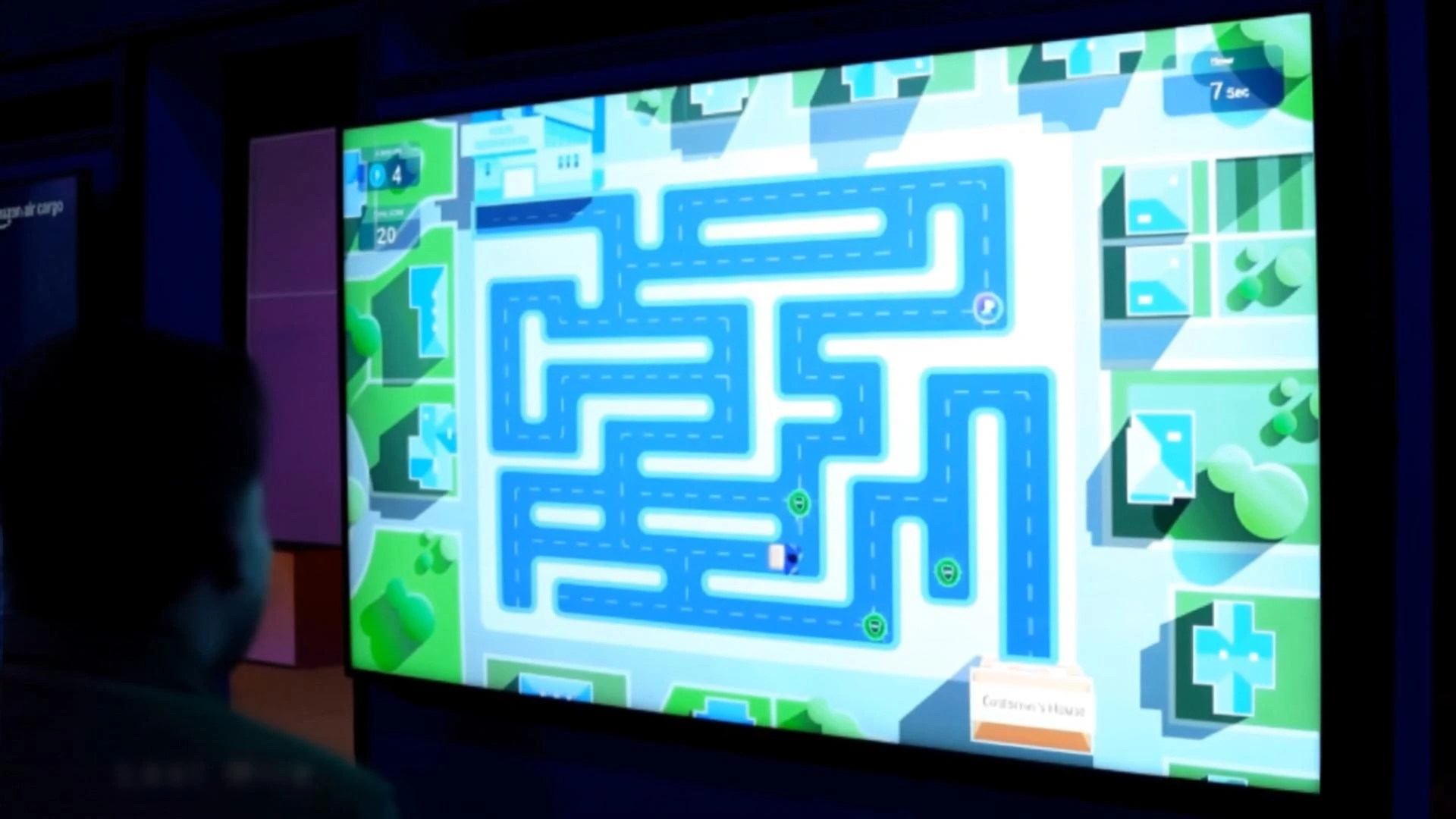
The ask from Amazon was specific: build a three-level game where each layer maps to one of the three service stages. Use hardware controls — a joystick — for physical engagement. Collect leads during play. Reward participants with tiered gifts. Deliver a polished, stable experience within two weeks.
Three Layers, One Coherent Journey
Layer 1 — Flight (Air Freight) A player pilots a parcel through the sky, collecting power-ups and avoiding hazards. Fast, instinctive, immediately engaging. The mechanic hooks players in the first fifteen seconds — which, in a busy event environment, is the only window you have.
Layer 2 — Truck (Transit) The truck drives forward while parcels fall from above. The player steers to collect them. Simple, accessible, satisfying. It maps naturally to how transit logistics actually work — movement, collection, routing — without needing any explanation.
Layer 3 — Maze (Final Delivery) A delivery partner navigates a last-mile maze to reach the recipient's house. This layer rewards careful thinking over quick reflexes, and it completes the narrative arc: from air to road to doorstep.
Together, the three layers gave participants a felt sense of what Amazon Shipping does that no brochure or video could replicate. They had literally moved cargo from air to delivery. The brand association was active, not passive.
The Real Challenge: 14 Days
The brief itself was clear. The timeline was not comfortable. From brief to live event: 14 to 16 days.
That is a compressed window for a project requiring design, UI development, Unity-based gameplay across three distinct mechanics, hardware sourcing and calibration, QR-based check-in integration, backend connectivity to Amazon's systems for prize fulfilment, and on-site testing and staging.
IIC Lab split the project into parallel tracks — design and UI, Unity gameplay, hardware integration, QA, and on-site staging — running simultaneously rather than sequentially. The result was a polished, stable experience delivered on time.
On-site, a separate challenge surfaced: venue lighting was causing QR scanning failures. The fix involved adjusting scanner angles, retuning exposure settings, adding clear on-screen guidance, and building a manual entry fallback. All of it resolved without disrupting the event.
What the Numbers Said
- 200–250 participants played the full three-layer experience
- Dropout rate was exceptionally low for a live event format
- Session time ran 2 to 3 minutes — long enough for engagement, fast enough for high rotation
- Many participants played again using friends' QR codes
- Older visitors described feeling like children again while playing
That last observation cannot go in a formal report. But it is the clearest possible sign that an experience has reached people in a way ordinary brand communication cannot.
Why This Matters for How You Think About Experience Design
A product video communicates information. A game that makes someone physically navigate your service ecosystem communicates something more durable — a memory of participation, a felt sense of how something works, an emotional association formed through doing rather than watching.
For brands in complex B2B or B2C spaces — logistics, finance, infrastructure, technology — interactive experience centers designed around participation rather than presentation are not a trend. They are a structural shift in what good communication actually means in high-noise environments.
The question is not whether this format works. The Amazon Sambhav numbers answer that. The question is what you want your audience to leave with.
Events are temporary. What people remember is not. If you need audiences to leave with genuine understanding of what you do — not just a branded memory — IIC Lab designs interactive experiences that turn exploration into conviction.

























Sign in to leave a comment.