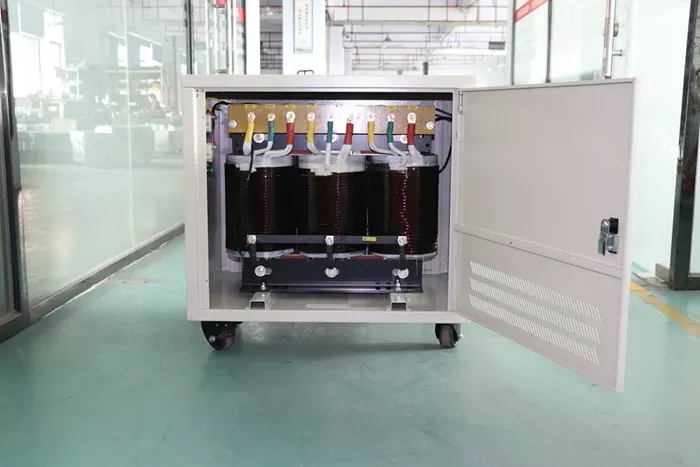

A step-up autotransformer is a specialized electrical device designed to increase voltage from a lower level to a higher level using a single continuous winding. Unlike conventional transformers that use separate primary and secondary windings, the autotransformer relies on a shared winding, making it more compact, efficient, and cost-effective. This unique design allows it to transfer electrical energy with minimal losses while maintaining high performance in applications requiring voltage boosting.
This comprehensive guide explains the working principle, structure and applications of step-up autotransformers.
Understanding the Step-up Autotransformer
A step-up autotransformer is a type of transformer that increases output voltage compared to input voltage by using a single winding that acts as both the primary and secondary circuit. Instead of electrical isolation, it uses a portion of the same winding for both input and output, which significantly reduces material usage and improves efficiency. This design makes it ideal for applications where electrical isolation is not a critical requirement.
The key principle behind a step-up autotransformer lies in electromagnetic induction. When alternating current flows through the winding, it creates a magnetic field that induces voltage across different sections of the same winding. By tapping into a specific point along the winding, a higher voltage can be obtained at the output.
Main Components of a Step-up Autotransformer
Single Continuous Winding
The most important component of a step-up autotransformer is its single winding, which serves both input and output functions. This winding is typically made of copper or aluminum conductors and is wound around a magnetic core. The winding includes taps at specific points to provide different voltage levels.
Magnetic Core
The magnetic core is usually made from laminated silicon steel to minimize eddy current losses. It provides a path for magnetic flux and enhances the efficiency of electromagnetic induction. The core design directly influences the performance and efficiency of the transformer.
Tap Connections
Taps are connection points along the winding that allow voltage to be stepped up or adjusted. In a step-up autotransformer, the output is taken from a higher number of turns compared to the input, resulting in increased voltage. These taps can be fixed or adjustable depending on the design.
How Does a Step-up Autotransformer Work?
The working principle of a step-up autotransformer is based on Faraday’s Law of Electromagnetic Induction. When an alternating current passes through the winding, it generates a magnetic flux in the core. This changing magnetic flux induces voltage in the same winding, and the voltage level depends on the number of turns between the input and output points.
Step 1: Input Voltage Application
The process begins when an AC voltage is applied to a portion of the winding. This section acts as the primary side, and the current flowing through it creates a magnetic field in the core. The strength of the magnetic field depends on the magnitude of the current and the number of turns.
Step 2: Magnetic Flux Generation
The alternating current produces a continuously changing magnetic flux within the core. This flux links the entire winding, including the portion used as the secondary. Because the winding is shared, the magnetic coupling is highly efficient compared to conventional transformers.
Step 3: Voltage Induction
The changing magnetic flux induces voltage across the entire winding. The induced voltage is proportional to the number of turns in the winding section. By selecting a section with more turns for the output, the transformer effectively steps up the voltage.
Step 4: Output Voltage Delivery
The output voltage is taken from a higher number of turns compared to the input section. This results in a higher voltage at the output terminals. The ratio of output voltage to input voltage is determined by the turns ratio of the winding.
Voltage Transformation Formula
The relationship between input and output voltage in a step-up autotransformer can be expressed using a simple formula:
Voltage Ratio = (Number of Output Turns) / (Number of Input Turns)
This formula shows that increasing the number of turns in the output section results in a higher output voltage. Because the winding is shared, part of the power is transferred directly through electrical conduction, which improves overall efficiency.
Key Characteristics of Step-up Autotransformers
High efficiency due to reduced copper and core losses
Compact size and lightweight construction
Lower cost compared to conventional transformers
No electrical isolation between input and output
Suitable for small voltage adjustments
These characteristics make step-up autotransformers particularly useful in applications where efficiency and cost are critical factors. However, the lack of electrical isolation can be a limitation in certain safety-sensitive environments.
Step-up Autotransformer vs Conventional Transformer
Understanding the differences between step-up autotransformers and conventional transformers is essential for selecting the right device. While both perform voltage transformation, their construction and performance characteristics vary significantly.
| Parameter | Step-up Autotransformer | Conventional Transformer |
|---|---|---|
| Winding Design | Single continuous winding | Separate primary and secondary windings |
| Efficiency | Higher efficiency | Moderate efficiency |
| Size & Weight | Smaller and lighter | Larger and heavier |
| Cost | Lower cost | Higher cost |
| Electrical Isolation | Not provided | Fully isolated |
Autotransformers are ideal when isolation is not required, while conventional transformers are preferred for safety and isolation purposes.
Applications of Step-up Autotransformers
Step-up autotransformers are widely used in various industries due to their efficiency and cost advantages. They are particularly useful in applications requiring moderate voltage increases.
Power Transmission Systems
They are used to boost voltage levels in power transmission lines, reducing current and minimizing transmission losses. This improves overall system efficiency and performance.
Industrial Equipment
Many industrial machines require specific voltage levels for optimal operation. Step-up autotransformers provide a reliable and efficient way to achieve these voltage requirements.
Renewable Energy Systems
In solar and wind energy systems, step-up autotransformers are used to increase voltage levels before feeding power into the grid. This ensures compatibility with grid voltage standards.
Voltage Regulation
They are commonly used for voltage regulation in electrical networks, ensuring stable and consistent voltage supply to sensitive equipment.
Conclusion
A step-up autotransformer is an efficient, compact, and cost-effective solution for increasing voltage in electrical systems. Its unique single-winding design allows for improved efficiency and reduced material usage, making it ideal for applications where electrical isolation is not required. By understanding its working principle, components, and practical applications, engineers and technicians can effectively utilize this device in a wide range of scenarios.
FAQs
1. How is a Step-up Autotransformer Different From a Conventional Transformer?
The main difference is that a step-up autotransformer uses a single winding for both input and output, while a conventional transformer uses separate windings. This makes the autotransformer more efficient and compact but eliminates electrical isolation.
2. Is a Step-up Autotransformer Safe?
It is safe when properly designed and used in appropriate applications. However, because it does not provide electrical isolation, additional safety measures such as grounding and protection devices are necessary.
3. Why is a Step-up Autotransformer More Efficient?
It is more efficient because part of the energy is transferred directly through electrical conduction rather than entirely through magnetic induction. This reduces losses and improves overall performance.
4. Can a Step-up Autotransformer Be Used for Large Voltage Increases?
It is generally not recommended for large voltage increases. Step-up autotransformers are best suited for applications involving relatively small voltage differences where efficiency and cost are priorities.



























Sign in to leave a comment.