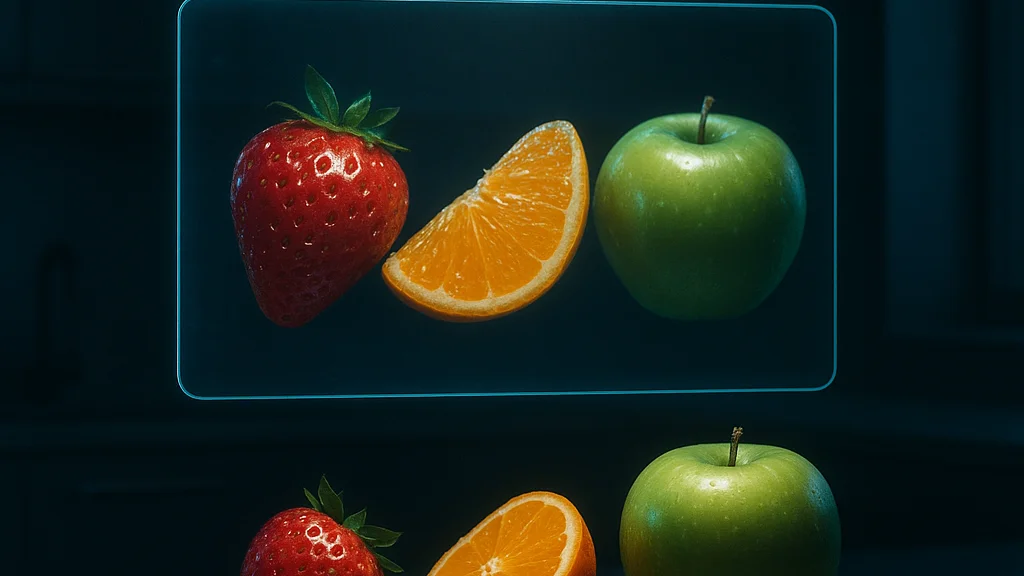

The thesis is simple: those viral AI fruit clips are not just weird food content. They are a stress test for how synthetic media reshapes appetite, disgust, and trust. Wired framed this sharply in its reporting on viral AI fruit videos, arguing that many of the clips carry a distinctly unsettling charge. I think that reading is correct, but incomplete. The darker part is not only the imagery itself. It is the system around it: recommendation engines rewarding sensory extremity, generative tools collapsing the line between edible and impossible, and food culture turning into a lab for frictionless synthetic spectacle.
If you have spent time on TikTok, Instagram Reels, or YouTube Shorts, you have probably seen the format. A strawberry opens like flesh. A mango peels itself with human-like skin tension. A knife glides through fruit that bleeds, pulses, or reveals anatomically suggestive interiors. The clips are bright, glossy, and often absurdly tactile. They are built to trigger the same reflex as classic food porn, but with an extra layer of violation. The result is a hybrid of culinary fantasy, body horror, and engagement bait.
For food and cooking trends, that matters more than it first appears. Food media has always used exaggeration. Think hyper-saturated cookbook covers, molten cheese pulls, or impossible burger stack photography. But generative video changes the economics and the ethics. It can produce endless pseudo-food scenes with no kitchen, no ingredients, no chef, no waste, and no accountability for what is being shown. That efficiency makes the format scalable. It also makes it culturally slippery.
WriteUpCafe has already explored the subject in There’s Something Very Dark About a Lot of Those Viral AI Fruit Videos and the companion Beginner’s Guide to the Dark Side of Viral AI Fruit Videos. What deserves closer attention now is the future: whether this trend burns out as a novelty, matures into a new visual language for food marketing, or becomes a cautionary example of how AI content teaches audiences to consume the unreal as if it were normal.
AI fruit videos are not really about fruit. They are about attention, and attention usually gets darker before it gets boring.
How food media became ideal terrain for synthetic surrealism
Food was always going to be one of the first categories where generative video found mass traction. The reason is practical. Unlike politics or finance, food content does not need factual precision to spread. It needs sensation. A viewer does not ask whether a peach can physically unfold like silk or whether a kiwi can contain a glassy gemstone center. The only test is whether the clip compels a pause, a replay, a comment, or a share.
That makes food a low-friction proving ground for AI aesthetics. For years, social platforms trained users to expect edible exaggeration: oversized pastries, fluorescent drinks, giant burritos, rainbow bagels, mirror-glaze cakes, and choreographed slicing videos. Generative systems did not invent that appetite. They inherited it. What they added was the ability to remove physical constraints altogether. Suddenly, food can be elastic, sentient, impossible, and still legible enough to trigger desire or revulsion.
There is also a production logic here. Traditional food content requires ingredients, lighting, set design, recipe testing, and often a skilled hand. AI-generated food clips can be assembled with prompts, templates, and iterative edits. For creators chasing volume, that is a major advantage. For platforms, synthetic food is ideal inventory: visually rich, globally legible, and detached from local language barriers. A dragon fruit splitting open in an uncanny way works in São Paulo, Seoul, and San Francisco.
Industry reports over the past few years have shown short-form video dominating social engagement across consumer categories, while AI video tools have become faster and cheaper. Even without attaching uncertain numbers, the directional shift is obvious. More creators can make more clips at lower cost, and recommendation systems can test them instantly against audience behavior. In that environment, the weirdest variants often outperform the merely pretty ones.
- Food imagery is universally recognizable and emotionally immediate.
- Short-form algorithms reward strong sensory hooks in the first seconds.
- Generative tools reduce production costs and remove physical limits.
- Surreal food crosses language markets more easily than dialogue-heavy content.
So the category did not drift into AI by accident. It was structurally primed for it.
Why so many of these clips feel dark rather than playful
The disturbing quality of viral AI fruit videos comes from a very specific collision: the visual codes of freshness and abundance mixed with the visual codes of injury, flesh, and mutation. Wired was right to focus on that emotional dissonance. Fruit traditionally signals health, ripeness, sweetness, and domestic comfort. When an AI model renders it with skin-like textures, wet surgical cuts, or impossible internal anatomy, the viewer experiences a category error. Your brain reads “food,” then “body,” then “threat.”
Actually, this is not new in art history or advertising. Surrealists, horror filmmakers, and some luxury fashion campaigns have long exploited the tension between beauty and violation. What is new is the scale and speed. A motif that once belonged to niche visual culture now appears in mainstream feeds between lunch recipes, grocery hauls, and home cooking tutorials. The context flattens the boundary between experimental grotesque and ordinary food entertainment.
There is also a machine-made quality that intensifies the effect. Human stylists usually understand where appetite collapses into disgust. AI systems do not understand that line; they statistically approximate images that satisfy prompts and learned patterns. The result can be hyper-detailed but emotionally off. A watermelon may glisten too much, a cut may open too smoothly, seeds may resemble teeth, pulp may mimic tissue. That slight wrongness is classic uncanny-valley territory, but applied to food.
For cooking culture, the darker implication is that engagement metrics can train creators toward more transgressive imagery over time. If a normal sliced orange gets weak performance and a semi-biological, semi-human orange explodes in comments, the incentive becomes obvious. This is how formats escalate online. Not through artistic intention alone, but through repeated optimization.
When synthetic food stops behaving like food, it does not simply become fantasy. It starts borrowing the emotional grammar of horror.
Several recurring features explain why these videos unsettle people so reliably:
- Texture confusion: surfaces resemble skin, membranes, or organs rather than peel and pulp.
- Impossible motion: fruit opens, breathes, heals, or reacts in ways associated with living bodies.
- Violence cues: cutting, splitting, and squeezing are staged like surgical or predatory acts.
- Hyperreal lighting: glossy rendering makes the scene feel more intimate and invasive.
- Context collapse: clips appear in ordinary food feeds, making the grotesque feel ambient.
That is why the mood often lands as darker than creators may intend. The medium is optimizing not for nourishment, but for nervous system capture.
The business model behind the uncanny plate
Behind every odd fruit clip is a more ordinary story about platform economics. Short-form video is brutally competitive. Creators need output, novelty, and retention. Brands need low-cost experimentation. Platforms need content that keeps users scrolling. AI fruit videos fit all three needs, which is why the format has survived beyond its first wave of novelty.
Food and beverage marketers are paying attention because synthetic visuals solve a familiar problem: how to make ingredients look new again. A strawberry is a strawberry, until software turns it into a jewel, a creature, or a kinetic object. That creates thumb-stopping potential without the cost of a full production shoot. For smaller agencies and solo creators, this matters. The barrier to entry for high-gloss visual experimentation has fallen sharply since the first consumer-facing image models went mainstream in 2022 and the video tools improved in the years after.
There is a second economic layer. Platforms increasingly reward content that generates comment wars, not just passive likes. AI fruit clips are excellent at this because they split audiences into camps: fascinated, disgusted, amused, suspicious, and morally annoyed. Every reaction becomes fuel. “Why does this look alive?” and “I hate this” perform just as well for distribution as admiration. In engagement terms, disgust can be as valuable as desire.
That creates a feedback loop with a few predictable outcomes:
- Creators test increasingly extreme prompts to stand out.
- Brands imitate the aesthetic cautiously, then more openly if metrics hold.
- Audiences become desensitized to mild surrealism and demand stronger novelty.
- Authentic food creators feel pressure to mimic synthetic visual intensity.
Actually, this last point matters a lot for cooking culture. If audiences get used to impossible textures and frictionless transformations, real food content can start to seem visually underpowered. A real chef slicing a real peach may struggle against a feed full of impossible peaches that bloom like flowers and glimmer like polished plastic. The danger is not that viewers literally mistake AI fruit for recipes. It is that the baseline for what counts as “interesting food” shifts away from craft and toward synthetic spectacle.
That would not be a trivial change. Food media has long influenced purchasing, dining expectations, and home cooking habits. If the next phase is less about taste and more about engineered visual shock, the category risks becoming detached from cooking altogether.
What changed recently, and why 2026 feels different
The conversation has shifted in 2026 because the tools are better, the outputs are harder to identify at a glance, and the public is less impressed by AI for its own sake. Early synthetic food clips spread because they looked novel. Newer ones spread because they can be emotionally manipulative while appearing polished enough to pass as deliberate art direction. That is a more mature, and more consequential, phase.
Several developments have pushed the trend forward. Video generation systems have improved temporal consistency, so fruit can now deform, slice, or ooze across multiple seconds without the obvious warping that used to expose AI. Editing workflows have also become more modular. Creators can generate a base clip, refine frames, add sound design, and package the result into platform-native formats quickly. The output no longer feels like a tech demo. It feels like content.
At the same time, labeling remains inconsistent across platforms. Some AI-generated posts are disclosed. Many are not. Even when labels exist, they are easy to miss and often do little to reduce engagement. Viewers respond to what they feel first, not to metadata. This is one reason the debate has widened from “can AI make food videos?” to “what does it do to food culture when synthetic food becomes ambient?”
There is also a broader regulatory and reputational backdrop. Across media sectors, companies are facing more scrutiny over synthetic content, provenance, and disclosure. While food clips may seem low-stakes compared with political deepfakes, they sit inside the same trust environment. If audiences repeatedly encounter polished but impossible food imagery without clear signals, skepticism can spill over into adjacent categories: recipe videos, restaurant promos, nutrition content, even product packaging photography.
That makes 2026 a hinge moment. The issue is no longer novelty alone. It is normalization. Once a synthetic visual grammar becomes routine, reversing audience expectations gets harder. The question for food creators is whether they want to inherit a feed culture where everything must look impossible to feel worth watching.
The cultural cost for cooks, brands, and viewers
When people discuss AI food imagery, they often focus on deception. That is part of the story, but not the deepest part. The larger cultural cost is erosion of sensory trust. Cooking is one of the most material things we do. It involves heat, texture, smell, timing, spoilage, labor, and failure. Viral AI fruit videos remove nearly all of that. They preserve the look of food while stripping away the conditions that make food meaningful.
For professional cooks and food media workers, this can feel like a subtle devaluation of craft. A painstakingly styled dessert shoot competes with a generated clip that can invent impossible shine, perfect symmetry, and physically unreal movement. The generated version may win attention despite having no recipe, no kitchen logic, and no edible referent. That does not just alter aesthetics. It changes what gets rewarded.
Brands face a different risk. Synthetic food can be exciting for campaigns, mood films, or conceptual launches, but overuse can damage credibility. If a beverage ad leans too far into AI gloss, consumers may read the product itself as artificial, overprocessed, or unserious. In food, authenticity remains commercially valuable even when the term is abused. Farm imagery, chef narratives, origin stories, and ingredient transparency still matter. A campaign that drifts into uncanny spectacle can undercut those signals fast.
Viewers, meanwhile, absorb a quieter lesson: that food exists primarily as visual stimulus. This is not entirely new, but AI intensifies it. The meal becomes less about cooking or eating and more about a stream of engineered sensory events. For younger audiences raised on short-form media, that could shape expectations around what food should look like online and what counts as shareable, desirable, or emotionally potent.
Some practical concerns follow from that shift:
- Home cooks may feel their real dishes are visually inadequate compared with synthetic content.
- Recipe discovery can become noisier as AI spectacle crowds out useful instruction.
- Food literacy may weaken if audiences consume more pseudo-food than actual cooking information.
- Brand trust can slip when polished visuals appear detached from real products.
None of this means AI has no place in food storytelling. It means the category needs boundaries, context, and editorial judgment. Otherwise, the weirdest incentives will set the tone.
Where the trend is likely headed next
The future of these videos will probably split into three lanes. First, there will be pure engagement farming: low-context clips designed to provoke disgust, fascination, or argument. That lane is already established and will continue as long as platforms reward reaction. Second, there will be commercial adaptation. Agencies and brands will borrow the visual language selectively, using surreal fruit or impossible textures in campaigns that still anchor themselves to real products. Third, there will be a more thoughtful artistic lane, where creators use synthetic food imagery to comment on consumption, waste, body politics, or industrial agriculture.
The middle lane is the most important for the food industry. Once marketers realize they can use AI surrealism without fully abandoning product clarity, the aesthetic may become mainstream in launch teasers, seasonal promotions, and packaging-led social content. Imagine a citrus brand using impossible peel animations to dramatize freshness, or a dessert company using synthetic cross-sections to exaggerate creaminess. The line between enhancement and fabrication will become the central editorial problem.
What should audiences and creators watch for over the next 12 to 24 months? A few signals matter more than hype:
- Disclosure norms: whether platforms make AI labels more visible and consistent.
- Brand standards: whether food advertisers publish rules for synthetic product imagery.
- Creator differentiation: whether real-cooking creators market authenticity as a premium.
- Audience fatigue: whether viewers begin rejecting uncanny food as repetitive rather than shocking.
- Tool accessibility: whether mobile-first AI video apps make the format even easier to mass-produce.
Actually, audience fatigue may be the strongest corrective force. Internet formats often burn bright, then collapse into parody. If AI fruit horror becomes too common, the emotional return will diminish. But fatigue does not automatically restore trust. It can leave behind a feed environment where viewers assume manipulation by default. That is a colder, more skeptical media culture, and food content may be one of its casualties.
The next battle is not over whether synthetic food looks impressive. It is over whether food media can stay connected to reality while borrowing AI’s visual power.
A more useful standard for food media in the AI era
If there is a constructive way forward, it starts with a simple distinction: synthetic imagery is not inherently the problem; undisclosed synthetic substitution is. Food media can use AI creatively for concept art, visual metaphors, menu ideation, campaign mockups, and editorial illustration. Problems deepen when generated food is presented in contexts where viewers reasonably expect an edible product, a reproducible recipe, or a truthful depiction of texture and preparation.
That suggests a practical standard for creators, publishers, and brands. Use AI when the goal is expressive interpretation. Be explicit when the goal is representation. A surreal editorial image for a trend story is one thing. A generated dessert shown as if it were a real menu item is another. The same rule should apply to fruit videos. If the clip is art, say so. If it is advertising, disclose the synthetic elements. If it is recipe content, keep the food real enough that the viewer is not being taught fantasy as technique.
For readers and viewers, media literacy around food now needs an update. We already learned to question filters, styling tricks, and portion illusions. Now we also need to ask whether the object itself ever existed. That may sound severe for a category as light as fruit clips, but small habits of skepticism usually form in low-stakes environments before they matter elsewhere.
The future of viral AI fruit videos, then, is not only about aesthetics. It is about norms. Food has always been one of the internet’s most intimate subjects because it touches routine, pleasure, family, and body. When that subject becomes a playground for increasingly uncanny synthetic media, the stakes are higher than a joke feed trend. We are watching a new visual language being negotiated in real time. Whether it becomes a clever tool, a manipulative crutch, or a full-blown trust problem depends on choices being made right now by platforms, creators, marketers, and audiences.
And that is the dark part that may last longer than the meme: once food stops needing to be real in order to feel compelling online, every honest image has to fight harder for belief.






























Sign in to leave a comment.