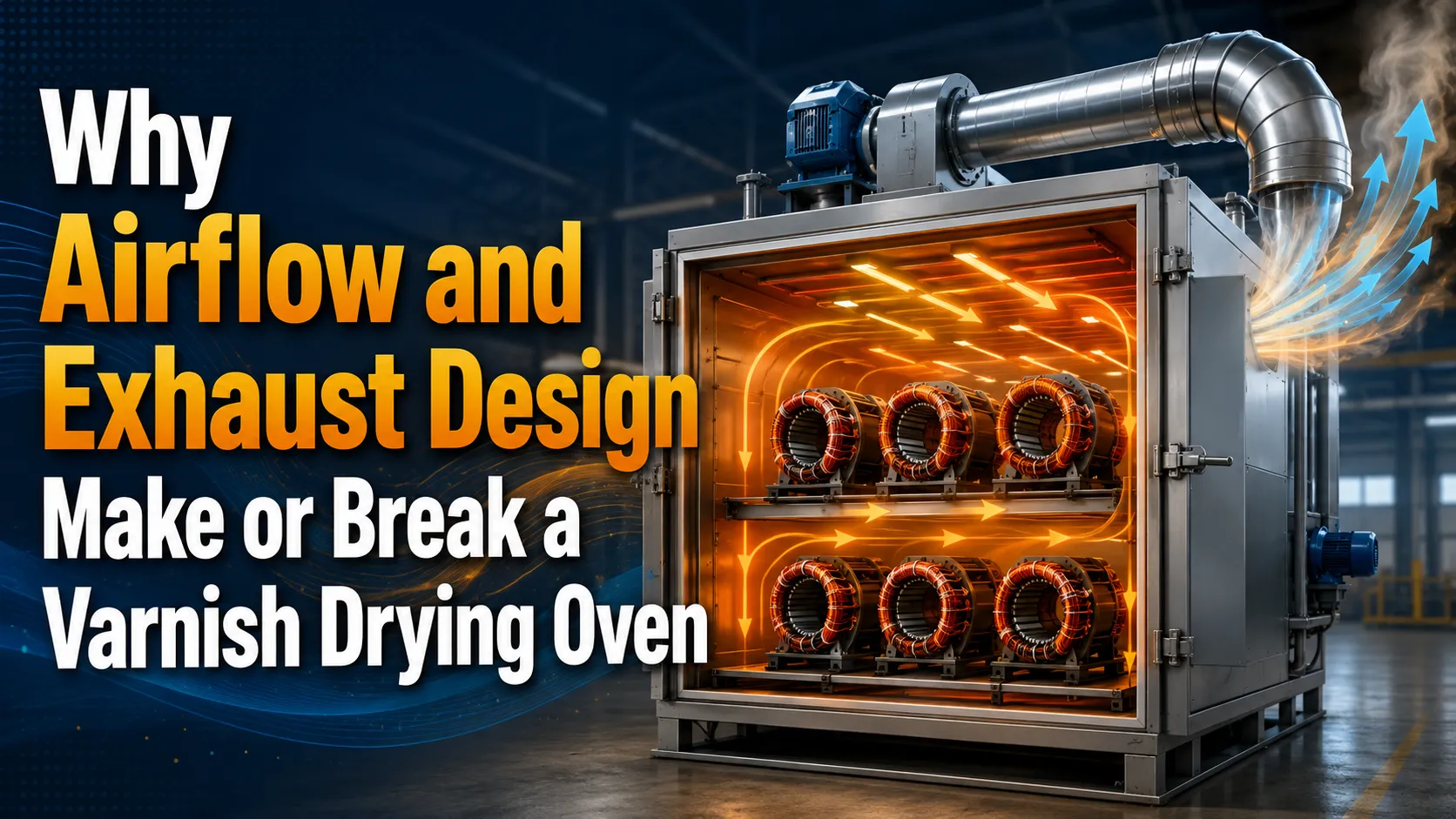

A Varnish Drying Oven is used to dry and cure insulating varnish applied to electric motor windings, stators, rotors, transformers, coils, and other electrical components.
Reaching the required oven temperature is not enough. The oven must also circulate heated air uniformly and remove the moisture, vapours, or curing by-products released from the varnish.
Poor airflow or inadequate exhaust can leave some areas undercured while other parts receive excessive heat.
The Role of Airflow
Airflow carries heated air around and through the varnished component.
Motor windings contain narrow spaces between copper wires, insulation layers, and the stator core. If heated air does not reach these areas evenly, the outside of the winding may dry while varnish deeper inside remains soft or incompletely cured.
Proper recirculated airflow helps provide:
- More uniform component temperature
- Consistent varnish drying
- Fewer hot and cold spots
- Better curing between winding layers
- Improved repeatability between production batches
Industrial oven guidance notes that temperature uniformity depends on properly designed air circulation, fresh-air openings, exhaust locations, and effective mixing of heated air before it enters the work chamber.
Why Exhaust Is Important
As varnish dries, it may release moisture, solvents, or other volatile substances.
The exhaust system removes these substances from the oven and introduces the fresh air required by the process.
Effective exhaust helps:
- Remove solvent vapours
- Prevent vapour accumulation
- Support consistent drying
- Reduce lingering odour
- Maintain suitable oven conditions
- Protect the recirculation and heating system from excessive contamination
This is especially important when solvent-borne insulating varnishes are used. OSHA notes that varnishes used for electric motor coating may be flammable and that solvent vapours associated with dip-tank and curing-oven processes can create safety hazards.
Air Circulation and Exhaust Perform Different Jobs
Air circulation and exhaust should not be confused.
Recirculation airflow repeatedly moves heated air through the oven to improve temperature uniformity.
Exhaust airflow removes a controlled portion of process air containing moisture or vapours and replaces it with fresh air.
Both systems must work together.
Too little exhaust may allow vapours to accumulate. Excessive exhaust may remove unnecessary heat and increase energy use. The correct balance depends on the varnish formulation, product load, oven volume, curing cycle, and applicable safety requirements.
How Poor Airflow Affects Varnish Curing
Weak, blocked, or uneven airflow may cause:
- Soft or wet varnish pockets
- Uneven curing
- Inconsistent winding temperature
- Trapped moisture or volatiles
- Longer processing time
- Surface defects
- Variation between components
- Reduced process reliability
Overloading the oven can create the same problem. When components are packed too closely, they may block the intended air path and prevent heated air from reaching the centre of the load.
How Poor Exhaust Affects the Process
An inadequate exhaust system may result in:
- Vapours remaining inside the chamber
- Strong odour after curing
- Slower removal of moisture or solvents
- Residue inside the oven or ducting
- Increased fire or explosion risk with flammable materials
- Inconsistent final varnish properties
OSHA requires mechanical ventilation in relevant finishing operations to remove flammable vapours and direct them safely to an exhaust system. Drying and curing equipment connected with flammable finishing materials must also meet applicable oven-safety requirements.
Real-Life Example
Consider a repair facility curing varnished electric motor stators.
If the stators are loaded too close together, heated air may circulate mainly around the outside of the load. The exposed surfaces can appear dry, while varnish between the inner winding layers remains incompletely cured.
By improving product spacing, recirculation airflow, and exhaust control, the facility can provide more consistent thermal exposure and better removal of released vapours throughout the cycle.
Important Operating Checks
Operators should regularly check:
- Recirculation fan operation
- Exhaust fan operation
- Air inlet and outlet condition
- Blocked ducts or filters
- Product spacing
- Door seals
- Temperature sensors
- Alarm and interlock operation
- Varnish load per cycle
- Oven cleanliness
The required curing temperature and time should always follow the varnish manufacturer’s technical data. ELANTAS states that impregnated products are drained and then cured according to the temperatures and durations specified for the selected varnish or resin.
Conclusion
Airflow and exhaust are essential parts of a reliable Varnish Drying Oven.
Recirculated airflow distributes heat uniformly around the varnished component, while the exhaust system removes moisture, solvents, and process vapours from the chamber.
When both systems are correctly designed and maintained, manufacturers can achieve more consistent curing, fewer wet or soft areas, better process repeatability, and safer operation—particularly when solvent-bearing varnishes are used.




















Sign in to leave a comment.