
Stock markets are no longer simply battlegrounds of intuition and gut feelings. With growing volumes of data, algorithmic complexity, and global interconnectedness, traders and financial institutions are increasingly turning to artificial intelligence (AI) to gain an edge. AI in stock trading isn’t a novelty—it’s becoming a foundational tool for analysis, decision-making, and execution.
In this article, we’ll explore what “AI in stock trading” means today, the technologies behind it, the benefits, risks, and how traders can harness AI responsibly for long-term success.
What Does AI in Stock Trading Encompass?
At its core, AI in stock trading refers to using algorithms, machine learning, and related data science techniques to automate or augment parts of the trading lifecycle. Key capabilities include:
- Data analysis: Process large datasets (historical prices, order books, fundamentals, news) to identify patterns and signals.
- Predictive modeling: Forecast price movements, volatility, or market sentiment using learned models.
- Natural language processing (NLP): Extract sentiment or relevant information from financial reports, news, social media, or regulatory filings.
- Automated execution: Turn predictions into trades automatically, often with minimal latency.
- Continuous learning: Models that update periodically (or in real time) to adapt to new market conditions.
With these tools, AI systems aim to reduce human biases, accelerate reaction times, and improve consistency in strategy execution.
Key Technologies Powering AI-Driven Trading
To understand the full potential, let’s break down the major technologies making AI in stock trading possible:
- Machine Learning (ML)
- Supervised, unsupervised, and reinforcement learning help detect repeatable market patterns. ML models can learn from historical data to classify stocks, predict direction, or cluster behaviors.
- Deep Learning
- Deep neural networks excel with more complex, non-linear relationships. Models like LSTM (Long Short-Term Memory) or convolutional networks can capture temporal or structural features (for example, price trends over time, or relationships between different assets).
- Natural Language Processing (NLP)
- Markets respond to news. Earnings reports, geopolitical events, regulatory changes—all can move prices. NLP helps scan massive amounts of unstructured text, analyze sentiment, detect risk, and generate signals before they’re fully priced in.
- Alternative Data Integration
- Beyond price charts and financial statements, AI systems are using alternative data: satellite imagery, foot traffic, credit card usage, weather data, and more. These less conventional sources can provide early insights.
- High-Frequency Algorithms & Execution Systems
- When trade opportunities last only milliseconds, automated execution matters. AI systems can react to signals and execute orders faster than a human could act.
- Risk Management & Portfolio Optimization
- AI also helps in building risk models, performing simulations, and balancing portfolios. By using AI-based stress tests, real-time monitoring, or dynamic rebalancing, traders can better control downside risk.
Benefits of Adopting AI in Stock Trading
Why are traders and firms investing heavily in AI capabilities?
- Speed and Efficiency: AI can process more data, more quickly, than human analysts. Faster reaction to market events helps capture opportunities or avoid losses.
- Reduction of Human Bias: Emotional factors—fear, greed, overconfidence—can lead to poor trading decisions. AI, when properly designed, operates without these biases.
- Consistency of Strategy: Strategy rules applied consistently across many instances (markets, times, assets) lead to more predictable returns and better evaluation metrics.
- Scalability: AI systems can monitor multiple markets, assets, and data streams in parallel. They can scale across geographies or trading styles without exponentially increasing human oversight.
- Improved Accuracy and Prediction: By learning from past outcomes, AI can improve its predictive power over time, spotting patterns or anomalies humans might miss.
Use Cases: AI in Action
Here are some concrete use cases where AI is already making a major difference:
- Algorithmic Trading & Quant Strategies: Firms use AI to build quant models, backtest, and deploy algorithmic strategies that exploit small, frequent opportunities or structural inefficiencies.
- Sentiment-Based Signals: Using NLP on news feeds, social media, earning call transcripts to detect shifts in public perception and act ahead of market moves.
- Forecasting Volatility: Predicting when volatility will spike (e.g. around macro announcements or earnings) to inform hedging strategies.
- Trade Execution Optimization: AI that determines optimal trade timing, slice large orders to reduce market impact, or route trades across different venues.
- Portfolio Risk Monitoring: Continuous monitoring of exposures
AI in Stock Trading: The Future of Smarter Investment Decisions
The stock market has always been a space of opportunity and uncertainty. For decades, investors relied on intuition, financial reports, and human expertise to make decisions. But today, with the emergence of artificial intelligence (AI), stock trading has undergone a massive transformation. AI is no longer just a buzzword—it has become a game-changer for investors, traders, and financial institutions worldwide.
In this article, we’ll dive deep into how AI in stock trading works, its real-world applications, benefits, challenges, and the future it holds for the investment landscape.
Why AI is Taking Over Stock Trading
The stock market generates vast amounts of data every second—market trends, company earnings, news sentiment, global events, and even social media discussions. For humans, analyzing all this information quickly and accurately is nearly impossible.
That’s where AI-powered trading systems step in. AI can:
- Process massive datasets at lightning speed.
- Detect patterns and trends that humans may overlook.
- Make real-time predictions with high accuracy.
- Automate buy/sell decisions based on algorithms.
With these capabilities, AI helps traders reduce risks, optimize strategies, and improve returns.
How AI Works in Stock Trading
AI in trading combines multiple technologies, including machine learning (ML), natural language processing (NLP), and predictive analytics. Let’s break it down:
- Data Collection and Analysis
- AI systems gather structured and unstructured data from financial reports, stock exchanges, social media, and even global news.
- Pattern Recognition
- Machine learning models analyze historical stock performance and identify recurring trends.
- Predictive Modeling
- AI algorithms predict future stock price movements by correlating various market indicators.
- Automated Execution
- Once predictions are made, AI-driven bots automatically execute trades at the right time to maximize profits.
- Continuous Learning
- AI systems evolve with every trade, improving accuracy and efficiency over time.
Key Applications of AI in Stock Trading
AI is reshaping trading strategies with several real-world applications:
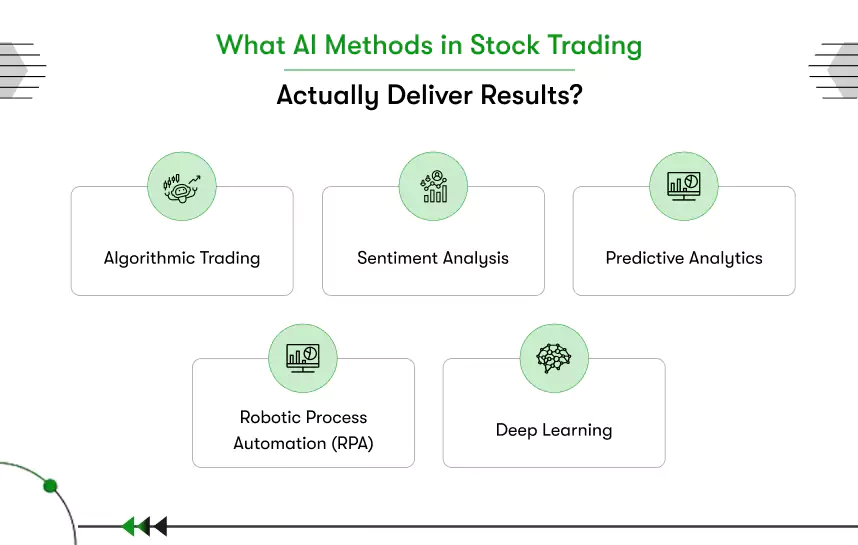
1. Algorithmic Trading
AI-based algorithms execute thousands of trades per second, much faster than human traders. These algorithms minimize errors and capitalize on micro-opportunities in the market.
2. Sentiment Analysis
AI tools use NLP to analyze investor sentiment by scanning news articles, social media, and financial reports. This helps traders understand how public opinion may impact stock performance.
3. Risk Management
AI systems assess portfolio risks by simulating different market scenarios and suggesting diversification strategies to minimize losses.
4. Fraud Detection
Stock markets are prone to manipulation and fraudulent activities. AI detects unusual trading patterns to flag potential risks and protect investors.
5. Personalized Investment Advice
AI-powered robo-advisors recommend tailored investment strategies based on individual risk appetite and financial goals.
Benefits of AI in Stock Trading
The rise of AI is not accidental—it offers significant benefits that investors can’t ignore.
- Faster Decision-Making: AI analyzes massive data in real time, helping traders act quickly.
- Improved Accuracy: Machine learning models reduce human bias and errors.
- Cost-Effectiveness: Automated trading lowers operational costs compared to traditional manual trading.
- 24/7 Market Monitoring: AI bots monitor markets round-the-clock, even when traders sleep.
- Higher Returns: With predictive analytics, AI helps investors identify high-profit opportunities.
Challenges of AI in Stock Trading
Despite its potential, AI trading comes with challenges:
- Data Reliability – Poor-quality or biased data can lead to inaccurate predictions.
- Market Volatility – AI may struggle in unprecedented scenarios, such as sudden political crises or pandemics.
- Ethical Concerns – Over-reliance on AI can reduce human oversight, raising transparency issues.
- High Initial Investment – Building AI trading systems requires significant capital and expertise.
Future of AI in Stock Trading
The future of AI in trading looks bright and dynamic. Here are some trends to watch:
- Quantum Computing + AI: Faster processing will take trading predictions to the next level.
- Integration with Blockchain: Secure and transparent transactions will complement AI-powered trading.
- Smarter Robo-Advisors: Personalized AI advisors will dominate retail investing.
- Global Adoption: Financial institutions worldwide are integrating AI to stay competitive.
Best Practices for Investors Using AI
If you’re considering AI-driven trading, here are some best practices:
- Start with trusted platforms that have proven AI capabilities.
- Use AI as a support tool, not a complete replacement for human judgment.
- Keep monitoring your portfolio regularly—automation doesn’t mean neglect.
- Stay updated with AI advancements to refine your strategies.
Case Study: How AI Transformed a Trading Firm
One hedge fund integrated AI models to predict market fluctuations by analyzing global events and social media sentiment. Within a year, the firm reported a 15% increase in returns and a significant reduction in risk exposure.
This case highlights the real-world impact of AI, proving that smart adoption can transform trading success.
Conclusion
The rise of AI in stock trading is redefining the way investors approach the market. From predictive analytics to algorithmic trading, AI empowers traders with precision, speed, and efficiency. While challenges like data quality and ethical concerns exist, the benefits far outweigh the risks.
As AI technology evolves, it will continue to make trading more data-driven, efficient, and profitable. Investors who embrace AI today are positioning themselves for smarter investment decisions tomorrow.




























Sign in to leave a comment.