
At first glance, aircraft and spacecraft seem like close relatives. Both represent humanity’s ambition to rise above Earth. Both require advanced materials, powerful propulsion systems, and extreme precision in engineering.
But once you look deeper, you realize they are built for entirely different worlds.
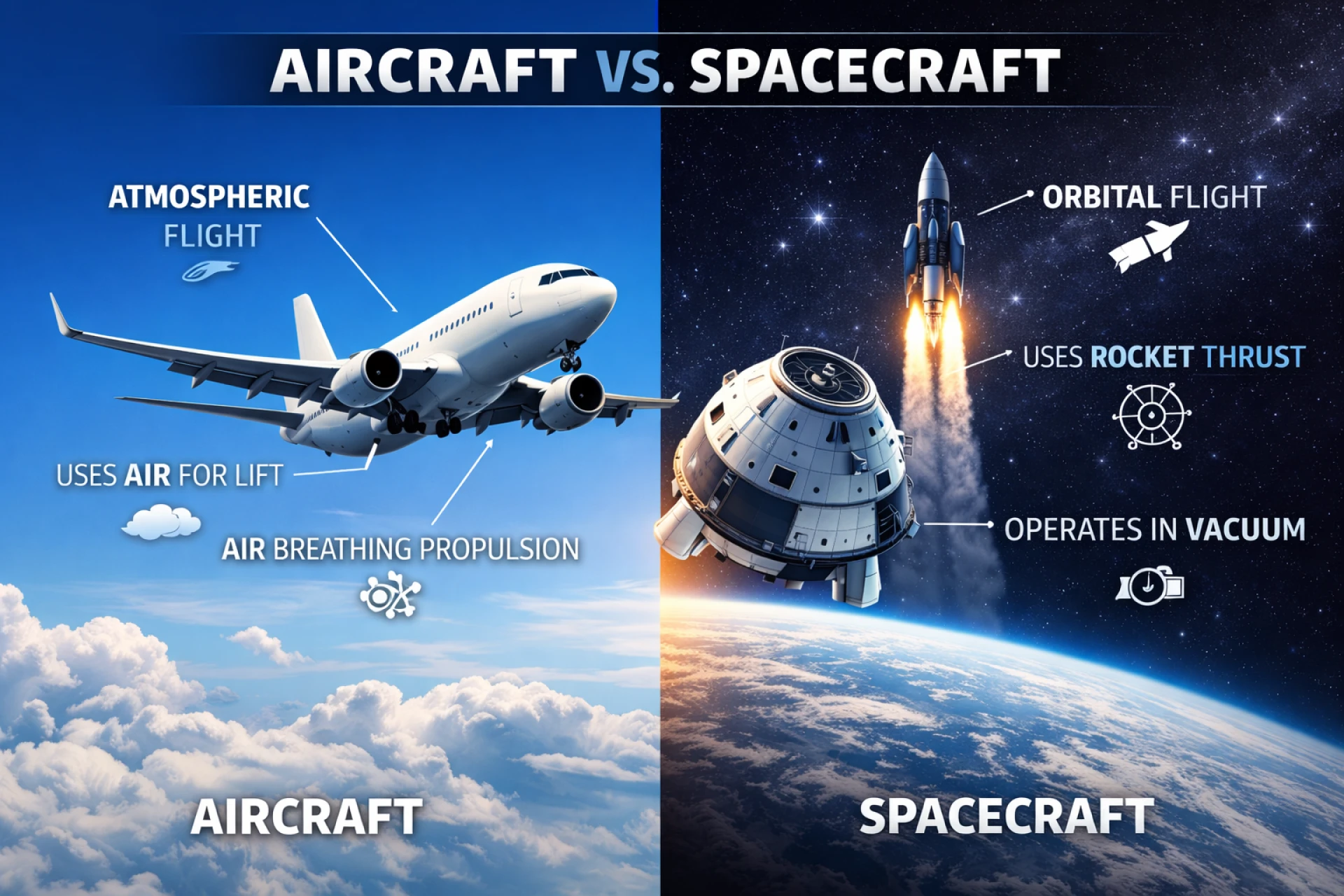
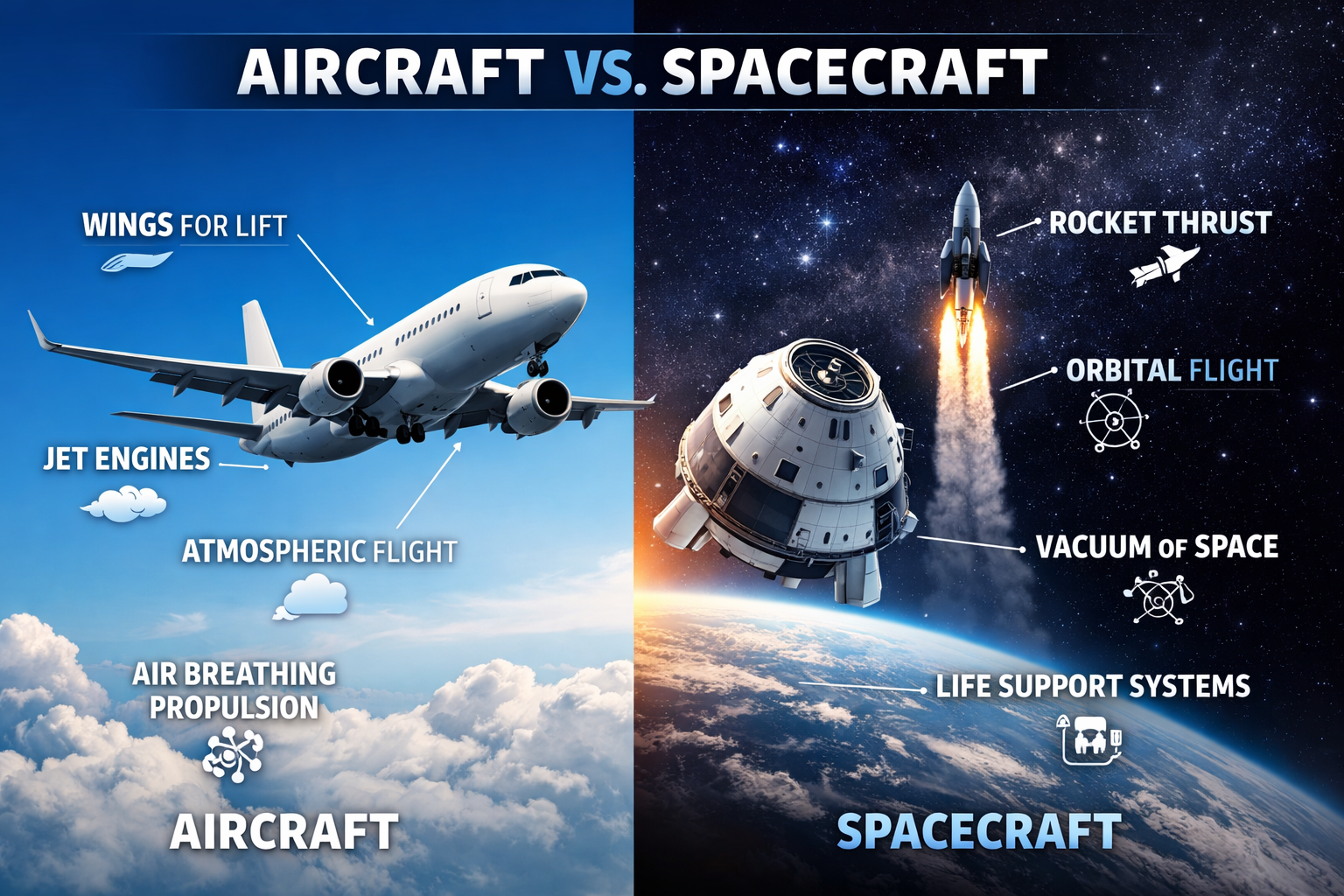
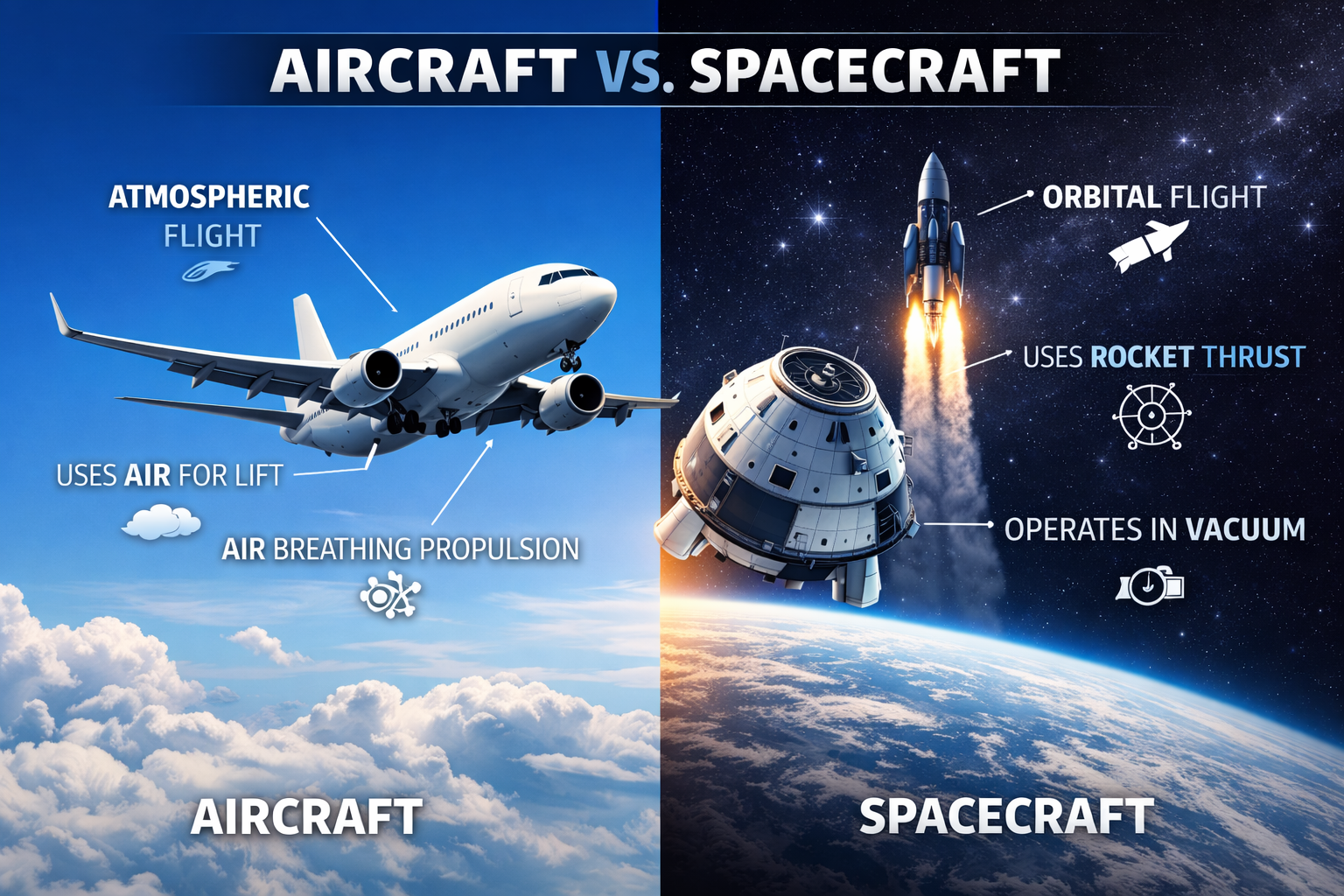
An aircraft is designed to master the atmosphere. A spacecraft is designed to survive without one. That single difference changes everything about how they are engineered.
The Environment Defines the Machine
Aircraft operate within Earth’s atmosphere. Even at high cruising altitudes, air is present. That air makes lift possible. It enables engines to function efficiently. It allows control surfaces to steer and stabilize the vehicle.
Spacecraft operate in the vacuum of space. There is no air to create lift. There is no oxygen to support combustion. There is no atmospheric pressure to rely on.
Because of this, every major system in a spacecraft must be self-contained. It must bring everything it needs with it.
Lift vs. Orbital Motion
Aircraft depend on aerodynamic lift. Their wings are shaped to create a pressure difference as air flows over and under them. This difference generates an upward force that counters gravity.
Without forward motion and airflow, an airplane cannot stay in the sky.
Spacecraft do not rely on lift once they leave the atmosphere. Instead, they use powerful rocket engines to reach extremely high speeds. Once in orbit, they remain in continuous free fall around Earth.
In simple terms, aircraft fly because of air. Spacecraft orbit because of velocity.
Propulsion Systems
Aircraft engines pull in atmospheric air, compress it, mix it with fuel, and ignite it. The surrounding air plays a direct role in the combustion process.
This makes aircraft engines highly efficient for atmospheric travel.
Spacecraft engines work differently. In space, there is no oxygen available. Rockets must carry both fuel and oxidizer onboard. This requirement adds significant weight and complexity.
Some spacecraft even use ion propulsion systems that produce small amounts of thrust over long durations. These systems would not function in the atmosphere but are ideal for deep space missions.
Structural Design Challenges
Aircraft structures must endure aerodynamic forces, turbulence, and repeated pressurization cycles. Commercial airliners are built for thousands of takeoffs and landings over decades of service.
Fatigue resistance and weight efficiency are critical.
Spacecraft face intense vibration and acceleration during launch. After reaching orbit, they must withstand radiation, micrometeoroids, and extreme temperature swings.
Unlike aircraft, spacecraft do not experience aerodynamic stress in orbit. However, the launch phase subjects them to some of the most violent mechanical conditions in engineering.
Thermal Control Systems
Temperature management is another major difference.
Aircraft benefit from airflow, which helps cool engines and onboard systems. Heat can dissipate through convection because air is present.
In space, convection is impossible. Without air, heat must be managed through radiation. Spacecraft use specialized radiator panels to release excess heat into space.
Thermal balance becomes a constant engineering challenge.
Life Support Requirements
Aircraft cabins are pressurized for passenger comfort at high altitudes. If needed, a pilot can descend to lower altitudes where breathable air exists.
Spacecraft do not have that option.
They must generate oxygen, remove carbon dioxide, control humidity, and maintain internal pressure independently. Life support systems must be highly reliable because there is no safe external environment to retreat to.
Control and Navigation
Aircraft use control surfaces such as ailerons, rudders, and elevators. These surfaces redirect airflow to change direction and orientation.
Spacecraft cannot rely on airflow. Instead, they use small thrusters or reaction wheels to adjust their position.
Every movement in space follows Newton’s laws of motion without atmospheric resistance.
Maintenance and Reusability
Aircraft are designed for frequent use. Commercial planes may operate multiple flights daily with structured inspection and maintenance programs.
Historically, spacecraft were built for single missions. Although reusable rockets and capsules are becoming more common, refurbishment is complex and costly.
The operational frequency of aviation far exceeds that of space missions.
Why the Differences Matter
Understanding the design differences between aircraft and spacecraft reveals how deeply engineering depends on environment.
An aircraft is optimized for efficiency within the atmosphere. Every system assumes air is available.
A spacecraft is optimized for survival beyond the atmosphere. Every system assumes isolation and vacuum.
These vehicles may share aerospace heritage, but their design philosophies reflect entirely different physical realities.
Conclusion
Aircraft and spacecraft both represent extraordinary achievements in engineering. They push the limits of materials science, propulsion technology, and human ingenuity.
Yet their differences are profound.
Aircraft are masters of the sky. Spacecraft are pioneers of the void.
And in aerospace engineering, the environment always dictates the design.

























Sign in to leave a comment.