
In today’s data-saturated business landscape, understanding how predictive analytics works can be the game-changer between surviving and thriving. Predictive analytics empowers businesses to forecast future trends, customer behavior, and operational challenges using historical data and advanced algorithms. From eCommerce to banking, industries across the spectrum are tapping into predictive models to stay ahead of the curve.
In this in-depth blog, we’ll unravel the core workings of predictive analytics—how it collects, processes, and transforms raw data into actionable insights. We'll also explore the tools, models, and real-world applications that showcase its undeniable value.
What is predictive analytics?
Predictive analytics is the use of statistical algorithms, machine learning techniques, and historical data to forecast future events. It doesn’t just explain what happened or why—it anticipates what is likely to happen next.
At its core, predictive analytics answers critical questions like:
- Which customer is likely to churn?
- Will demand spike next month?
- Is this transaction fraudulent?
It empowers decision-makers to act with foresight rather than hindsight.
The Predictive Analytics Workflow
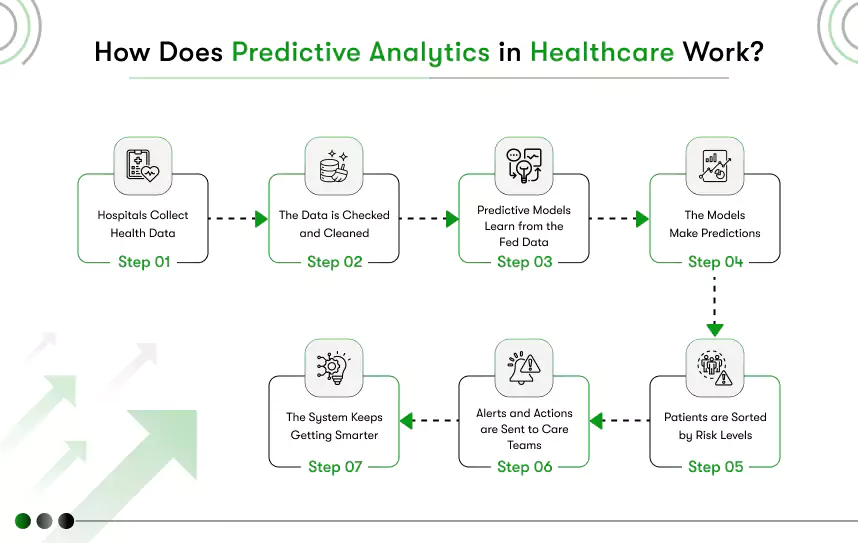
Let’s break down how predictive analytics works step by step:
1. Data Collection
The process begins with gathering relevant historical and real-time data from multiple sources:
- Customer interaction logs
- Transaction data
- Social media sentiment
- Website analytics
- IoT or sensor data (for manufacturing, logistics, etc.)
This raw data forms the foundation of predictive modeling.
2. Data Cleaning & Preprocessing
Raw data is rarely perfect. Preprocessing involves:
- Removing duplicate or missing entries
- Normalizing numerical ranges
- Encoding categorical data
- Filtering outliers
High-quality input is critical. Without proper preprocessing, even the best algorithms can yield misleading results.
3. Feature Engineering
Here, data scientists identify the most relevant attributes (or features) that influence the outcome. For instance:
- In customer churn analysis, factors like subscription age, support tickets, and usage frequency could be crucial.
- In fraud detection, transaction amount, location, and time may be key.
Feature engineering also involves:
- Creating new features (ratios, aggregates, flags)
- Reducing dimensionality (via PCA or similar techniques)
4. Model Selection & Training
This is the heart of predictive analytics. Depending on the problem, different algorithms may be used:
- Linear Regression—For continuous value prediction (e.g., sales forecasting)
- Logistic Regression—For binary outcomes (e.g., will churn or not)
- Decision Trees & Random Forests—For classification and ranking
- Neural Networks—For highly complex, non-linear problems
- K-Means Clustering—For segmentation-based predictive models
The model is trained using historical data where outcomes are already known. The goal: uncover patterns that can predict future outcomes.
5. Validation & Testing
After training, the model is tested on unseen data to evaluate:
- Accuracy
- Precision & recall
- F1 score
- ROC-AUC score
This ensures the model generalizes well and isn’t overfitting the training data.
6. Deployment & Monitoring
Once validated, the model is deployed into the production environment, where it starts making predictions in real time or at set intervals.
Monitoring is ongoing—it’s vital to:
- Retrain models as data evolves
- Tune parameters to retain accuracy
- Detect concept drift (when patterns change over time)
Key Use Cases of Predictive Analytics
Understanding how predictive analytics works becomes even clearer when seen in real-world applications:
Customer Churn Prediction
Subscription-based companies use churn models to forecast which users are at risk of leaving—and then target them with retention campaigns.
Fraud Detection
Banks and fintech firms utilize predictive models to flag suspicious transactions in real time, reducing fraud losses significantly.
Product Recommendation
eCommerce giants like Amazon use predictive analytics to suggest products you’re likely to buy based on browsing and purchasing history.
Demand Forecasting
Retailers forecast demand by analyzing seasonality, promotions, and regional data to optimize inventory and reduce deadstock.
Predictive Maintenance
In manufacturing and logistics, predictive models forecast equipment failure before it happens—saving costs and avoiding downtime.
Common Predictive Analytics Tools & Platforms
Several tools help implement predictive analytics effectively:
- Python & R – For custom model building
- Tableau/Power BI—For data visualization
- Azure ML / AWS SageMaker – Cloud-based model training & deployment
- SAP Predictive Analytics / IBM SPSS – Enterprise-grade platforms
Challenges in Predictive Analytics Implementation
Though promising, predictive analytics isn’t without challenges:
- Data Silos: Fragmented data sources reduce accuracy
- Bias in Data: Skewed data leads to skewed predictions
- Privacy Concerns: Especially in regulated industries like healthcare and finance
- Scalability: Real-time predictions at scale require robust infrastructure
A skilled predictive analytics consulting team can help you mitigate these risks.
Why Partner With Experts Like Kody Technolab?
Predictive analytics isn’t plug-and-play. Every business requires a unique data model tailored to its goals, industry, and audience.
At Kody Technolab, we help enterprises build predictive systems that:
- Enhance decision-making accuracy
- Increase customer retention and conversion
- Reduce operational inefficiencies
Our team ensures your business doesn't just implement analytics but extracts maximum ROI from it.
Final Thoughts
Understanding how predictive analytics works is no longer just a technical curiosity—it’s a strategic necessity. Whether you’re in banking, retail, manufacturing, or SaaS, predictive models can be the engine behind smarter, faster, and more customer-centric decisions.
If you're ready to turn your data into foresight, it’s time to embrace predictive analytics—intelligently and strategically.


























Sign in to leave a comment.