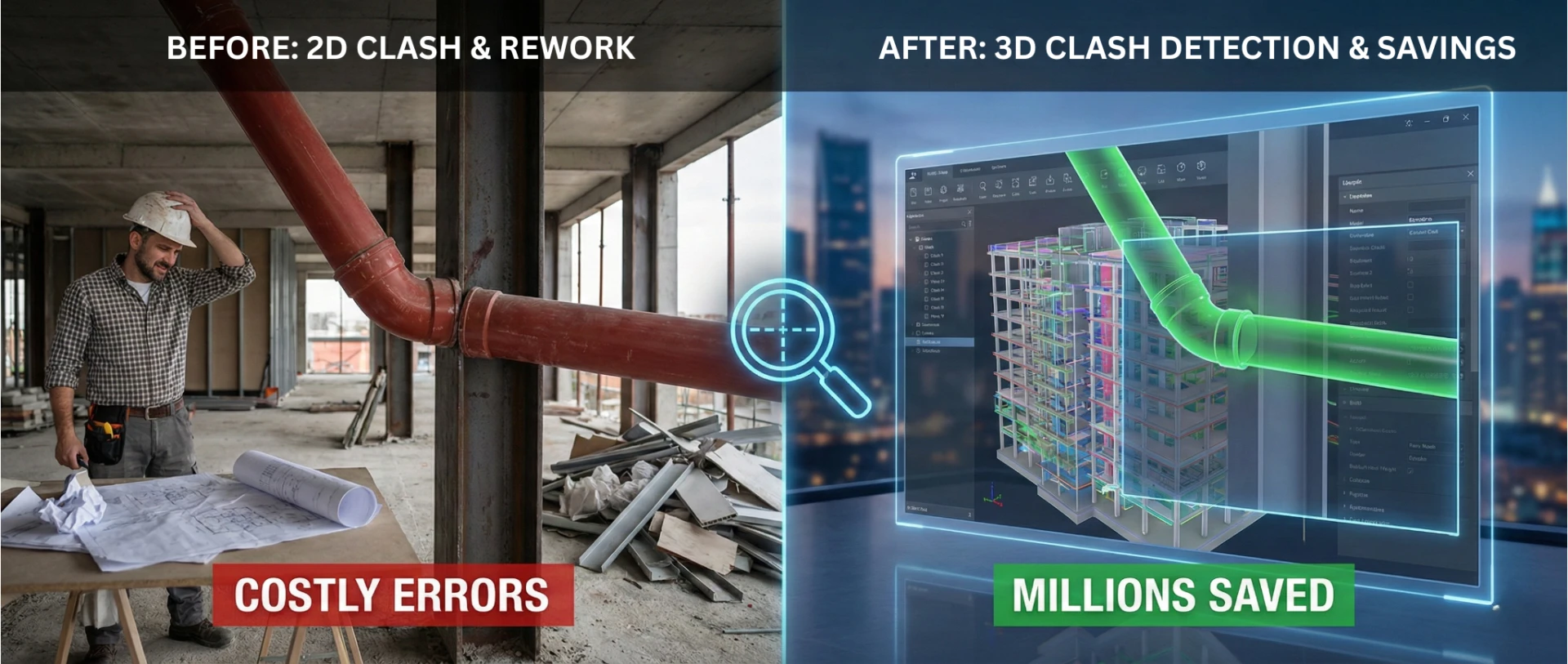

The Hidden Tax on Construction
There is an expensive secret hidden in the budget of almost every major construction project: the cost of being wrong the first time.
The statistics on construction rework are sobering. Industry research consistently indicates that rework accounts for roughly 5% to 12% of total construction costs on average projects. For a $100 million development, that is $5 million to $12 million vanishing into tear-outs, change orders, and schedule delays.
Historically, this waste was accepted as the “cost of doing business.” When architects, structural engineers, and piping design specialists work in siloed 2D environments, spatial conflicts are inevitable. A duct route planned on one drawing board unknowingly intersects with a structural beam designed on another.
Today, accepting these conflicts until they manifest on the physical jobsite is practically negligent. The adoption of Building Information Modelling (BIM) and advanced 3D clash detection has transformed conflict resolution from physical crisis management into a proactive digital process.
Defining the Digital Battlefield: What is 3D Clash Detection?
At its core, 3D clash detection is the process of federating various design models, architectural, structural, and MEP into a single, composite 3D environment before construction begins. Specialized software then algorithmically scans this “digital twin” to identify where elements physically overlap or violate spatial constraints.
It sounds simple, but the nuance lies in the types of clashes identified. A robust Virtual Design and Construction (VDC) strategy doesn’t just look for physical collisions; it categorizes risks:
- Hard Clashes: The most obvious offences. A plumbing pipe runs directly through a steel column, or HVAC ductwork occupies the same space as a cable tray. These are showstoppers that require immediate redesign.
- Soft (Clearance) Clashes: These are insidious “time bombs.” Components don’t physically touch, but they violate necessary spatial buffers. For example, a valve might fit perfectly, but there is insufficient clearance for a maintenance technician to access it later.
- Workflow (4D) Clashes: These involve time. Does the delivery of large equipment conflict with the erection of the curtain wall? These scheduling conflicts, visualized in 4D BIM, prevent logistical nightmares on site.
In the era of 2D drawings, “clash detection” was done via light tables and manual overlays, a process prone to devastating human error. In a 3D environment, the software instantly detects thousands of these instances.
The Economics of Pre-emption: Why Early Detection Matters
The financial argument for 3D clash detection rests on a fundamental principle of project management: the cost of rectifying an error increases exponentially the later it is discovered in the project lifecycle.
Consider the “1-10-100 Rule” concept often applied to quality costs. Fixing a conflict during the design phase in a BIM model might cost $1 (figuratively) in staff time. Fixing that same conflict during fabrication might cost $10. Fixing it on the jobsite after concrete is poured and crews are standing idle waiting for an RFI response can easily cost $100 or more.
A study by the Construction Industry Institute (CII) found that design errors and omissions are a leading cause of rework. By shifting conflict resolution upstream into the virtual environment, contractors report significant ROI.
Leading general contractors utilizing mature BIM coordination processes frequently report reducing field-generated RFIs (Requests for Information) by 40% to 60%. Every avoided RFI is a saved administrative cost, a prevented delay, and potentially thousands of dollars in avoided material waste.
Beyond the Budget: The Operational Revolution
While saving millions is the headline benefit, the operational advantages of robust clash detection are equally transformative for AEC firms.
Enabling Prefabrication and Modular Construction
Offsite construction requires absolute certainty. You cannot fabricate complex multi-trade racks in a factory if you are unsure they will fit the site conditions. A clash-free, validated 3D model serves as the “source of truth” to move construction hours from a chaotic jobsite to a controlled factory environment, improving safety and quality.
Enhancing Stakeholder Collaboration
Traditionally, coordination meetings involved rolling out 2D plans and arguing over territory above the ceiling grid. 3D clash detection changes the dynamic. The model provides an objective, visual basis for discussion. It moves the conversation from “Who made this mistake?” to “How do we collectively solve this spatial challenge?”
Schedule Certainty
Rework is the enemy of the critical path. An unresolved clash discovered during installation doesn’t just cost money; it stops work in that area, cascading delays throughout subsequent trades. By resolving these issues virtually, projects gain significantly higher schedule predictability.
Actionable Takeaways for Implementing Effective Clash Detection
Adopting software is easy; adopting a successful process is difficult. Here is how firms can move from merely buying tools to realizing value:
- Define Responsibility Early in the BIM Execution Plan (BEP): Clearly establish who is responsible for running clash tests, at what frequency, and who “owns” the resolution of specific conflict types.
- Prioritize, Don’t Just Detect: Running a clash test on a large hospital project can yield 10,000 “hits.” Most are irrelevant noise (e.g., flexible conduit hitting drywall). Your VDC team must filter results to focus on high-priority issues first to avoid “clash fatigue.”
- Implement “Clash-Free” Milestones: Tie design phase payments or progression to specific coordination milestones. Do not allow the project to move into construction documentation until major systems are coordinated digitally.
- Involve the Trades: The best clash resolution often comes from the subcontractors who will actually build the work. Involve key trade partners in the coordination process early, utilizing their detailed fabrication models rather than generic design models.
The New Standard of Care
We are rapidly approaching a point at which failing to use 3D clash detection on complex projects will be considered professional negligence. The technology has matured from an innovative differentiator to an essential risk management tool.
As artificial intelligence and machine learning begin to enter the VDC space, we can expect software to not only detect clashes but also auto-suggest resolutions based on code requirements and past project data.
But until then, the mandate for AEC professionals is clear: Build it twice. Build it first in the digital world, where mistakes are cheap, so you can build it once, flawlessly, in the real world, where mistakes cost millions.

























Sign in to leave a comment.