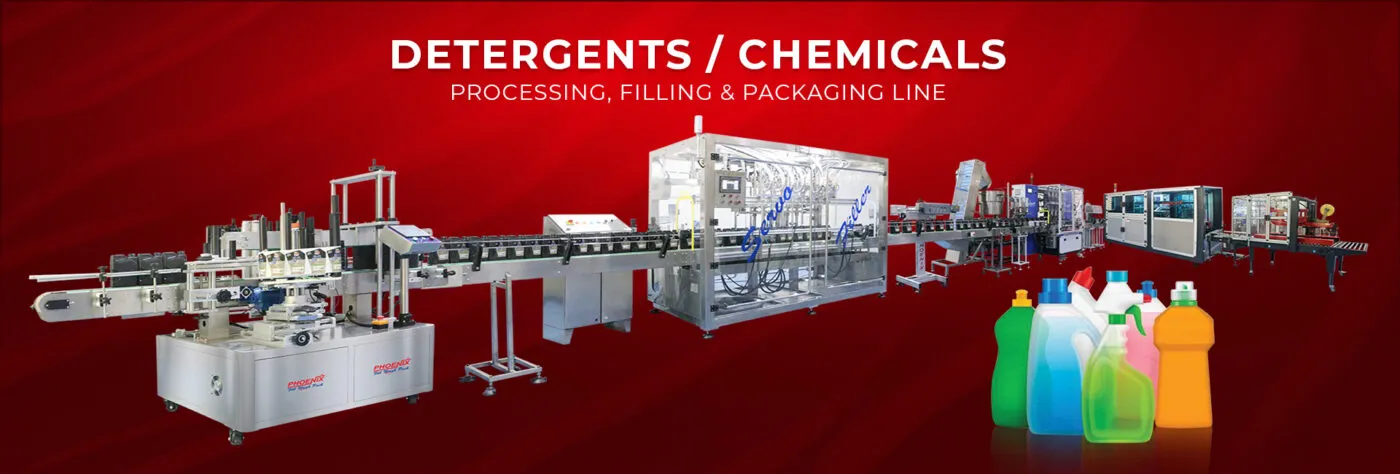

Detergent manufacturers in the UAE are producing everything from liquid dish soap to granulated laundry powder, and each of these products behaves very differently once it reaches the filling line. Choosing the right detergent packaging machine is what separates a production run that hits target output from one that stalls at changeover, underfills bottles, or leaves powder residue clogging the line.
This guide covers the machine types available, the packaging formats they support, and the questions worth asking before you commit to a specific line.
Why Detergent Type Decides the Machine, Not the Other Way Around
Detergents span an unusually wide range of physical forms: thin liquids, thick gels, free-flowing powders, and granulated formulas all fall under the same product category, yet each demands a different filling and packaging approach.
A machine built for free-flowing liquid detergent will underfill or overfill a granulated powder because the dosing mechanism assumes a consistent flow rate that powders simply don't have. This is why the first decision in any detergent packaging project is identifying exactly which form (or forms) of detergent the line needs to handle — before comparing machine models.
Matching Production Volume to Automation Level
Small and mid-sized detergent producers often start with semi-automatic equipment, where an operator loads containers and triggers each fill cycle manually. This keeps upfront cost low and gives the flexibility to run short batches of different formulations.
Larger operations running continuous shifts need fully automatic lines that combine filling, capping, and labeling into one synchronized process. The right call depends less on current output and more on where production volume is heading over the next two to three years — automation is expensive to retrofit later.
Packaging Format Changes What the Machine Needs to Do
Bottles, pouches, and bulk containers each place different demands on a packaging line:
• Bottles need accurate liquid dosing plus a capping and labeling stage that runs at the same speed as the filler, or the filler becomes a bottleneck.
• Pouches and sachets suit powder or gel detergents sold in smaller retail sizes, and need a sealing stage that holds up under repeated handling.
• Bulk containers, used for institutional or wholesale detergent, need higher-capacity dosing systems designed for sustained runs rather than quick changeovers.
Confirming the packaging format upfront avoids buying a machine that fills accurately but can't be paired with the capping or sealing equipment the product actually needs.
Questions Worth Asking Before You Buy
1. Has the supplier tested this exact machine on your detergent formulation, or only on a similar product?
2. How is dosing accuracy maintained as viscosity or moisture content varies between batches?
3. What is the realistic changeover time between different container sizes or formulations?
4. Is after-sales support and spare parts availability local, or does it depend on importing parts?
Manufacturers who ask these questions before ordering tend to avoid the most common and costly mistake in detergent packaging: a machine that performs well in a demo but underperforms on the actual product it needs to run day after day.
About the author: This Post was contributed by Phoenix Dison Tec LLC, a Sharjah-based supplier of filling and packaging machinery for the UAE and wider GCC, including a complete range of detergent packaging machines for liquid, gel, and powder detergent producers — from semi-automatic fillers to fully integrated filling, capping, and labeling lines.


















Sign in to leave a comment.