
Drying a slurry or paste is different from drying a free-flowing solid. Sticky and viscous materials can be difficult to handle in a conventional dryer. They may spread unevenly or retain moisture when drying conditions are not well controlled.
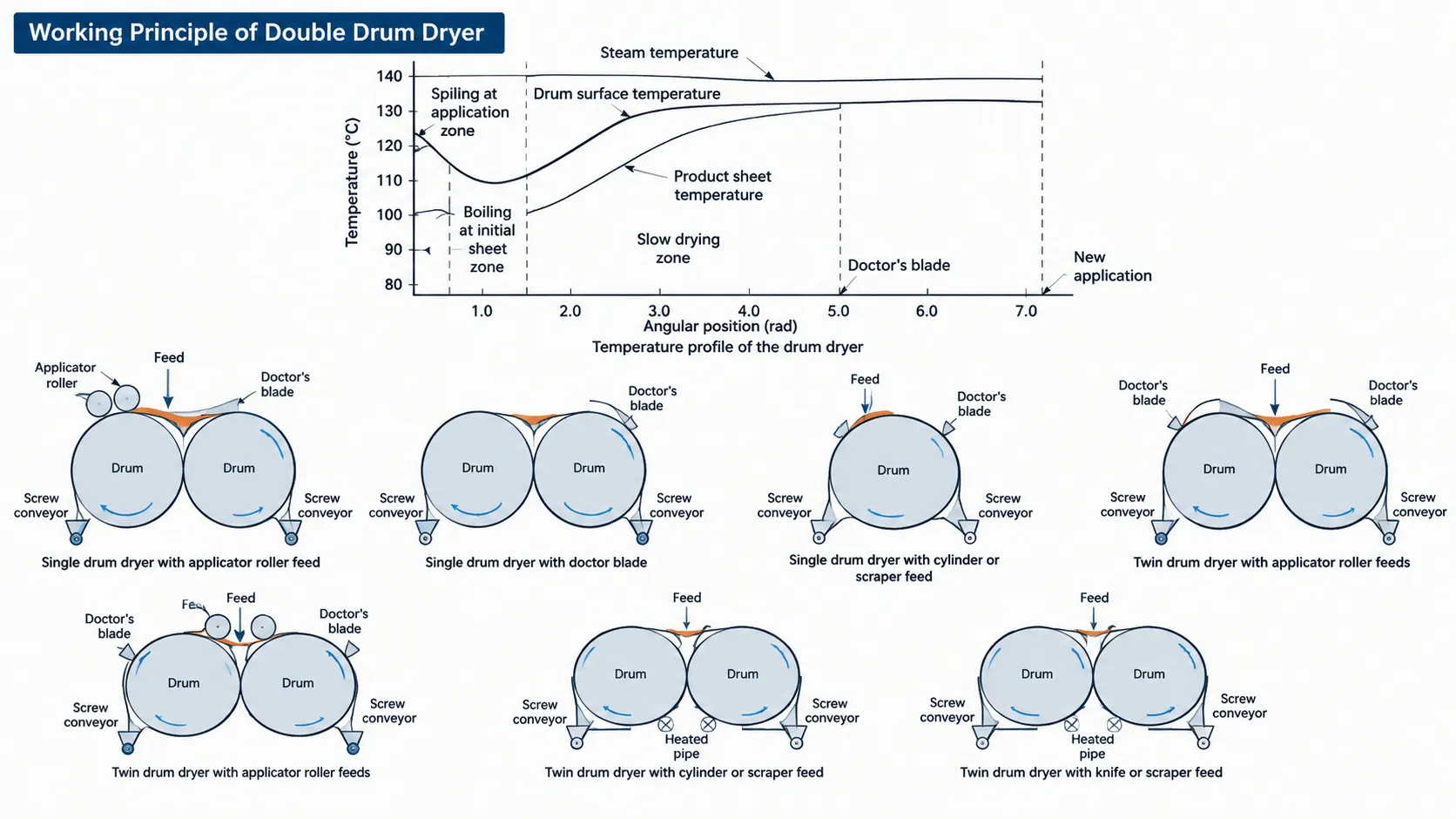
A drum dryer dries the feed as a thin layer on a rotating heated drum. Heat passes through the drum wall to the wet material by conduction. Moisture evaporates as the drum rotates, and a doctor blade removes the dried layer.
Drum dryers are also called roller dryers. They are used for slurries, pastes, concentrated solutions, suspensions and other viscous materials that can form a film on a heated surface.
What Is a Drum Dryer?
A drum dryer is an indirect industrial drying system. Its main working part is a hollow rotating drum with a heated inner side and a process surface on the outside.
The wet material is applied to the drum and spread into a thin film. A heating medium inside the drum supplies the required heat. That heat moves through the drum wall into the product.
As the drum turns, the material loses moisture. When the required drying stage is reached, the dried film is removed with a doctor blade or scraper.
Drum Dryer Working Principle
The drum dryer working principle is based mainly on conductive heat transfer.
First, the wet feed enters the feeding or application system. It is then spread over the rotating drum. In a double-drum design, the material can enter between two counter-rotating drums and form a controlled film.
As the drum rotates, the wet layer stays in contact with the heated surface. Heat moves through the drum wall and reaches the material. Moisture absorbs this heat and evaporates.
The product continues to travel with the drum while its moisture content falls. Drum speed controls the time available for drying.
Near the end of the cycle, the dried film reaches the doctor blade. The blade separates it from the drum surface, and the product moves to collection or the next process stage.
The process is:
Feed application → Thin film formation → Heat transfer → Moisture evaporation → Drying → Scraping → Product collection
What Controls Drum Dryer Performance?
Drum drying is not controlled by temperature alone. Several process variables affect drying rate, final moisture and product quality.
Steam Pressure
In a steam-heated drum, steam pressure affects the heating condition of the drum surface. The required pressure depends on the material and drying duty.
Drum Rotation Speed
Drum speed controls the residence time of the material on the heated surface.
A faster drum gives less drying time. A slower drum gives more exposure time. The correct setting depends on feed moisture, heat sensitivity and required final moisture.
Film Thickness
Film thickness is important because heat must pass through the wet layer before moisture can evaporate. A controlled and uniform layer helps maintain consistent drying across the drum.
Drum Speed Ratio
In multi-drum systems, the speed relationship between the drums can influence material distribution and film formation.
Typical Drum Dryer Operating Range
For common applications, Kerone provides the following typical ranges:
| Parameter | Typical Range |
| Steam pressure inside drum | 29–115 psi |
| Drum rotation speed | 2–30 rpm |
| Thin-sheet applicator width | 0.05–0.5 mm |
| Drum rotation speed ratio | 1–5 |
These are typical values, not fixed specifications for every dryer. Actual conditions depend on the feed material, moisture content, production requirement and required product quality.
Types of Drum Dryers
Drum dryers are generally classified by operating pressure and drum arrangement.
Atmospheric Drum Dryer
An atmospheric drum dryer operates at normal pressure on the drying side. It can be used when the product can tolerate the required drying conditions without a vacuum.
Vacuum Drum Dryer
A vacuum drum dryer operates under reduced pressure. This can be useful when the process requires lower-pressure drying conditions or tighter control for heat-sensitive materials.
Single Drum Dryer
A single drum dryer uses one heated rotating drum. The feed is applied to the drum surface as a film. It remains on the heated surface during part of the rotation and is then removed with a doctor blade.
Double Drum Dryer
A double drum dryer uses two heated drums rotating in opposite directions. The feed is introduced between the drums and forms a film on the heated surfaces.
Twin Drum Dryer
A twin drum dryer also uses two drums, but its arrangement and feeding or rotation configuration differ from a conventional double-drum design. The suitable arrangement depends on the feed and required product form.
Why Drum Surface and Doctor Blade Matter
The drum surface directly contacts the product. Its finish and geometry therefore affect film formation and product removal.
A properly machined surface helps the material form a consistent layer. Surface material and finish must also match the product and operating conditions.
The doctor blade must remove the dried film cleanly and consistently without unnecessary damage to the drum.
Depending on the application, Kerone can use cast iron, carbon steel and stainless steel drum and blade materials, along with hardened or ceramic-coated surfaces where required.
Applications of Drum Dryers
Drum dryers are mainly used when the feed enters the process as a slurry, paste, concentrated solution, suspension or viscous liquid.
Common application areas include:
Food and dairy: cereal-based products, milk products, tomato puree, broth, yeast, malt extract and fruit purees.
Chemical processing: calcium carbonate, sodium benzoate, calcium chloride, sodium acetate, pigments, dye intermediates, sulphates and carbonates.
Pharmaceutical and bioprocessing: selected extracts, powders, antibiotics and other products that need controlled moisture removal.
Agricultural and plant-based materials: selected grain, fruit, vegetable, seed and plant-derived materials.
Advantages of Drum Drying
A drum dryer offers practical benefits when the product is suitable for film drying.
Controlled drying: Drum speed, heating conditions and film formation can be adjusted to the process.
Suitable for viscous feeds: slurries and pastes can be handled directly.
Direct heat transfer: The wet material stays in contact with the heated drum surface.
Continuous operation: Feed application and product removal can be arranged for continuous drying.
Flexible configuration: Single, double, twin, atmospheric and vacuum designs can be selected for different process needs.
Custom engineering: Drum dimensions, surface materials, heating arrangements and operating conditions can be selected for the application.
How Kerone Designs Drum Dryers
A drum dryer should be designed around the material, not only around a standard machine size.
Kerone considers viscosity, moisture content, solids concentration, heat sensitivity, corrosive or abrasive behaviour, final moisture and desired product form when developing a drying system.
Drum construction, heating uniformity, feeding method, rotation speed, scraping arrangement and process control all affect the final design.
With around 50 years of industrial drying experience, Kerone develops drum dryers for both conventional and difficult applications. Customized configurations are also available when standard conditions are not suitable.
Frequently Asked Questions
What is the working principle of a drum dryer?
A drum dryer spreads wet material over a rotating heated drum. Heat passes through the drum wall, moisture evaporates, and the dried film is removed by a doctor blade.
What materials can be dried in a drum dryer?
Drum dryers can process slurries, pastes, concentrated solutions, suspensions and viscous materials that can form a film on the drum.
What affects drum dryer performance?
Important variables include steam pressure, drum speed, film thickness, applicator arrangement, drum speed ratio and feed properties.
Are drum dryers suitable for continuous drying?
Yes. Wet feed can be continuously applied to the rotating drum, and the dried product can be continuously removed.
Can a drum dryer be customised?
Yes. Drum size, surface construction, heating conditions, feeding arrangement, scraping system and controls can be selected according to the application.




















Sign in to leave a comment.